Finding of long-sought drug target structure may expedite drug discovery
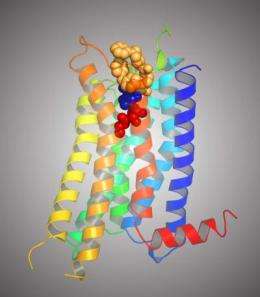
In this representation, the newly determined structure of the A2A receptor for adenosine is shown surrounding its synthetic agonist, a molecule that turns on the receptor. The spiral shapes and the slim connecting loops represent the receptor protein, winding back and forth through the cell membrane. The central (red) part of the agonist is critical for activation of the receptor. The top (tan-colored) part of the agonist, facing the outside of the cell, acts like arms to fill much of the remaining space in the binding site and stabilize the receptor, in order to obtain a crystallized structure. Credit: NIH/National Institute of Diabetes and Digestive and Kidney Diseases
Researchers have solved the three-dimensional structure of a key biological receptor. The finding has the potential to speed drug discovery in many areas, from arthritis to respiratory disorders to wound healing, because it enables chemists to better examine and design molecules for use in experimental drugs.
The researchers are from the National Institutes of Health, collaborating with labs at The Scripps Research Institute and the University of California, San Diego. The finding is published in the March 10 edition of Science Express.
"This is an important step forward it was impossible until recently to know how this type of receptor is switched on by chemical signals like a tiny machine," said Dr. Kenneth A. Jacobson, chief of the Laboratory of Bioorganic Chemistry in NIH's National Institute of Diabetes and Digestive and Kidney Diseases (NIDDK) and an author on the paper. "The architecture of the activated receptor allows us to think in more detailed terms about the other half of the drug interaction. We hope that we're on the verge of a revolution that will expedite the process of crafting new drugs to treat disease."
With this finding, scientists in Jacobson's lab, including co-author Dr. Zhan-Guo Gao, will next work on testing this drug-engineering approach with similar molecules they have newly synthesized.
Jacobson and Gao are part of the NIDDK's intramural program, which enables basic scientists and clinicians of diverse skills and expertise to collaborate on solutions to some of the most difficult issues of human health. Several compounds from Jacobson's lab are currently in clinical trials as potential treatments for conditions including chronic hepatitis C, psoriasis and rheumatoid arthritis.
"Discoveries like this, with the potential to lead to future treatments in a wide variety of areas, are why NIH funds basic science," said NIDDK Director Dr. Griffin P. Rodgers. "By understanding the body at its smallest components, we can learn how to improve whole-body health."
A receptor is a protein that receives and sends signals to other molecules. The three-dimensional structure of the solved receptor also contains an agonist a chemical command signal from outside the cell in this case, an adenosine molecule. Similar to the function of a telephone receiver, the receptor acts as a sensor, picking up the message from the agonist and transmitting its information, which begins processes inside the cell.
The researchers discovered that a previously known agonist molecule would bind to its receptor target in a way that stabilizes the protein for crystallization. Once crystallized, the structure can be seen by bombarding it with X-rays. The agonist solidifies the protein by connecting to multiple parts of the receptor with its molecular arms, in the process initiating the function of the entire structure. This adenosine receptor, called A2A, counteracts inflammation and responds to organs in distress. It belongs to the G-protein coupled receptor family, which is involved in processes necessary for many drugs currently in use to take effect. These findings may lead to new drugs for many diseases.
The research was also supported by the National Cancer Institute and the National Institute of General Medical Sciences, both components of the NIH.
"Long-term NIH technology investments in structural biology, including the Protein Structure Initiative, have brought diverse teams of investigators together and yielded powerful methods like the ones used in this study," said NIGMS Director Dr. Jeremy M. Berg. "Receptors must undergo substantial changes in shape in order to function, and revealing these molecular dances in such great detail is an impressive accomplishment."
Provided by National Institutes of Health
-
From lemons to lemonade: Reaction uses carbon dioxide to make carbon-based semiconductor,
32 comments
-
Thioridazine kills cancer stem cells in human while avoiding toxic side-effects of conventional cancer treatments,
3 comments
-
SpaceX private rocket blasts off for space station (Update),
42 comments
-
Climate scientists say they have solved riddle of rising sea,
30 comments
-
Research team claims to have found evidence Lake Cheko is impact crater for Tunguska Event,
18 comments
-
Potential Breakthrough in Seizure Control
21 hours ago
-
Popping/Cracked sternum.
May 25, 2012
-
Which Mental Illness Encompasses This Problem?
May 25, 2012
-
A question about drug tolerance
May 23, 2012
-
Poor nutrition leading to overeating?
May 23, 2012
-
Math and dyslexia?
May 21, 2012
- More from Physics Forums - Medical Sciences
More news stories
Keep food safety in mind this memorial day weekend
(HealthDay) -- Picnics, parades and cookouts are as much a part of Memorial Day weekend as tributes to the United States' war veterans.
7 hours ago |
not rated yet |
0
Family history of Alzheimer's affects functional connectivity
(HealthDay) -- Cognitively normal individuals with a family history of late-onset Alzheimer's disease (AD) may display lower resting state functional connectivity in the default mode network (DMN) of the brain, ...
Medicine & Health / Alzheimer's disease & dementia
16 hours ago |
not rated yet |
0
Transvaginal mesh op restores pelvic organ prolapse at price
(HealthDay) -- Transvaginal mesh (TVM) procedures are effective for anatomical restoration of pelvic organ prolapse (POP), but patients report a worsening of sexual function following surgery, according to ...
17 hours ago |
not rated yet |
0
Travel to high altitudes tied to Crohn's, colitis flare-ups
(HealthDay) -- People with inflammatory bowel disease, which includes Crohn's disease and colitis, may be at increased risk for flare-ups when they fly or travel to high altitudes for skiing or mountain climbing, ...
Medicine & Health / Inflammatory disorders
17 hours ago |
not rated yet |
1
|
Weight struggles? Blame new neurons in your hypothalamus
New nerve cells formed in a select part of the brain could hold considerable sway over how much you eat and consequently weigh, new animal research by Johns Hopkins scientists suggests in a study published in the May issue ...
Medicine & Health / Neuroscience
May 21, 2012 |
5 / 5 (1) |
6
|
Scientist: Evolution debate will soon be history
(AP) -- Richard Leakey predicts skepticism over evolution will soon be history. Not that the avowed atheist has any doubts himself.
Dell tablet leak: 10.1-inch display, two-battery choice
(Phys.org) -- Headline after headline talks about vendors tablets in the wings as likely number-one contenders for the iPad. Such claims have justifiably been taken with a grain of salt, considering ...
SpotterRF debuts Radar Backpack Kit (w/ Video)
(Phys.org) -- SpotterRF has announced a special radar backpack kit designed to enhance situational awareness for soldiers on the ground. The company says its special radar is designed for warfighters as part ...
SpaceX capsule has 'new car' smell, astronauts say (Update)
SpaceX's Dragon cargo vessel smells like a new car, said astronauts at the International Space Station after opening the hatches Saturday following the spacecraft's landmark mission to the orbiting lab.
Thousands of shellfish found dead in Peru
Thousands of crustaceans were found dead off the coast of Lima following the mystery mass death of dolphins and pelicans, the Peruvian Navy said Friday.
Astronomers seize last chance in lifetime for Venus Transit
Astronomers are gearing for one the rarest events in the Solar System: an alignment of Earth, Venus and the Sun that will not be seen for another 105 years.