The biosignature of tuberculosis
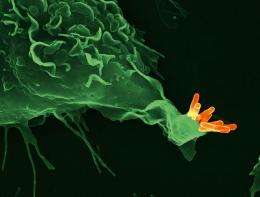
(PhysOrg.com) -- The germ that causes tuberculosis is highly infectious, but not very effective: around two billion people throughout the world carry the pathogenic bacterium Mycobacterium tuberculosis - only one tenth of them, however, actually develop the disease following infection. Nobody knows who will fall ill, and who won’t. Therefore, scientists have been looking for biological markers that will enable them to predict susceptibility to tuberculosis. Researchers from the Max Planck Institute for Infection Biology in Berlin have now discovered several candidates for such biomarkers. They compared the gene activity in tuberculosis patients and in individuals latently infected with the pathogen. According to their findings, tuberculosis infection can alter the activity of almost 2000 human genes. These include genes that regulate the activity of the immune system and control the “suicide” programme of immune cells.
Up to now, no biomarkers were known which could indicate the progression of a tuberculosis infection. “This is one of the reasons why it is so difficult to develop new drugs and vaccines for tuberculosis,” says Stefan Kaufmann from the Max Planck Institute for Infection Biology. Substances that are easily detected in the body are suitable for use as biomarkers. The Max Planck researchers analysed blood samples from healthy subjects and subjects infected with tuberculosis from South Africa and measured the genetic activity in the blood cells using RNA screening. The research, which is being carried out with partners in Africa, the USA and Europe, is supported by the Bill and Melinda Gates Foundation.
The activity of 1935 genes in tuberculosis patients differs from that of latently infected patients. The Berlin-based researchers observed the greatest differences between the two groups in the Fc gamma receptor. This receptor sits on the surface of immune cells and ensures that the cells are able to identify and eliminate bacteria which are loaded with antibodies. The values recorded for the receptor in patients suffering from tuberculosis were significantly higher than those recorded in latently infected and non-infected subjects.
Similar to the Fc gamma receptor, four other genes have a characteristic activity profile for latent infections. Using these five biomarkers, the researchers were able to diagnose tuberculosis patients with 94 percent certainty and latently infected healthy subjects with 97 percent certainty. “These genes form a kind of signature for tuberculosis. We will be able to use them in future as markers to establish whether a patient is ill or simply carries tuberculosis bacteria without being ill. In the long term, we would like to define a signature that will enable us to predict whether or not a latently infected healthy subject will eventually develop tuberculosis,” hopes Stefan Kaufmann. However, before that can be achieved the candidates will have to be tested on individuals of varying ethnic origins, as the activity of individual genes can differ in tuberculosis patients of different origins. The group already observed a similar pattern in Europeans in tests carried out previously.
The analysis of the gene activity also shows that only a balanced immune system can keep the tuberculosis bacteria under control. If the immune system becomes imbalanced, the latent tuberculosis infection develops into an acute illness. Thus, a certain group of killer cells and genes known as apoptosis genes, which control the “suicide” programme of cells, are less active in tuberculosis patients than in people who do not have the disease. It is possible that the pathogens evade destruction by the immune system in this way.
More information: J Maertzdorf, et al. Human gene expression profiles of susceptibility and resistance in tuberculosis. Genes and Immunity (2011) 12, 15–22


