Smartphone app for cancer diagnosis may be on the way
Feb 24, 2011 by Lin Edwards report
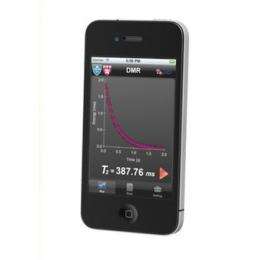
Portable NMR smartphone app. Image credit: R. Weissleder et al. DOI:10.1126/scitranslmed.3002048

(PhysOrg.com) -- Researchers in the US have developed a device that works with a smartphone to diagnose a suspicious lump in a patient and determine within an hour if it is benign or cancerous.

The current procedure for diagnosis of suspicious lumps is to use a needle to extract a sample from the lump and then to send the cells to a pathology laboratory for examination. The sample is stained to look for tell-tale proteins and the cell shape is examined. The results are obtained within a few days, but are occasionally inconclusive.

Dr Ralph Weissleder of the Massachusetts General Hospital in Boston and colleagues have developed a miniaturized (NMR) scanner that identifies molecules by the way their nuclei are affected by magnetic fields. It also attaches to proteins to allow specific proteins, such as those found in tumor cells, to be identified.

The gadget was tested on suspicious cells collected by fine needle aspiration from 50 patients. Because the samples needed are so small, cells could be taken from several areas of the suspected tumor. The samples were labeled with magnetic nanoparticles and then injected into the micro-NMR machine.

The results can be read by connecting the device to a loaded with a specially-programmed application. The samples tested revealed nine markers for . When the results for four of these proteins were combined they allowed the team to produce a diagnosis.
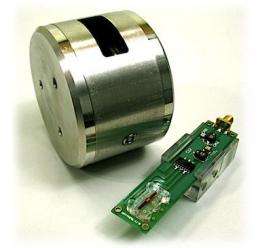
A portable Nuclear Magnetic Resonance device. Image credit: R. Weissleder.

The tests and analyses took an average of less than one hour for each patient and resulted in accurate diagnosis in 48 of the 50 patients. Another test produced 100% accuracy in 20 patients. Standard pathology tests on similar biopsies produce an accurate diagnosis in 74 to 84 percent of cases.

Dr Weissleder said being able to sample the suspected tumor at several sites made the test more accurate. He said having the results available within the hour is a great advantage because it would reduce patient stress as people hate the days of waiting for standard pathology results to arrive, not knowing whether or not they have cancer. The greater accuracy of the micro-NMR would also cut the number of repeat biopsies needed.

In their paper, published in the journal Science Translational Medicine, the researchers say eventually the micro-NMR machine could be used to test cancer patients to determine if they are responding to drugs by analyzing for specific proteins in blood samples.

Explore further: Common food supplement fights degenerative brain disorders

More information: J. B. Haun, C. M. Castro, R. Wang, V. M. Peterson, B. S. Marinelli, H. Lee, R. Weissleder, Micro-NMR for Rapid Molecular Analysis of Human Tumor Samples. Sci. Transl. Med. 3, 71ra16 (2011). DOI:10.1126/scitranslmed.3002048

Related Stories

Implantable Device Offers Continuous Cancer Monitoring

Jul 21, 2009

(PhysOrg.com) -- Surgical removal of a tissue sample is now the standard for diagnosing cancer. Such procedures, known as biopsies, are accurate but offer only a snapshot of the tumor at a single moment in time.

Coming Soon: Tuberculosis Detection with a Chip?

Jul 29, 2009

(PhysOrg.com) -- Many of the new techniques based on nanotechnology that have been developed for faster and more sensitive detection of pathogens fail in day-to-day clinical use because they require complex sample preparation ...

New 'dentist' test to detect oral cancer will save lives

Aug 09, 2010

A new test for oral cancer, which a dentist could perform by simply using a brush to collect cells from a patient's mouth, is set to be developed by researchers at the University of Sheffield and Sheffield ...

Recommended for you

Common food supplement fights degenerative brain disorders

11 minutes ago

Widely available in pharmacies and health stores, phosphatidylserine is a natural food supplement produced from beef, oysters, and soy. Proven to improve cognition and slow memory loss, it's a popular treatment for older ...

Finding a family for a pair of orphan receptors in the brain

41 minutes ago

Researchers at Emory University have identified a protein that stimulates a pair of "orphan receptors" found in the brain, solving a long-standing biological puzzle and possibly leading to future treatments for neurological ...

Insight into the dazzling impact of insulin in cells

1 hour ago

Australian scientists have charted the path of insulin action in cells in precise detail like never before. This provides a comprehensive blueprint for understanding what goes wrong in diabetes.

Do men's and women's hearts burn fuel differently?

4 hours ago

Researchers at the University of Illinois at Chicago College of Medicine will study gender differences in how the heart uses and stores fat—its main energy source—and how changes in fat metabolism play ...

Study suggests new source of kidneys for transplant

20 hours ago

Nearly 20 percent of kidneys that are recovered from deceased donors in the U.S. are refused for transplant due to factors ranging from scarring in small blood vessels of the kidney's filtering units to the organ going too ...

User comments : 0

More news stories

Game system castAR debuts at Maker Faire

(Phys.org) —Two tech talents, formerly employees at video game publisher Valve, have been working on their own vision in the form of game-ready glasses. Their company, Technical Illusions, will seek to ...

Glaucoma drug can cause droopy eyelids

Prostaglandin analogues (PGAs), drugs which lower intraocular pressure, are often the first line of treatment for people with glaucoma, but their use is not without risks. PGAs have long been associated with blurred vision, ...

How gold nanoparticles can help fight ovarian cancer

Positively charged gold nanoparticles are usually toxic to cells, but cancer cells somehow manage to avoid nanoparticle toxicity. Mayo Clinic researchers found out why, and determined how to make the nanoparticles effective ...