Mind-moved bionic arm goes on display in US
February 17, 2011

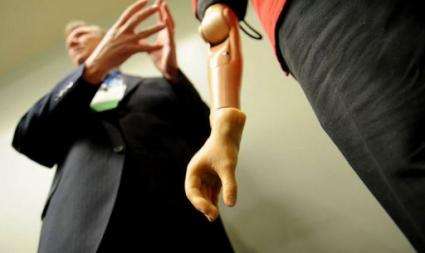
Todd Kuiken (L) explains the bionic arm on Glen Lehman

Enlarge

Todd Kuiken (L), Director of the Center for Bionic Medicine and Director of Amputee Services at The Rehabilitation Institute of Chicago, explains the bionic arm on Glen Lehman (R), a retired sergeant first class in the United States Army.

A bionic prosthetic arm that is controlled by its operator's thoughts and feels like the amputee's lost limb went on display Thursday at a major US science conference.

More than 50 amputees worldwide, many of them military veterans whose limbs were lost in combat, have received such devices since they were first developed by US doctor Todd Kuiken in 2002.

The arm uses technology called Targeted Muscle Reinervation (TMR), which works by rerouting brain signals from nerves that were severed in the injury to muscles that are working and intact.

"What we do is use the nerves that are still left," Kuiken said. "Muscle becomes the biological amplifier."

Glen Lehman, a retired US military sergeant who lost his arm in Iraq, demonstrated the latest technology at the annual conference of the American Association for the Advancement of Science in Washington.

"It feels great, if feels intuitive. It is a lot better than the other prosthetic I have now," said Lehman, whose forearm and elbow were blown off in a Baghdad grenade attack in 2008.

"The other one is still controlled by muscle impulse, you just flex muscle to make it move, it is not intuitive. This arm is more trained to me, whereas the other arm I had to train to it," he said.

"It does feel like my own hand."

Lehman demonstrated for reporters how he could pinch his finger and thumb together, lift his forearm and bend his elbow, and turn his wrist just by thinking about those actions.

Kuiken said more advances, such as the ability to transfer some sensation to the limb, are being studied in the lab but have not yet made it to patients.

Other drawbacks include the inability to sense how hard the battery-powered prosthetic hand is squeezing, but Kuiken said scientists are working on ways to improve the technology with added sensors.

"Our goal would be to put sensors in the prosthesis to, for example, know how hard you are squeezing and then bring that up and have a device squeeze on this area (of the bicep) so the patient has an idea of how hard he is squeezing."
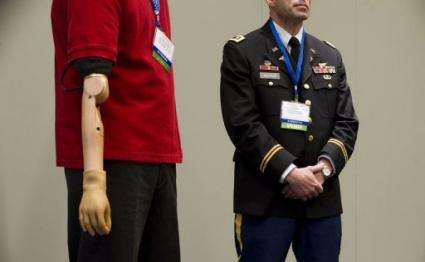
Glen Lehman (L), a retired sergeant first class in the United States Army stands with his bionic arm
Enlarge

Glen Lehman (L), a retired sergeant first class in the United States Army who received Targeted Muscle Reinnervation (TMR) surgery after he lost his arm in Iraq, stands with his bionic arm next to LTC Martin Baechler, M.D., a surgeon at Walter Reed Army Medical Center, during a presentation of the latest in TMR, a bionic limb technology.

Kuiken said the team has encountered some technological "challenges" that have slowed progress but is "excited about moving forward."

A series of other efforts to test and improve on these mind-reading robotics, known as brain-computer interfaces, were also showcased at the conference.

Among them, how researchers can now place computer chips on the surface of the brain to interpret neural activity, potentially allowing spinal cord injury patients to control a range of devices from computer games to prosthetics.

Someday, patients who are bed-ridden will be able to wear a special electronic cap that allows them to maneuver a rolling robot carrying a video camera, so that the patient could join in the dinner conversation without leaving the bedroom.

But the stunning technology is anything but easy work for the patients.

According to Jose del R. Millan and his team at the Ecole Polytechnique Federale de Lausanne in Switzerland, in a "typical brain-computer interface (BCI) set-up," users send mental messages of either left, right, or no-command.

"But it turns out that no-command is very taxing to maintain and requires extreme concentration. After about an hour, most users are spent. Not much help if you need to maneuver that wheelchair through an airport," his team said in a statement.

So now researchers are figuring out how to hook up a machine to interpret a user's brain signals and read their intent.

Users are asked to read or speak aloud while thinking of as many left, right or no commands as possible. The technology learns to sift through the fray and figure out when a command has been delivered.

The result "makes multitasking a reality while at the same time allows users to catch a break."

(c) 2011 AFP

Filter


Move the slider to adjust rank threshold, so that you can hide some of the comments.


Display comments: newest first

nuge
Feb 17, 2011

Rank: 5 / 5 (1)
What fantastic news! This is really what engineering is all about, and is why I became one. Thanks for inspiring me!
kaasinees
Feb 18, 2011

Rank: not rated yet
Maybe they should ask the japanese for an anatomicly correct arm. The arm looks horrible
Rank 5 /5 (7 votes)
Relevant PhysicsForums posts
  • Potential Breakthrough in Seizure Control
    created18 hours ago
  • Popping/Cracked sternum.
    created23 hours ago
  • Which Mental Illness Encompasses This Problem?
    created23 hours ago
  • A question about drug tolerance
    createdMay 23, 2012
  • Poor nutrition leading to overeating?
    createdMay 23, 2012
  • Math and dyslexia?
    createdMay 21, 2012
  • More from Physics Forums - Medical Sciences

More news stories

Keep food safety in mind this memorial day weekend

(HealthDay) -- Picnics, parades and cookouts are as much a part of Memorial Day weekend as tributes to the United States' war veterans.

Medicine & Health / Health

created 4 hours ago | popularity not rated yet | comments 0

Family history of Alzheimer's affects functional connectivity

(HealthDay) -- Cognitively normal individuals with a family history of late-onset Alzheimer's disease (AD) may display lower resting state functional connectivity in the default mode network (DMN) of the brain, ...

Medicine & Health / Alzheimer's disease & dementia

created 13 hours ago | popularity not rated yet | comments 0

Transvaginal mesh op restores pelvic organ prolapse at price

(HealthDay) -- Transvaginal mesh (TVM) procedures are effective for anatomical restoration of pelvic organ prolapse (POP), but patients report a worsening of sexual function following surgery, according to ...

Medicine & Health / Other

created 13 hours ago | popularity not rated yet | comments 0

Travel to high altitudes tied to Crohn's, colitis flare-ups

(HealthDay) -- People with inflammatory bowel disease, which includes Crohn's disease and colitis, may be at increased risk for flare-ups when they fly or travel to high altitudes for skiing or mountain climbing, ...

Medicine & Health / Inflammatory disorders

created 14 hours ago | popularity not rated yet | comments 1 | with audio podcast

Of mice and mental models: Neuroscientific implications of risk-optimized behavior in the mouse

(Medical Xpress) -- Regardless of an organism’s biological complexity, every encephalized animal continuously makes under-informed behavioral choices that can have serious consequences. Despite its ubiquity, ...

Medicine & Health / Neuroscience

created May 25, 2012 | popularity not rated yet | comments 0 | with audio podcast feature


Dell tablet leak: 10.1-inch display, two-battery choice

(Phys.org) -- Headline after headline talks about vendors’ tablets in the wings as likely number-one contenders for the iPad. Such claims have justifiably been taken with a grain of salt, considering ...

Scientist: Evolution debate will soon be history

(AP) -- Richard Leakey predicts skepticism over evolution will soon be history. Not that the avowed atheist has any doubts himself.

SpotterRF debuts Radar Backpack Kit (w/ Video)

(Phys.org) -- SpotterRF has announced a special radar backpack kit designed to enhance situational awareness for soldiers on the ground. The company says its special radar is designed for warfighters as part ...

SpaceX capsule has 'new car' smell, astronauts say (Update)

SpaceX's Dragon cargo vessel smells like a new car, said astronauts at the International Space Station after opening the hatches Saturday following the spacecraft's landmark mission to the orbiting lab.

Thousands of shellfish found dead in Peru

Thousands of crustaceans were found dead off the coast of Lima following the mystery mass death of dolphins and pelicans, the Peruvian Navy said Friday.

Australia hails surprise super-telescope decision

Australia has hailed a surprise decision giving it a role in a radio telescope project aimed at revolutionising astronomy, vowing to draw on its decades of experience in space science.