Immune interaction optimises foetal nourishment during pregnancy
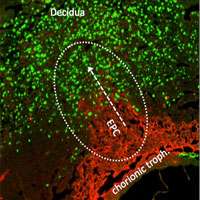
(PhysOrg.com) -- Paternal genes advise maternal immune cells on how to build the best womb for developing foetuses.
Researchers at the University of Cambridge and the Babraham Institute have identified a mechanism by which specific combinations of genes can lead to miscarriage and other complications in pregnancies.
The research revealed that paternal immune genes (MHC) in the placenta provide information to uterine natural killer (NK) cells to ensure that the foetus receives sufficient blood supply. Unlike their blood counterpart NK cells, which kill infectious and cancerous cells, uterine NK (uNK) cells actually help placental cells adapt the blood vessels in the womb to nourish the foetus.
By mating mice whose only genetic difference was in the MHC genes of the mother and father (1% of the genome), the researchers found that uNK cells would sense the difference in highly variable MHC genes. When faced with mismatched MHC genes from the father's immune system, uNKs were presumably not switched off and could focus on optimising the blood flow of the womb.
Francesco Colucci of the University of Cambridge Department of Obstetrics and Gynaecology had previously identified the particular genes expressed by mouse uNK cells and Ashley Moffett of the University of Cambridge's Department of Pathology had pioneered the research relevant to human uNK cells and MHC genes. But up until now, it was not clear which paternal MHC genes were expressed by mouse placentae.
"What is most exciting," Colucci says, "is that by revealing the similarities between human and mouse immunology of pregnancy, the [teams] lay new foundation for using mouse genetics to test new ideas and hypotheses informed by human genetics data."
The interaction of MHC and NK genes is also key in foetal programming of adult diseases such as diabetes and hypertension which are known to have early developmental origins
Colucci's work, published in Proceedings of the National Academy of Sciences of the United States of America (PNAS) yesterday, was funded by the BBSRC and the Wellcome Trust, along with the Centre for Trophoblast Research, Medical Research Council, and NIHR Cambridge Biomedical Research Centre.
Colucci describes the next steps of where this research is leading, saying, "We are now well positioned to explore how the inherent variability of these immune system genes affects reproductive success by comparing NK receptors and MHC in normal pregnancy to those with disorders."
In the future research, the 'good' and 'bad' combinations in humans will be mimicked in mice to examine uterine blood vessels and foetus/placenta growth. The results of these experiments should help provide an understanding of how to prevent pregnancy disorders.
"This paradox has puzzled scientists for decades and understanding how the foetus evades rejection, except in severe pregnancy complications, has remained elusive," said Dr Myriam Hemberger of the Babraham Institute, the senior co-author who is an expert in mouse placental development. "Our findings show that paternal antigens on foetal trophoblast cells, which form the placenta and are therefore in direct contact with maternal tissue, help to transform the uterus for robust placental and foetal growth. This is essential for reproductive success."
Provided by
University of Cambridge
-
From lemons to lemonade: Reaction uses carbon dioxide to make carbon-based semiconductor,
28 comments
-
Thioridazine kills cancer stem cells in human while avoiding toxic side-effects of conventional cancer treatments,
3 comments
-
SpaceX private rocket blasts off for space station (Update),
42 comments
-
Climate scientists say they have solved riddle of rising sea,
30 comments
-
Scotland passes turbine test to harness tidal power,
41 comments
-
Potential Breakthrough in Seizure Control
14 hours ago
-
Popping/Cracked sternum.
18 hours ago
-
Which Mental Illness Encompasses This Problem?
19 hours ago
-
A question about drug tolerance
May 23, 2012
-
Poor nutrition leading to overeating?
May 23, 2012
-
Math and dyslexia?
May 21, 2012
- More from Physics Forums - Medical Sciences
More news stories
Family history of Alzheimer's affects functional connectivity
(HealthDay) -- Cognitively normal individuals with a family history of late-onset Alzheimer's disease (AD) may display lower resting state functional connectivity in the default mode network (DMN) of the brain, ...
Medicine & Health / Alzheimer's disease & dementia
8 hours ago |
not rated yet |
0
Transvaginal mesh op restores pelvic organ prolapse at price
(HealthDay) -- Transvaginal mesh (TVM) procedures are effective for anatomical restoration of pelvic organ prolapse (POP), but patients report a worsening of sexual function following surgery, according to ...
9 hours ago |
not rated yet |
0
Travel to high altitudes tied to Crohn's, colitis flare-ups
(HealthDay) -- People with inflammatory bowel disease, which includes Crohn's disease and colitis, may be at increased risk for flare-ups when they fly or travel to high altitudes for skiing or mountain climbing, ...
Medicine & Health / Inflammatory disorders
9 hours ago |
not rated yet |
1
|
Of mice and mental models: Neuroscientific implications of risk-optimized behavior in the mouse
(Medical Xpress) -- Regardless of an organism’s biological complexity, every encephalized animal continuously makes under-informed behavioral choices that can have serious consequences. Despite its ubiquity, ...
Weight struggles? Blame new neurons in your hypothalamus
New nerve cells formed in a select part of the brain could hold considerable sway over how much you eat and consequently weigh, new animal research by Johns Hopkins scientists suggests in a study published in the May issue ...
Medicine & Health / Neuroscience
May 21, 2012 |
5 / 5 (1) |
6
|
SpotterRF debuts Radar Backpack Kit (w/ Video)
(Phys.org) -- SpotterRF has announced a special radar backpack kit designed to enhance situational awareness for soldiers on the ground. The company says its special radar is designed for warfighters as part ...
Australia hails surprise super-telescope decision
Australia has hailed a surprise decision giving it a role in a radio telescope project aimed at revolutionising astronomy, vowing to draw on its decades of experience in space science.
Astronomers seize last chance in lifetime for Venus Transit
Astronomers are gearing for one the rarest events in the Solar System: an alignment of Earth, Venus and the Sun that will not be seen for another 105 years.
Thousands of shellfish found dead in Peru
Thousands of crustaceans were found dead off the coast of Lima following the mystery mass death of dolphins and pelicans, the Peruvian Navy said Friday.
SpaceX capsule has 'new car' smell, astronauts say
SpaceX's Dragon cargo vessel smells like a new car, said astronauts at the International Space Station after opening the hatches Saturday following the spacecraft's landmark mission to the orbiting lab.
Astronauts enter world's 1st private supply ship
(AP) -- Space station astronauts floated into the Dragon on Saturday, a day after its heralded arrival as the world's first commercial supply ship.