Eyewitness memory susceptible to misinformation after testing
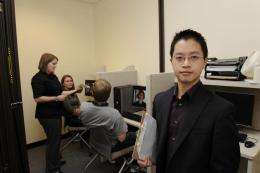
(PhysOrg.com) -- Last week, the Orlando Sentinel newspaper reported that Palm Beach County, Fla., law enforcement is working to develop a consistent set of rules for eyewitnesses, hoping it will help prevent false convictions. And a new Iowa State University study published in the Journal of Experimental Psychology finds that there may be good reason to question the recall of some eyewitnesses.
The study summarizes two experiments conducted by Jason Chan, an ISU assistant professor of psychology; and Moses Langley, a former Iowa State graduate student who is now a psychology faculty member at the University of Wisconsin-Parkside. Both experiments found that subjects who witnessed a criminal event and were tested about it immediately afterward were more susceptible to having misinformation -- or false information -- instilled in their later recall of the event than non-tested subjects. The researchers call that effect "retrieval-enhanced suggestibility," or RES.
Applying to criminal cases, Chan theorizes that an eyewitness who is asked to make a police statement about a crime may have his or her memory clouded by misinformation -- possibly introduced unknowingly by law enforcement, or through erroneous online accounts or news reports -- by the time the witness is asked to provide testimony in court.
"There are many cases in which misinformation is introduced unknowingly to people," said Chan, an assistant professor of psychology at Iowa State. "It could be police, or through friends, or a number of sources. And people can confuse their memories, even if it's information not specifically pertaining to that witnessed case. For example, if you saw a bank robbery and later saw a movie depicting bank robberies, whatever you remember from that movie -- which has nothing to do with the real-life case -- can interfere with your ability to recall the real-life case.
"So misinformation comes from all sorts of sources, especially nowadays with TV news reports trying to compete with people's accounts on Twitter with what they just saw," he continued. "Outlets are trying to compete with these Twitter feeds all the time, so they report something and don't verify the source of the information."
Summarizing two experiments
In the study's first experiment, 78 Iowa State undergraduates viewed a 43-minute pilot episode of the FOX television program "24" that they had not seen before. Half of the subjects then took a 24-question recall test, while the remaining subjects played the video game Tetris. All participants then listened to an eight-minute audio narrative that summarized the video and contained some misinformation about the crime they witnessed in the video. All the subjects returned a week later to take the same recall test. The researchers found that the tested subjects were more likely to recall the misinformation than the non-tested participants.
The researchers duplicated the experiment with 60 undergraduates, with the only difference being a one-week delay in the presentation of the misinformation prior to the second recall test. They found an even more powerful RES effect in the tested subjects, who reported the misinformation much more frequently than their non-tested counterparts.
"The most surprising finding from this line of research was that taking the immediate test, or initially recalling that event, somehow increased your susceptibility to misleading information later," Chan said. "That was definitely not expected. In fact, my collaborators and I expected the opposite based on what we know from the burgeoning cognitive psychology literature on the testing effect."
Initial testing can reinforce memory too
In both experiments, the researchers also found that the subjects who were initially tested and not provided the misinformation recalled the event's details more accurately than the non-tested subjects one week later. So the initial test reinforced their memory of the event.
"One really great thing about testing for memory is that not only does it enhance memory for the original information, it also lets you learn new information better," Chan said. "But because of this dual mechanism, under a situation when you present people with new information that is misleading, it can enhance their learning of that misleading information. The misinformation is more likely to be recalled if people don't question the accuracy of that new information."
This is the latest of three studies Chan has published on RES, with the other two published in Psychological Science (2009) and the Journal of Memory and Language (2010). He plans to continue his work on the influences of eyewitness memory.
"I think that because of all this new misinformation that's floating around, research in this area has even more real world relevance nowadays," he said.


