US researchers defend animal testing
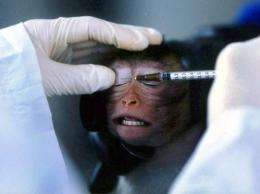
A Chinese researcher injects a monkey with an experimental solution at a laboratory in the southern Chinese city of Guangzhou. US researchers defended animal testing, telling a small group at one of the biggest science conferences in the United States that not doing animal research would be unethical and cost human lives.
US researchers defended animal testing, telling a small group at one of the biggest science conferences in the United States that not doing animal research would be unethical and cost human lives.
The researchers, who are or have been involved in animal research, told a symposium at the annual meeting of the American Association for the Advancement of Science (AAAS) that testing on animals has led to "dramatic developments in research that have improved and affected the quality of human life."
"To not do animal testing would mean that we would not be able to bring treatments and interventions and cures in a timely way. And what that means is people would die," Stuart Zola of Emory University, which is home to the Yerkes National Primate Research Center, told AFP after the symposium.
Treatments for diseases such as diabetes and polio were made possible through animal research, the researchers said, and animals are currently being used in hepatitis-, HIV- and stem cell-related research, among others.
But animal rights activists continue to bring pressure on laboratories that use animals to develop drugs and vaccines, urging them to stop the practice and use other means to develop the next wonder drug, treatment or cure.
Animal rights activists also insist they will never use medications developed through animal testing, but the researchers said they probably already have done.
"I get a lot of emails from animal rights activists, and one of them said, 'I have hepatitis C, and if you discover any drugs using chimpanzees that help hepatitis C patients, I'm not going to take them,'" John Vandenberg of the Southwest National Primate Research Center in Texas told AFP.
"I didn't communicate back to him that if he's taking any drug whatsoever for hepatitis C, it was developed with chimpanzees. There's this ignorance in the world as to where these drugs come from, where vaccines come from," he said.
The researchers also argued that animal research in the United States is covered by a bevy of rules and regulations to ensure that the animals used in testing are treated humanely.
"It is quite dramatically regulated," said Zola.
Institutions that receive federal funding have to have an "animal care and use committee that reviews every protocol that uses even a single rodent," said Zola.
That protocol is then reviewed by another panel, which includes veterinarians, experts in medicine, and a representative of the public, and only when everyone has signed off on the protocol can testing proceed.
(c) 2011 AFP
-
From lemons to lemonade: Reaction uses carbon dioxide to make carbon-based semiconductor,
28 comments
-
Thioridazine kills cancer stem cells in human while avoiding toxic side-effects of conventional cancer treatments,
3 comments
-
SpaceX private rocket blasts off for space station (Update),
42 comments
-
Climate scientists say they have solved riddle of rising sea,
30 comments
-
Scotland passes turbine test to harness tidal power,
41 comments
-
Potential Breakthrough in Seizure Control
14 hours ago
-
Popping/Cracked sternum.
18 hours ago
-
Which Mental Illness Encompasses This Problem?
19 hours ago
-
A question about drug tolerance
May 23, 2012
-
Poor nutrition leading to overeating?
May 23, 2012
-
Math and dyslexia?
May 21, 2012
- More from Physics Forums - Medical Sciences
More news stories
Family history of Alzheimer's affects functional connectivity
(HealthDay) -- Cognitively normal individuals with a family history of late-onset Alzheimer's disease (AD) may display lower resting state functional connectivity in the default mode network (DMN) of the brain, ...
Medicine & Health / Alzheimer's disease & dementia
8 hours ago |
not rated yet |
0
Transvaginal mesh op restores pelvic organ prolapse at price
(HealthDay) -- Transvaginal mesh (TVM) procedures are effective for anatomical restoration of pelvic organ prolapse (POP), but patients report a worsening of sexual function following surgery, according to ...
9 hours ago |
not rated yet |
0
Travel to high altitudes tied to Crohn's, colitis flare-ups
(HealthDay) -- People with inflammatory bowel disease, which includes Crohn's disease and colitis, may be at increased risk for flare-ups when they fly or travel to high altitudes for skiing or mountain climbing, ...
Medicine & Health / Inflammatory disorders
9 hours ago |
not rated yet |
1
|
Of mice and mental models: Neuroscientific implications of risk-optimized behavior in the mouse
(Medical Xpress) -- Regardless of an organism’s biological complexity, every encephalized animal continuously makes under-informed behavioral choices that can have serious consequences. Despite its ubiquity, ...
Weight struggles? Blame new neurons in your hypothalamus
New nerve cells formed in a select part of the brain could hold considerable sway over how much you eat and consequently weigh, new animal research by Johns Hopkins scientists suggests in a study published in the May issue ...
Medicine & Health / Neuroscience
May 21, 2012 |
5 / 5 (1) |
6
|
SpotterRF debuts Radar Backpack Kit (w/ Video)
(Phys.org) -- SpotterRF has announced a special radar backpack kit designed to enhance situational awareness for soldiers on the ground. The company says its special radar is designed for warfighters as part ...
Australia hails surprise super-telescope decision
Australia has hailed a surprise decision giving it a role in a radio telescope project aimed at revolutionising astronomy, vowing to draw on its decades of experience in space science.
Astronomers seize last chance in lifetime for Venus Transit
Astronomers are gearing for one the rarest events in the Solar System: an alignment of Earth, Venus and the Sun that will not be seen for another 105 years.
Thousands of shellfish found dead in Peru
Thousands of crustaceans were found dead off the coast of Lima following the mystery mass death of dolphins and pelicans, the Peruvian Navy said Friday.
SpaceX capsule has 'new car' smell, astronauts say
SpaceX's Dragon cargo vessel smells like a new car, said astronauts at the International Space Station after opening the hatches Saturday following the spacecraft's landmark mission to the orbiting lab.
Astronauts enter world's 1st private supply ship
(AP) -- Space station astronauts floated into the Dragon on Saturday, a day after its heralded arrival as the world's first commercial supply ship.
Feb 22, 2011
Rank: not rated yet
With this type of justification there's nearly nothing to refrain from non-consensual experiments on humans.
And in fact, exactly this kind of justification is systematically put forward when the topic "collateral damages" is raised.
Thus, there is no sound justification. People are using , hurting, and killing animals just because the _can_ do it.
The criterion of the Categorical Imperative is not met.