More young people are winding up in nursing homes
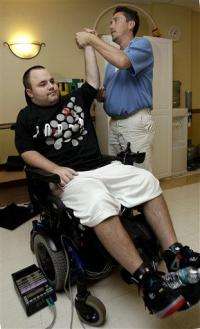
(AP) -- Adam Martin doesn't fit in here. No one else in this nursing home wears Air Jordans. No one else has stacks of music videos by 2Pac and Jay-Z. No one else is just 26.
It's no longer unusual to find a nursing home resident who is decades younger than his neighbor: About one in seven people now living in such facilities in the U.S. is under 65. But the growing phenomenon presents a host of challenges for nursing homes, while patients like Martin face staggering isolation.
"It's just a depressing place to live," Martin says. "I'm stuck here. You don't have no privacy at all. People die around you all the time. It starts to really get depressing because all you're seeing is negative, negative, negative."
The number of under-65 nursing home residents has risen about 22 percent in the past eight years to about 203,000, according to an analysis of statistics from the Centers for Medicare and Medicaid Services. That number has climbed as mental health facilities close and medical advances keep people alive after they've suffered traumatic injuries. Still, the overall percentage of nursing home residents 30 and younger is less than 1 percent.
Martin was left a quadriplegic when he was accidentally shot in the neck last year by his stepbrother. He spent weeks hospitalized before being released to a different nursing home and eventually ended up in his current residence, the Sarasota Health and Rehabilitation Center. There are other residents who are well short of retirement age, but he is the youngest.
The yellow calendar on the wall of Martin's small end-of-the-hall room advertises activities such as arts and crafts. In the small common room down the hall, a worker draws a bingo ball and intones, "I-16. I-one-six." As Martin maneuvers his motorized wheelchair through the hallway, most of those he passes have white hair and wrinkled skin.
"It's lonely here," Martin says, as a single tear drips from his right eye.
Martin exchanges muted hellos with older residents as he travels down the hall to smoke outside. His entire daily routine, from showering to eating to enjoying a cigarette, is dictated by the schedules of those on whom he relies for help.
He usually wakes up late, then waits for an aide to shower him, dress him and return him to his wheelchair. He watches TV, goes to therapy five days a week and waits most days for his friend to bring him meals.
He mostly keeps to himself, engaging in infrequent and superficial conversations with his elders.
Martin's parents are unable to care for him at home. His father is a truck driver who is constantly on the road, and his stepmother is sick with lupus. Medicaid pays his bills; it could take a lawsuit for him to get care outside a nursing home.
Advocates who help young patients find alternatives to nursing homes say people are often surprised to learn there are so many in the facilities. About 15 percent of nursing home residents are under 65.
"When I tell people I try to get kids out of nursing homes, they have no idea," says Katie Chandler, a social worker for the nonprofit Georgia Advocacy Office.
Federal law requires states to provide alternatives to institutional care when possible, though its implementation varies from place to place. Navigating the system can require a knowledgeable advocate and, sometimes, litigation.
Not all younger nursing home residents are there for good. Some nursing homes are seeing an increase in patients who come to recover there instead of in a hospital, because it is cheaper for their insurance company.
Like Martin, many younger residents have suffered a traumatic injury. Others have neuromuscular diseases such as multiple sclerosis, or have suffered a stroke.
Brent Kaderli, 26, of Baytown, Texas, became a quadriplegic after a car accident in 2006. He hopes rehabilitation will help him gain enough strength to move into an assisted living facility and eventually, to an apartment with his girlfriend.
He shares his nursing home room with an older man who suffers from dementia. It is not ideal, but because his parents' home is not modified to accommodate his wheelchair, he thinks it's the only option right now.
"Just knowing that one day I will be better, I'm still hoping and praying for that. In the meantime, I think about my family and my friends, what I used to be able to do, and I stay sad a lot," he says. "This is probably the best that I could have at this point."
The same generational tensions that exist outside nursing homes are inside them as well, and are sometimes exacerbated by the often close confines.
Older residents complain about loud music and visitors, younger residents complain about living with someone with dementia or being served creamed spinach. Many nursing homes try to house younger residents together, though in many cases their small numbers make that difficult.
For young people who find themselves newly disabled, the psychological and social needs are often even more challenging than their physical demands. That presents a challenge for nursing homes that are used to serving people near the ends of their lives.
At Bayshore Health Center in Duluth, Minn., 34 of the 160 residents are younger people, all living in private rooms in their own wing. The staff has found that subtle changes can improve their lives.
Instead of bingo night, there are poker games and outings to nightclubs. For someone who stays up late watching a movie, breakfast can be served at 10 a.m., rather than 7 a.m. Pizza is offered in place of lasagna; Mountain Dew and Coke are poured instead of coffee and tea.
Still, many younger residents sink into depression because of their physical limitations, their loneliness and their nursing home surroundings.
"For them it's a life sentence. When you're 40 years old you know you're never getting out. This is the way your life will be forever and ever. Amen," says Diane Persson, a gerontologist who has written about the boom in younger nursing home residents.
Martin fears that may be true for him. He used to look forward to joining the Army and earning a college degree in science or engineering. Now he simply looks forward to visits from his friend Paul Tuttle, who on this day brings him nachos he feeds him along with sips of water.
"If I'm not here, he's got no one his age to talk to about football or anything," Tuttle says, wiping Martin's face.
Propped in his wheelchair, Martin says: "It makes you feel old. If that's all you're around, that's what you become."
(This version corrects Katie Chandler's affiliation to Georgia Advocacy Office, not state of Georgia.)
©2010 The Associated Press. All rights reserved. This material may not be published, broadcast, rewritten or redistributed.


