Spice and dye point toward better treatment for traumatic brain injuries
An old Indian spice and a dye whose cousin makes sports drinks blue are pointing scientists toward better treatment of traumatic brain injuries.
TBIs, the signature wound of the Iraq and Afghanistan wars, occur on football fields and roadways as well when an injured brain swells inside the closed confines of the skull, causing cell damage and symptoms ranging from headaches and confusion to seizures, slurred speech and death.
Medical College of Georgia researchers suspect that one day curcumin – the biologically active ingredient that makes the spice turmeric yellow – and the dye brilliant blue G – or their analogues – may be what doctors order to block the dangerous swelling.
"Today we don't have good therapies for TBIs, which can mean many good and often young minds are damaged or even lost," said Dr. Cargill H. Alleyne Jr., Chairman of the MCG Department of Neurosurgery. "We believe these attempts to characterize how edema and secondary injury develop after head trauma will enhance our efforts at prevention as well as identify novel therapies. This may eventually make a big difference for those injured on battlefields, football fields and highways."
"This is a dire situation for these patients," added Dr. Krishnan Dhandapani, MCG neuroscientist who vividly remembers a young TBI patient he saw his first week on the MCG faculty. The young male was riding an all-terrain vehicle helmetless when he flipped and hit his head on a rock. MCG Neurosurgeon John Vender, who had removed a portion of the patient's skull to give the brain room to swell, explained that was one of the biggest problems after trauma.
"He explained that patients get this delayed swelling, it pushes back on the skull, the pressure on their brain starts rising so blood flow to the brain gets cut off," Dhandapani said. "They go unconscious and it's basically downhill from there."
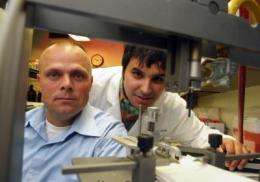
MCG graduate student Donald E. Kimbler, who works in Dhandapani's lab, has his own memories. The nurse anesthetist and U.S. Army major spent about a year in Afghanistan as part of a forward surgical team that stabilized injured soldiers within the golden hour following injury. Kimbler kept his vow never to lose a patient on the operating table in a warzone; now the nurse anesthetist sees his studies as a way to improve long-term results.
Their target is the aquaporin-4, a natural channel for moving water in and out of cells that occurs in high levels in the brain following trauma. "We think this is a crucial part of what causes the post-traumatic edema," Dhandapani said. They don't have a drug that directly blocks aquaporin-4 so they backtracked to what triggers it.
They found the major pro-inflammatory factor NF-KappaB in the gene that activates the aquaporin-4 gene. When they added it to brain cells in a dish, aquaporin-4 levels shot up. They determined that interleukin-1 beta – the same classic pro-inflammation mediator that causes a fever to fight off infection – was a major culprit. And, that curcumin can block NF-KappaB's ability to bind to aquaporin-4 and reduce resulting swelling. "It's like blocking the on switch," said Dhandapani. Mice with head trauma that get curcumin have much better recoveries, including less PTSD-like behaviors such as anxiety attacks and depression. "A lot of patients who survive head trauma become depressed, anxious, they have activity and sleeping problems. You see that in a lot of football players," who experience multiple concussions, which are basically mild TBIs, Dhandapani said.
A $1.7 million grant from the National Institutes of Health and a recent grant from the TriService Nursing Research Program of the Department of the Defense is helping the scientists better parse all the steps, including the role of toll-like receptors, a part of the innate immune response that rallies the body to fight an infection. That role made the researchers suspect the receptors might also have a role in the inflammation and swelling following a TBI. They've shown that mice missing toll-like receptors have less swelling and lower aquaporin-4 following a head injury. Curcumin appears to block these receptors.
That's where brilliant blue G also comes in. Evidence suggests another part of the innate immune response, P2X7 receptor, works with toll-like receptors. "If you block one, it blunts the response. If you block them both, it brings it back down to uninjured levels," Dhandapani said. Brilliant blue G seems to block P2X7. When Kimbler puts it in the drinking water of mice, swelling is reduced and outcomes improved. "You can imagine a soldier in Kabul or Bagdad or Afghanistan and he has brilliant blue G or its analogue in his water bottle," Dhandapani said, who hopes one day to take a clinical trial to the Army.
The scientist and student note analogues of curcumin and brilliant blue G likely will need to be identified because curcumin is not easily absorbed and therapeutic levels of the blue dye likely would turn a patient blue. But identifying the target for drug therapies is more then half the battle.
Kimbler was captivated by Dhandapani and his research when he was looking for a place to study science. "Nurse anesthetists are expected to go into one of the hard sciences, mainly neuroscience to teach," he said. A friend who was paralyzed and treated at MCG and the Charlie Norwood Veterans Affairs Medical Center strengthened his interest in neuroscience and Augusta. His war experience, seeing the confused aftermath of a soldier whose Hummer blew up, sealed the deal. He plans to teach in a U.S. Army Graduate Program in Anesthesia Nursing – ideally in the operating room - after he completes graduate school in 2012. "But I will take whatever the Army needs."
Dhandapani, a 2003 graduate of the MCG School of Graduate Studies, is president of the Alumni Association. His studies in TBI as well as hemorrhagic stroke – another condition for which there is no good therapy – have helped the MCG Department of Neurosurgery move into the top 25 in the country in National Institutes of Health funding.
Most neurosurgery departments have a clinical rather than research focus, said Alleyne, who was determined to have both when he was named Chairman in 2007. "As a surgeon, you get a lot of reward from helping people one patient at a time but as a clinical researcher you can magnify that 100-fold if you can change the way we do things by creating a new treatment paradigm. Then you are helping whole generations of patients. That is why we do this."


