Learn more quickly by transcranial magnetic brain stimulation
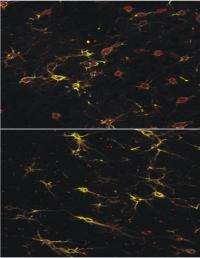
What sounds like science fiction is actually possible: thanks to magnetic stimulation, the activity of certain brain nerve cells can be deliberately influenced. What happens in the brain in this context has been unclear up to now. Medical experts from Bochum under the leadership of Prof. Dr. Klaus Funke (Department of Neurophysiology) have now shown that various stimulus patterns changed the activity of distinct neuronal cell types. In addition, certain stimulus patterns led to rats learning more easily.
The knowledge obtained could contribute to cerebral stimulation being used more purposefully in future to treat functional disorders of the brain. The researchers have published their studies in the Journal of Neuroscience and in the European Journal of Neuroscience.
Transcranial magnetic stimulation (TMS) is a relatively new method of pain-free stimulation of cerebral nerve cells. The method, which was presented by Anthony Barker for the first time in 1985, is based on the fact that the cortex, the rind of the brain located directly underneath the skull bone, can be stimulated by means of a magnetic field. TMS is applied in diagnostics, in fundamental research and also as a potential therapeutic instrument. Used in diagnostics, one single magnetic pulse serves to test the activability of nerve cells in an area of the cortex, in order to assess changes in diseases or after consumption of medications or also following a prior artificial stimulation of the brain. One single magnetic pulse can also serve to test the involvement of a certain area of the cortex in a sensorial, motoric or cognitive task, as it disturbs its natural activity for a short period, i.e. "switches off" the area on a temporary basis.
Since the mid-1990's, repetitive TMS has been used to make purposeful changes to the activability of nerve cells in the human cortex: "In general, the activity of the cells drops as a result of a low-frequency stimulation, i.e. with one magnetic pulse per second. At higher frequencies from five to 50 pulses per second, the activity of the cells increases", explained Prof. Funke. Above all, the researchers are specifically addressing with the effects of specific stimulus patterns like the so-called theta burst stimulation (TBS), in which 50 Hz bursts are repeated with 5 Hz. "This rhythm is based on the natural theta rhythm of four to seven Hertz which can be observed in an EEG", says Funke. The effect is above all dependent on whether such stimulus patterns are provided continuously (cTBS, attenuating effect) or with interruptions (intermittent, iTBS, strengthening effect).
It is unknown to a great extent how precisely the activity of nerve cells is changed by repeated stimulation. It is assumed that the contact points (synapses) between the cells are strengthened (synaptic potentation) or weakened (synaptic depression) as a result of the repeated stimulation, a process which also plays an important role in learning. Some time ago, it was also shown that the effects of TMS and learning interact in humans.
The researchers in Bochum have now shown for the first time that an artificial cortex stimulation specifically changes the activity of certain inhibitory nerve cells as a function of the stimulus protocol used. The balanced interaction of excitatory and inhibitory nerve cells is the absolute prerequisite for healthy functioning of the brain. Nerve cells specialised in inhibition of other nerve cells show a much greater variety in terms of cell shape and activity structure than their excitatory counterparts. Amongst other things, they produce various functional proteins in their cell body. In his studies, Prof. Funke has concentrated on the examination of the proteins Parvalbumin (PV), Calbindin-D28k (CB) and Calretinin (CR). They are formed by various inhibitory cells as a function of activity, with the result that their quantity gives information about the activity of the nerve cells in question.
For example, the examinations showed that activating stimulation protocol (iTBS) almost only reduces the PV content of the cells, whereas continuous stimulation attenuating activity (cTBS protocol), or a likewise attenuating 1 Hz stimulation, mainly reduces the CB production. CR formation was not changed by any of the tested stimulus protocols. Registration of the electrical activity of nerve cells confirmed a change in inhibition of the cortical activity.
In a second study, recently published in the European Journal of Neuroscience, Prof. Funke's group was able to show that rats also learned more quickly if they were treated with the activating stimulus protocol (iTBS) before each training, but not if the inhibiting cTBS protocol has been used. It was seen that the initially reduced formation of the protein Parvalbumin (PV) was increased again by the learning procedure, but only in the areas of the brain involved in the learning process. For animals not involved in the specific learning task, production of PV remained reduced following iTBS. "The iTBS treatment therefore initially reduces the activity of certain inhibiting nerve cells more generally, with the result that the following learning activities can be stored more easily," concludes Prof. Funke. "This process is termed "gating". In a second step, the learning activity restores the normal inhibition and PV production."
Repetitive TMS is already being used in clinical trials with limited success for therapy of functional disorders of the brain, above all in severe depressions. In addition, it was shown that especially disorders of the inhibitory nerve cells play an important role in neuropsychiatric diseases such as schizophrenia. "It is doubtless too early to derive new forms of treatment of functional disorders of the brain from the results of our study, but the knowledge obtained provides an important contribution for a possibly more specific application of TMS in future", is Prof. Funke's hope.
More information: Benali, A., Trippe, J., Weiler, E., Mix, A., Petrasch-Parwez, E., Girzalsky, W., Eysel, U.T., Erdmann, R. and Funke, K. (2011) Theta-burst transcranial magnetic stimulation alters cortical inhibition. J. Neurosci., in press.
Mix, A., Benali, A., Eysel, U.T., Funke, K. (2010) Continuous and intermittent transcranial magnetic theta burst stimulation modify tactile learning performance and cortical protein expression in the rat differently. In: Eur. J. Neurosci. 32(9):1575-86. doi:10.1111/j.1460-9568.2010.07425.x . Epub 2010 Oct 18


