Why older people are less astute drivers and how the answer could help us understand depression
January 25, 2011

Why older people are less astute drivers and how the answer could help us understand depression

Enlarge

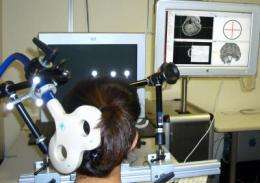
A test subject has the medial temporal visual area (MT) of her brain temporarily weakened so that researchers can study how it affects her ability to detect motion. University of Rochester Professor Duje Tadin has found that the MT area is responsible for allowing humans to ignore background motion in their environments and instead focus in on more important motion of smaller objects in the foreground. Credit: University of Rochester

When elderly drivers get behind the wheel, they often confront the harrowing reality that they cannot easily see other cars, pedestrians, or cyclists moving around them. This frightening effect of aging, it turns out, is not necessarily a result of a reduced ability to perceive moving objects, as one might suspect, but a heightened awareness of the backdrop against which these objects move.

A team of scientists led by University of Rochester Professor Duje Tadin has isolated the cause of this phenomenon, and the surprising results could not only help train elderly people to be better drivers, but they could also help better understand abnormal in psychological conditions like depression and . Their research, conducted at the Berenson-Allen Center for Noninvasive at the Harvard Medical School, will be published in the on January 25.

In a healthy, young person, a brain region called the middle temporal visual area, or MT, actively suppresses often irrelevant background motion so that he or she can concentrate on the more important motions of smaller objects in the foreground. Previous studies have found that elderly people, as well as those with psychological conditions such as schizophrenia and depression, are better at perceiving motion in the background. But this above average motion perception is not something to look forward to as we age. Because the brain is spending its limited resources constantly paying attention to the unimportant motions of background objects, it has a harder time noticing the motions of smaller objects.

“The amount of visual information around us is huge, and we don’t have the brain power to process it all,” Tadin said. “Evolutionarily speaking, are the most important visual features to detect quickly, because they could be your lunch or they could want to eat you for lunch. It just makes sense that our vision prioritizes processing them.”

Tadin and his colleagues discovered that the MT was responsible for this effect by using a technique called Transcranial Magnetic Stimulation (TMS). By precisely placing magnetic coils on the back of a subject’s head, the scientists stimulated the MT with electrical signals for 15 minutes to temporarily inhibit its functioning. Then, while the MT was less active, they tested how well subjects identified motions of smaller and larger objects. They found that when the MT was inhibited, subjects had an easier time identifying the motion of large, background-like objects. These results indicate that an improperly functioning MT may be the cause behind better than normal perception of background motion in older adults.

This knowledge could be useful to psychiatrists trying to better diagnose schizophrenia and depression, Tadin says. Current diagnostic techniques for these conditions can involve subjective and qualitative information like a history of hallucinations or feelings of apathy. But if a person also exhibits better than normal detection of background motion, it could be a quantitative confirmation that he or she has one of these afflictions.

Provided by University of Rochester search and more info website

4.5 /5 (6 votes)  

Rank 4.5 /5 (6 votes)
Relevant PhysicsForums posts
  • Potential Breakthrough in Seizure Control
    created11 hours ago
  • Popping/Cracked sternum.
    created15 hours ago
  • Which Mental Illness Encompasses This Problem?
    created15 hours ago
  • A question about drug tolerance
    createdMay 23, 2012
  • Poor nutrition leading to overeating?
    createdMay 23, 2012
  • Math and dyslexia?
    createdMay 21, 2012
  • More from Physics Forums - Medical Sciences

More news stories

Family history of Alzheimer's affects functional connectivity

(HealthDay) -- Cognitively normal individuals with a family history of late-onset Alzheimer's disease (AD) may display lower resting state functional connectivity in the default mode network (DMN) of the brain, ...

Medicine & Health / Alzheimer's disease & dementia

created 5 hours ago | popularity not rated yet | comments 0

Transvaginal mesh op restores pelvic organ prolapse at price

(HealthDay) -- Transvaginal mesh (TVM) procedures are effective for anatomical restoration of pelvic organ prolapse (POP), but patients report a worsening of sexual function following surgery, according to ...

Medicine & Health / Other

created 5 hours ago | popularity not rated yet | comments 0

Travel to high altitudes tied to Crohn's, colitis flare-ups

(HealthDay) -- People with inflammatory bowel disease, which includes Crohn's disease and colitis, may be at increased risk for flare-ups when they fly or travel to high altitudes for skiing or mountain climbing, ...

Medicine & Health / Inflammatory disorders

created 6 hours ago | popularity not rated yet | comments 1 | with audio podcast

Skp2 activates cancer-promoting, glucose-processing Akt

HER2 and its epidermal growth factor receptor cousins mobilize a specialized protein to activate a major player in cancer development and sugar metabolism, scientists report in the May 25 issue of Cell.

Medicine & Health / Cancer

created 23 hours ago | popularity not rated yet | comments 0 | with audio podcast

Tongue analysis software uses ancient Chinese medicine to warn of disease

For 5,000 years, the Chinese have used a system of medicine based on the flow and balance of positive and negative energies in the body. In this system, the appearance of the tongue is one of the measures used to classify ...

Medicine & Health / Other

created 21 hours ago | popularity 1 / 5 (1) | comments 0 | with audio podcast


SpotterRF debuts Radar Backpack Kit (w/ Video)

(Phys.org) -- SpotterRF has announced a special radar backpack kit designed to enhance situational awareness for soldiers on the ground. The company says its special radar is designed for warfighters as part ...

Australia hails surprise super-telescope decision

Australia has hailed a surprise decision giving it a role in a radio telescope project aimed at revolutionising astronomy, vowing to draw on its decades of experience in space science.

Astronomers seize last chance in lifetime for Venus Transit

Astronomers are gearing for one the rarest events in the Solar System: an alignment of Earth, Venus and the Sun that will not be seen for another 105 years.

SpaceX capsule has 'new car' smell, astronauts say

SpaceX's Dragon cargo vessel smells like a new car, said astronauts at the International Space Station after opening the hatches Saturday following the spacecraft's landmark mission to the orbiting lab.

Thousands of shellfish found dead in Peru

Thousands of crustaceans were found dead off the coast of Lima following the mystery mass death of dolphins and pelicans, the Peruvian Navy said Friday.

Astronauts enter world's 1st private supply ship

(AP) -- Space station astronauts floated into the Dragon on Saturday, a day after its heralded arrival as the world's first commercial supply ship.