New glaucoma test allows earlier, more accurate detection
January 4, 2011

New glaucoma test allows earlier, more accurate detection

Enlarge

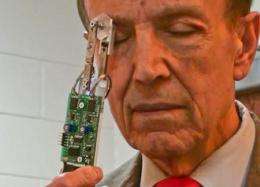
Cumbersome glaucoma tests requiring a visit to the ophthalmologist could soon be history thanks to a home test developed by an engineer at the University of Arizona.

A new hand-held instrument involving a system of micro-force sensors, specially designed microchips, and math-based programmed procedures has been designed by researchers at the UA College of Engineering. The easy-to-use probe gently rubs the eyelid and can be used at home, threatening to replace painful and the need for a sterilized sensor.

"You simply close your eye and rub the eyelid like you might casually rub your eye," said Eniko Enikov, professor of aerospace and mechanical engineering and head of the Advanced Micro and Nanosystems Laboratory at the University of Arizona's College of Engineering. "The instrument detects the stiffness and, therefore, infers the intraocular pressure," Enikov said.

Work on the probe began four years ago in collaboration with Dr. Gholan Peyman, a Phoenix ophthalmologist. The instrument went through several years of refinement and modifications to arrive at the current design, a prototype instrument that's noninvasive and simpler than current procedures. It can also be used in situations that are difficult or impossible with current tests.

In addition to screening for glaucoma -- an that can lead to blindness if left untreated -- the device can be used to measure drainage of intraocular fluid. Patients could use the probe at home to trace how much the pressure decreases after using eye drop medications.

According to the Glaucoma Research Foundation, glaucoma is a leading cause of blindness. There is no cure, everyone is at risk, and there may be no symptoms to warn you. More than 4 million Americans have but only half know they have it.

The development work was funded through the National Science Foundation, and Enikov and Peyman now are seeking investors to help fund final development and commercialization of the product.

"The innovation with our device is that it's noninvasive, simpler to use and applies to a variety of situations that are either difficult to address or impossible to test using the current procedures," Enikov said. "That's why we're so excited about this probe. It has great potential to improve medical care, and significant commercial possibilities, as well."

Provided by University of Arizona search and more info website


Rank 5 /5 (1 vote)
Relevant PhysicsForums posts

More news stories

Family history of Alzheimer's affects functional connectivity

(HealthDay) -- Cognitively normal individuals with a family history of late-onset Alzheimer's disease (AD) may display lower resting state functional connectivity in the default mode network (DMN) of the brain, ...

Medicine & Health / Alzheimer's disease & dementia

created 4 hours ago | popularity not rated yet | comments 0

Transvaginal mesh op restores pelvic organ prolapse at price

(HealthDay) -- Transvaginal mesh (TVM) procedures are effective for anatomical restoration of pelvic organ prolapse (POP), but patients report a worsening of sexual function following surgery, according to ...

Medicine & Health / Other

created 5 hours ago | popularity not rated yet | comments 0

Travel to high altitudes tied to Crohn's, colitis flare-ups

(HealthDay) -- People with inflammatory bowel disease, which includes Crohn's disease and colitis, may be at increased risk for flare-ups when they fly or travel to high altitudes for skiing or mountain climbing, ...

Medicine & Health / Inflammatory disorders

created 5 hours ago | popularity not rated yet | comments 1 | with audio podcast

Skp2 activates cancer-promoting, glucose-processing Akt

HER2 and its epidermal growth factor receptor cousins mobilize a specialized protein to activate a major player in cancer development and sugar metabolism, scientists report in the May 25 issue of Cell.

Medicine & Health / Cancer

created 23 hours ago | popularity not rated yet | comments 0 | with audio podcast

Tongue analysis software uses ancient Chinese medicine to warn of disease

For 5,000 years, the Chinese have used a system of medicine based on the flow and balance of positive and negative energies in the body. In this system, the appearance of the tongue is one of the measures used to classify ...

Medicine & Health / Other

created 20 hours ago | popularity 1 / 5 (1) | comments 0 | with audio podcast


SpotterRF debuts Radar Backpack Kit (w/ Video)

(Phys.org) -- SpotterRF has announced a special radar backpack kit designed to enhance situational awareness for soldiers on the ground. The company says its special radar is designed for warfighters as part ...

Australia hails surprise super-telescope decision

Australia has hailed a surprise decision giving it a role in a radio telescope project aimed at revolutionising astronomy, vowing to draw on its decades of experience in space science.

Astronomers seize last chance in lifetime for Venus Transit

Astronomers are gearing for one the rarest events in the Solar System: an alignment of Earth, Venus and the Sun that will not be seen for another 105 years.

SpaceX capsule has 'new car' smell, astronauts say

SpaceX's Dragon cargo vessel smells like a new car, said astronauts at the International Space Station after opening the hatches Saturday following the spacecraft's landmark mission to the orbiting lab.

Thousands of shellfish found dead in Peru

Thousands of crustaceans were found dead off the coast of Lima following the mystery mass death of dolphins and pelicans, the Peruvian Navy said Friday.

Astronauts enter world's 1st private supply ship

(AP) -- Space station astronauts floated into the Dragon on Saturday, a day after its heralded arrival as the world's first commercial supply ship.