
(PhysOrg.com) -- Supplementing seasonal flu vaccines with a viral protein that remains relatively constant may provide broader protection against emerging flu strains such as the 2009 H1N1 pandemic strain, scientists from Emory University School of Medicine have shown. The results are published online in the Proceedings of the National Academy of Sciences Early Edition.
Public health authorities are often playing catch-up when choosing which viral strains will go into the season’s flu shot, because of the influenza virus’ ability to change quickly and incorporate genetic information from viruses that infect animals such as pigs and chickens.
To meet this challenge, Emory researchers combined a vaccine made from a standard laboratory strain with virus-like particles (VLPs) containing M2, a viral protein that changes relatively little compared with other parts of the virus. These particles are shells that look like viruses but can’t replicate.
The combination could protect mice from a variety of flu strains, including the 2009 H1N1 pandemic strain and a H5N1 avian flu strain from Vietnam. Neither component of the combination could provide the same level of immune protection by itself.
The first author of the paper is postdoctoral fellow Jaemin Song. Senior authors are Sang-Moo Kang, PhD, assistant professor of microbiology and immunology, and Richard Compans, PhD, professor of microbiology and immunology. Compans is director of the Emory Influenza Pathogenesis and Immunology Research Center and a member of the Emory Vaccine Center.
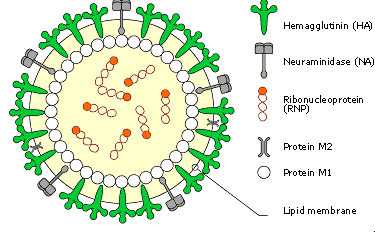
Part of the M2 protein is accessible on the outside of an influenza virus.
When someone is vaccinated or infected with influenza virus, the immune system makes a variety of antibodies against different parts of the virus. Most of them attack a protein on the surface of the virus called hemagglutinin, which helps the virus stick to target cells and get inside.
Viral strains are known by the variety of hemagglutinin they carry, along with another protein called neuraminidase: H1N1, H3N2 etc. However, vaccination against a H1N1 strain doesn’t necessarily protect against all H1N1 varieties. For example, the standard seasonal flu vaccines from 2000 to 2008 contained H1N1 strains, but across the population, immune resistance against the 2009 pandemic strain was still rare.
Previous research on flu vaccines that would provide broader protection has focused on the M2 protein, because it is exposed on the surface of the virus and is thus a good target for the immune system, yet doesn’t change as much as hemagglutinin or neuraminidase. The problem has been that M2 is not much of a vaccine by itself.
The Emory team incorporated the M2 protein into VLPs, which are made by introducing several viral genes into insect cells. Mice immunized with the M2 VLPs or with an inactivated lab strain of flu virus still became very sick and lost a large amount of weight when they were exposed to H3N2 flu virus. (Unimmunized mice exposed to the same dose of H3N2 all died.)
However, when mice were immunized with the M2 VLPs and the lab strain together, they didn’t even lose weight after being exposed to H3N2. The researchers also measured the levels of virus in the lungs of the mice four days after exposure. Immunization with the VLP combination drove down lung viral levels by a factor of more than 50, compared with mice immunized against the lab strain only.
In further experiments, the combination approach provided a similar level of immune protection, lasting several months in mice, against the 2009 pandemic H1N1 strain and a H5N1 strain from Vietnam.
“The results provide evidence that supplementation of seasonal influenza vaccines is a promising approach for overcoming the limitation of strain-specific protection by current vaccines and developing a universal influenza A vaccine,” the authors conclude.
More information: J.M. Song, et al. Vaccination inducing broad and improved cross protection against multiple subtypes of influenza A virus. PNAS Early Edition (2010).
Provided by Emory University


