Blood test to spot cancer gets big boost from J&J
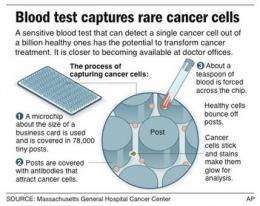
(AP) -- A blood test so sensitive that it can spot a single cancer cell lurking among a billion healthy ones is moving one step closer to being available at your doctor's office.
Boston scientists who invented the test and health care giant Johnson & Johnson will announce Monday that they are joining forces to bring it to market. Four big cancer centers also will start studies using the experimental test this year.
Stray cancer cells in the blood mean that a tumor has spread or is likely to, many doctors believe. A test that can capture such cells has the potential to transform care for many types of cancer, especially breast, prostate, colon and lung.
Initially, doctors want to use the test to try to predict what treatments would be best for each patient's tumor and find out quickly if they are working.
"This is like a liquid biopsy" that avoids painful tissue sampling and may give a better way to monitor patients than periodic imaging scans, said Dr. Daniel Haber, chief of Massachusetts General Hospital's cancer center and one of the test's inventors.
Ultimately, the test may offer a way to screen for cancer besides the mammograms, colonoscopies and other less-than-ideal methods used now.
"There's a lot of potential here, and that's why there's a lot of excitement," said Dr. Mark Kris, lung cancer chief at Memorial Sloan-Kettering Cancer Center in New York. He had no role in developing the test, but Sloan-Kettering is one of the sites that will study it this year.
Many people have their cancers diagnosed through needle biopsies. These often do not provide enough of a sample to determine what genes or pathways control a tumor's growth. Or the sample may no longer be available by the time the patient gets sent to a specialist to decide what treatment to prescribe.
Doctors typically give a drug or radiation treatment and then do a CT scan two months later to look for tumor shrinkage. Some patients only live long enough to try one or two treatments, so a test that can gauge success sooner, by looking at cancer cells in the blood, could give patients more options.
"If you could find out quickly, 'this drug is working, stay on it,' or 'this drug is not working, try something else,' that would be huge," Haber said.
The only test on the market now to find tumor cells in blood - CellSearch, made by J&J's Veridex unit - just gives a cell count. It doesn't capture whole cells that doctors can analyze to choose treatments.
Interest in trying to collect these cells soared in 2007, after Haber and his colleagues published a study of Mass General's test. It is far more powerful than CellSearch and traps cells intact. It requires only a couple of teaspoons of blood and can be done repeatedly to monitor treatment or determine why a drug has stopped working and what to try next.
"That's what got the scientific community's interest," Kris said. Doctors can give a drug one day and sample blood the next day to see if the circulating tumor cells are gone, he explained.
The test uses a microchip that resembles a lab slide covered in 78,000 tiny posts, like bristles on a hairbrush. The posts are coated with antibodies that bind to tumor cells. When blood is forced across the chip, cells ping off the posts like balls in a pinball machine. The cancer cells stick, and stains make them glow so researchers can count and capture them for study.
The test can find one cancer cell in a billion or more healthy cells, said Mehmet Toner, a Harvard University bioengineer who helped design it. Researchers know this because they spiked blood samples with cancer cells and then searched for them with the chip.
Studies of the chip have been published in the journals Nature, the New England Journal of Medicine and Science Translational Medicine. It is the most promising of several dozen that companies and universities are rushing to develop to capture circulating tumor cells, said Bob McCormack, technology chief for Veridex.
The agreement announced Monday will have Veridex and J&J's Ortho Biotech Oncology unit work to improve the microchip, including trying a cheaper plastic to make it practical for mass production. No price goal has been set, a company official said, but the current CellSearch test costs several hundred dollars.
The companies will start a research center at Mass General and will have rights to license the test from the hospital, which holds the patents.
In a separate effort, Mass General, Sloan-Kettering, University of Texas M.D. Anderson Cancer Center in Houston and Dana-Farber Cancer Institute in Boston will start using the test this year. They are one of the "dream teams" sharing a $15 million grant from the Stand Up to Cancer telethon, run by the American Association for Cancer Research.
Already, scientists have been surprised to find that more cancer patients harbor these stray cells than has been believed. In one study, the test was used on men thought to have cancer confined to the prostate, "but we found these cells in two-thirds of patients," Toner said.
This might mean that cancer cells enter the blood soon after a tumor starts, or that more cancers have already spread but are unseen by doctors.
Or it could mean something else entirely, because researchers have much to learn about these cells, said Dr. Minetta Liu, a breast cancer specialist at Georgetown University's Lombardi Comprehensive Cancer Center. She led a session on them at the recent San Antonio Breast Cancer Symposium and has been a paid speaker for Veridex. She hopes the cells will someday aid cancer screening.
"The dream is, a woman comes in for her mammogram and gets a tube of blood drawn," so doctors can look for cancer cells in her blood as well as tumors on the imaging exam, she said.
That's still far off, but Mass General's test already is letting doctors monitor patients without painful biopsies. Like Greg Vrettos, who suffered a collapsed lung from a biopsy in 2004, when he was diagnosed with lung cancer.
"It had spread to both lungs and they couldn't operate," said Vrettos, 63, a nonsmoker and retired electrical engineer from Durham, N.H. Tests from the biopsy showed that he was a good candidate for the drug Iressa, which he has taken ever since. He goes to Boston every three months for CT scans and the blood test.
"They could look at the number of cancer cells and see that it dropped over time. It corresponded with what the scans were showing," Vrettos said of doctors looking at his blood tests.
The test also showed when he had a setback last January and needed to have his treatment adjusted.
"I think it's going to be revolutionary," he said of the test.
More information: Mass General: http://tinyurl.com/2e7tbuz
National Cancer Institute: http://tinyurl.com/28tbow5
©2010 The Associated Press. All rights reserved. This material may not be published, broadcast, rewritten or redistributed.


