New vaccine to assist worldwide eradication of polio
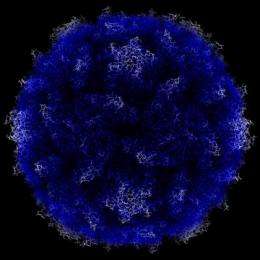
Scientists at the University of Leeds are joining the global fight to eradicate polio by developing a new type of vaccine that can trick the body to develop immunity against the disease.
The project has been awarded $500,000 from the Bill and Melinda Gates Foundation, through the World Health Organisation, and aims to be effective against all polio subtypes.
Led by Professor Dave Rowlands and Dr Nicola Stonehouse from the University's Faculty of Biological Sciences, the research team will design a replica virus particle that looks and behaves like the real virus, but is actually an empty protein shell.
The researchers believe the hoax virus will trigger the body's immune system, but because it does not contain the genetic blueprint that replicates the virus inside the body, has no chance of causing or helping to spread the disease.
"This is an entirely new strategic approach against polio," says Dr Stonehouse. "This project is not about improving the efficiency of the current types of vaccine. Our intention is to design and produce a replica virus particle that carries no RNA cargo. This means it will be entirely safe to use as it can't ever cause the disease, and unlike current vaccines, can be produced without needing to grow large amounts of the infectious virus."
The team, led by Leeds, brings together researchers from Harvard University, the University of Oxford and the UK's National Institute for Biological Standards and Control (NIBSC), a centre of the Health Protection Agency. The first stage of the research will focus on proving that that the new approach is viable against the virus.
Current polio vaccines in use around the world are either delivered orally or injected, but contain either a weakened form of the virus, or an inactivated virus to kickstart the immune response. Whilst these have been extremely successful in reducing polio globally, the virus persists in several countries and unexpected outbreaks still occur.
"What excites me about this project is that we're working towards a risk-free vaccine that will be essential for the complete eradication of polio from the globe," adds Dr Stonehouse. "As well as being safe to produce and use, it will be stable enough not to need refrigeration and could be injected as part of current childhood vaccination programmes."
Although a similar approach using replica virus particles has been used successfully to create the human papilloma virus (HPV) vaccine against cervical cancer, the complexity of the polio virus creates significant additional challenges.
"With polio, the virus particle's surface matures and changes because of the genetic material inside, and so ensuring that our replica particle mimics this surface exactly is not going to be easy. Since it's essentially an empty protein shell, it also has to be robust enough that it doesn't fall apart," explains Professor Rowlands. "This will be an iterative process, where we keep testing, refining and improving the particles we design until we achieve exactly the right structure and surface."
"We believe that if the project is successful, this new approach could help to completely eradicate this disease for good."


