1 tale told is 2 tails gained: Anoles key to medically applicable regeneration?
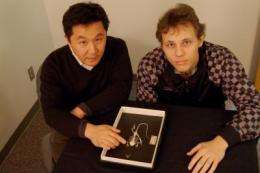
Arizona State University professor Kenro Kusumi, with Anolis lizard tail in hand, may hold the most likely key to unlock the secrets of medically applicable regeneration.
Anolis lizards first entered Arizona State University biologist Kenro Kusumi's life in 1980 when, as a member of a junior curator program, he recorded in his field notebook that he had found an Anolis egg on a field trip. Kusumi still has those notes, along with other memorabilia that document the influence that both his early life and more recent experiences have had on his current pursuits in developmental biology. One such souvenir is a small Pueblo lizard sculpture that sits on a table in his office. With one missing leg and a tail, broken and repaired in two places, it is not particularly eye-catching, but it does symbolize Kusumi's current research model: a lizard which can "fix" or more accurately, regenerate, its broken tail.
Human regeneration is mainly limited to small portions of liver tissue, bone, or muscle, yet understanding how regeneration occurs in other taxonomic groups may enable scientists to improve human regenerative abilities in the future. Kusumi is working to understand the molecular processes that enable some lizards to regenerate their tissues with fellow ASU School of Life Sciences faculty members Jeanne Wilson-Rawls, Allan Rawls, Rebecca Fisher and Dale DeNardo (collectively referred to as "JARKD" by their students). Lizards can regenerate facial bones, certain areas of the spinal cord, and, as is most commonly known, most lizards can regenerate their tail—including muscles, cartilage, and spinal cord. The regenerated tail does not contain bone, but instead is supported by a tube of hyaline cartilage—the same cartilage humans have lining many of their joints. With widespread medical problems such as arthritis and spinal cord injuries, the application of these regenerative abilities is of extreme interest to medical institutions.
"Members of my family have terrible osteoarthritis," Kusumi explains. "That means the cartilage at the joints has degenerated. These lizards can regenerate that kind of cartilage, and they have no problem doing so. How is it that we can't do this, but they can?" With the help of the Anolis model, Kusumi and the rest of the JARKD team are delving into this mystery, recently funded by a $412,606 grant from the National Institutes of Health and a $225,000 grant from the Arizona Biomedical Research Commission.
Many vertebrate and invertebrate species can regenerate tissues, but there are several kinds of regeneration. Lizards most likely use stem-cell mediated regeneration, where new cells involved in regrowth arise from tissue-specific progenitor cells. This type of regeneration is the best bet for a regenerative process compatible with the human system, Kusumi says. Now that the Anolis carolinensis genome is sequenced, rather than trying to solve the puzzle blind, the research team has a view of the bigger picture as a guide to work from.
Molecular methods have improved to the point that the JARKD team is focusing on this question at the perfect time. Kusumi mused, "the beauty is that now we know enough about development that we can actually have candidates for what cells are making this new tail—we can have guesses as to what might be right." Using this candidate approach, Wilson-Rawls and graduate student Rajani George have successfully identified and isolated lizard cells that can make new muscle. Meanwhile, the Kusumi lab is working to uncover what developmental control genes are being expressed in regenerating tails. Here, with collaborators from the Translational Genomics Research Institute (TGen), JARKD is using RNA-Seq, a next-generation technology that allows researchers to take a more unbiased approach, finding all the genes being expressed in a tissue at one point in time. When compared with embryonic development of the tail, which is being investigated by graduate student Walter Eckalbar, differences between initial tissue generation and regenerative processes can be identified. The genes involved in regeneration are likely conserved across various taxonomic classes, but the genetic switches for those genes may be turned off or down. "Once we understand the nuts and bolts of how this is happening, we can use available technologies to manipulate and change that," Kusumi explains, "then we will try to translate that to the mouse model."
A regenerating mouse tail is only one of the many images inspired by Kusumi's Anolis studies. In concert with colleagues at the Smithsonian Tropical Research Institute (STRI) in Panama and Elizabeth Hutchins, one of Kusumi's graduate students, the JARKD team is adopting an evolutionary perspective of various Anolis processes or adaptations. "Occasionally you have a very unique opportunity to look at a natural experiment where one species arrived on one island or was isolated in a region, which then led to the adaptive radiation of many species to fill a variety of niches," Kusumi says. Anolis has in fact been described by some scientists as the "Darwin's finch" of reptiles. This reference points to the number and range of ecomorphs in the Anolis genus, as species have arisen in different regions bearing highly similar behaviors and morphology (also known as convergent evolution). While anoles have been the focus of many evolutionary studies, the JARKD-STRI team is focusing on the intersection of evolution and development, where "you can look for the regulatory changes that drove a limb to be longer or muscles to be more robust."
With such a bright road ahead for both the regenerative and evolutionary undertakings, Kusumi hopes ASU will lead internationally, as a center for the Anolis work. The opportunity to create such an interdisciplinary research program attracted him in part to School of Life Sciences in ASU's College of Liberal Arts and Sciences, which Kusumi describes as a place that "breaks down the walls between disciplines. Of course, the realization of this vision depends on complex collaborations, which Kusumi jokes are growing so large that listing those not involved may be easier. Kusumi's Anolis collaborations go well beyond JARKD, STRI, TGen and ASU, and also include some of Kusumi's undergraduate mentees. Glenn Markov, a Barrett's Honors College undergraduate and member of the School of Life Sciences Undergraduate Research (SOLUR) program, has spent two years contributing to the ground work of the regeneration project. Much like the tissue-specific process of human progenitor cells, each member of the collaborative team—whether undergraduate, graduate student, or faculty—makes unique contributions to ensure the creation of a functional end product.
Mark Twain once stated "a man who carries a cat by the tail learns something he can learn in no other way." In a similar vein, Kusumi, with lizard tail in hand, may hold the most likely key to unlock the secrets of medically applicable regeneration.


