Scientists find molecular glue needed to wire the brain
Dec 08, 2010
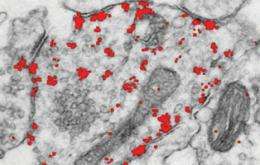
Red dots on electron micrograph show SynCAM molecules within a synapse between two brain cells. Yale researchers say the molecules acts as a sort of glue and is crucial to function of neurons.

(PhysOrg.com) -- Yale University researchers have found that a single molecule not only connects brain cells but also changes how we learn. The findings, reported in the December 9 issue of the journal Neuron, may help researchers discover ways to improve memory and could lead to new therapies to correct neurological disorders.

The junctions between over which nerve pulses pass — called — are crucial for regulating learning and memory and how we think. Aberrations in the structure and function of synapses have been linked to mental retardation and autism, while synapses are lost in the aging brains of Alzheimer's patients.

However, the mechanisms that organize synapses in the living brain remain a puzzle. Yale scientists identified one critical piece of this puzzle, a molecule called SynCAM 1 that spans across synaptic junctions.

"We hypothesized that this molecule might promote new synapses in the developing brain, but were surprised that it also impacts the maintenance and function of these structures," said Thomas Biederer, associate professor of molecular biophysics and biochemistry and senior author of the study. "We can now define how this molecule supports the brain's ability to wire itself."

The Yale team focused on SynCAM 1, an adhesion molecule that helps to hold synaptic junctions together. They found that when the SynCAM 1 gene was activated in mice, more synaptic connections formed. Mice without the molecule produced fewer synapses.

When we learn, new synapses can form. However, the strength of synaptic connections also changes during learning, based on the amount of stimuli received — a quality scientists termed "plasticity." Together with a group in Germany led by Valentin Stein, the team was surprised to find that SynCAM 1 controls an important form of synaptic plasticity.

Unexpectedly, Biederer and colleagues also found that mice with high amounts of SynCAM 1 are unable to learn while mice lacking SynCAM 1 — and having fewer synapses — learn better. Apparently an excess of the molecule can be damaging. This builds on recent theories suggesting that having too many connections isn't always better and that the balance of synaptic activity is crucial for proper learning and memory.

"Synapses are dynamic structures. It appears that SynCAM 1 ties synapses together; some of this molecule is needed to promote contact but too much glues down the synapse and inhibits its function. It may act a bit like a sculptor who helps give synapses their shape." Biederer also said that the molecule is almost identical in mice and man, and likely has the same roles in human brains.

Explore further: Key protein is linked to circadian clocks, helps regulate metabolism

Related Stories

Special protein helps maintain an efficient brain

May 18, 2009

(PhysOrg.com) -- The instruction manual for maintaining an efficient brain may soon include a section on synaptotagmin-IV (Syt-IV), a protein known to influence learning and memory, thanks to a study by UW-Madison researchers.

Researchers make new finding about how memory is stored

Apr 23, 2008

Researchers at Wake Forest University School of Medicine are the first to show that the location of protein-destroying “machines” in nerve cells in the brain may play an important role in how memories are formed – a ...

New insight into Alzheimer’s disease

Dec 24, 2008

(PhysOrg.com) -- A new molecule important in a part of the memory that allows recognition of people has been identified by researchers at the University of Bristol. This type of memory is impaired at an early ...

Recommended for you

New concussion data: Two biomarkers better than one

21 hours ago

Scientists are scrambling to gather data for the FDA to support the need for a blood test to diagnose brain injury in the United States. The University of Rochester Medical Center just added significant evidence by reporting ...

User comments : 0

More news stories

Taxing unhealthy food spurs people to buy less

Labeling foods and beverages as less-healthy and taxing them motivates people to make healthier choices, finds a recent study in the American Journal of Preventive Medicine. When faced with a 30 percent tax on ...

Sound waves precisely position nanowires

(Phys.org) —The smaller components become, the more difficult it is to create patterns in an economical and reproducible way, according to an interdisciplinary team of Penn State researchers who, using ...

'Ugly' finding: Unattractive workers suffer more

People who are considered unattractive are more likely to be belittled and bullied in the workplace, according to a first-of-its-kind study led by a Michigan State University business scholar.

Pearly perfection

The mystery of how pearls form into the most perfectly spherical large objects in nature may have an unlikely explanation, scientists are proposing in a new study. It appears in ACS' journal Langmuir, named ...

An environmentally friendly battery made from wood

Taking inspiration from trees, scientists have developed a battery made from a sliver of wood coated with tin that shows promise for becoming a tiny, long-lasting, efficient and environmentally friendly energy ...