New miniature smart chip implant to combat chronic pain
December 15, 2010 by Lin Edwards report

New miniature smart chip implant to combat chronic pain

Enlarge

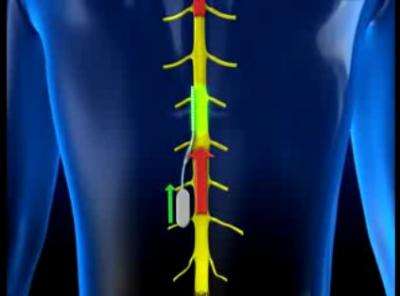
(PhysOrg.com) -- Human trials will begin in Australia next year of a new device containing tiny smart chips which is implanted in the spinal cord or other nerves in the body to block pain signals and prevent them reaching the brain.

The smart chip implant technology is officially called Implantable Neuro Sensing and Stimulation or INS2, and is designed to combat chronic pai. It has been developed over the last couple of years by National ICT (NICTA) in Sydney. The development team of 10 includes biomedical experts, electrical and mechanical engineers, software developers, and experts in textile technology.

There are already devices that can be implanted to block pain, but according to NICTA’s chief technology officer, Dr. John Parker, these are around the size of a matchbox, whereas the new implant is around the size of a single match head. Dr. Parker said the smaller size improves the reliability of the device and enables it to be implanted closer to the spine.

This video is not supported by your browser at this time.

The new implant consists of one or two smart chips built into a biocompatible device about the size of the head of a match. The device is sewn into a 1.22 mm wide container of a polymer material with integrated electronic wires. The device is then implanted on the target nerve such as the or elsewhere in the body. The device is operated by an internal computer processor run by a battery the size of a SIM card that can be recharged wirelessly. Wireless recharging means there is no need for external wires or devices.

The device monitors the properties of the nerves carrying pain signals to the brain and can be "fine-tuned" to block the undesirable pain signals with electrical pulses of up to 10 volts. Since the pain signals no longer reach the , there is little or no sensation of pain. The device will be able to manage different levels of pain in different ways.

NICTA said the device may have numerous applications apart from treating chronic back pain or leg pain, and could be used to block pain caused by nerve damage and migraines. It also has the potential to help control epileptic seizures and the tremors caused by Parkinson’s disease.

NICTA is planning to form a new company in Sydney, Saluda Medical, to commercialize the implant.

NICTA is funded by the federal government of Australia and the NSW state government, and Eric Roozendaal, the NSW treasurer and minister for state and regional development, said the new device is an exciting new technology that “has the potential to deliver a revolution in the management of chronic .”

More information: http://www.nicta.c … lant_systems

© 2010 PhysOrg.com

4.5 /5 (13 votes)  

Filter


Move the slider to adjust rank threshold, so that you can hide some of the comments.


Display comments: newest first

kaasinees
Dec 15, 2010

Rank: 2.3 / 5 (9)
Yeah right... Fighting the symptons instead of the cause. "Get back to work!". Cheap ass bastards.
EvgenijM
Dec 15, 2010

Rank: 3.7 / 5 (3)
Yeah right... Fighting the symptons instead of the cause. "Get back to work!". Cheap ass bastards.

Lol. With that mindset - do you even use a handkerchief when you got a cold?
davaguco
Dec 15, 2010

Rank: 5 / 5 (4)
You should ask people with illnesses that cause them severe chronic pain. They could care little if the device won't cure them. As long as it stops the pain (or most of it), they will find it very valuable.

Of course, a cure would be better, but that might be a few years (or decades) away.
kaasinees
Dec 15, 2010

Rank: 2.7 / 5 (7)
@EvgenijM

What are you talking about? Paracetamol is not just a pain killer it breaks down acids in your body. Relieves stress. All to help you heal faster. Besides when you have a flu you body fights the cause not the symptons.

Go away, think harder and try again. Next jackass's turn.
kaasinees
Dec 15, 2010

Rank: 3 / 5 (8)
@davaguco
Any sane person would agree with me, i rather feel the pain so i can feel what is wrong, what is harming me. You have no idea what will happen when you cant percieve pain anymore. Your brain wont be able to respond to pain, thus protect itself.
Fighting symptons is almost never the solution. There are rare occasions where the cause triggers a different cause to trigger a sympton that is dangerous to your body.
Some people get inflamation from over reactive immuno response from certain flu. The sympton is not from the flu itself, it is the combination of a flaw in the immuno response and a strain of flu.
This situation is not such a occasion.

Screwing up the body like this can make things alot worse, and if it doesnt its better to feel the pain, so you are reminded not to make strange movements that can screw up your back for ex. Pain is there for a reason.
pauljpease
Dec 15, 2010

Rank: 3.7 / 5 (6)
@kaasinees

First of all, I'm reporting your comment for belligerent language. There's no need to call someone a "jackass" because they disagree with you.

Second, I also disagree with your assertion that this is pointless as it doesn't address the cause of the pain. For two reasons. First, many times the cause of chronic pain is simply nerve damage. Meaning, there IS NO UNDERLYING CAUSE that can be addressed. Nerves get damaged and the person feels a constant pain when nothing is really wrong. Seems like this would be great for those situations. Second of all, a person doesn't need to be reminded every second of every day that there is a problem with their body. You claim that if their pain goes away it's like they'll forget about the underlying cause of the pain. I doubt anyone who needs to have a chip implanted in their spine is going to forget there's something wrong! But many times there is no cure, such as many degenerative diseases. Should these people suffer needlessly?
juliah
Dec 15, 2010

Rank: 5 / 5 (2)
Ok, Obviously some people commenting on here don't live with Chronic pain. I have osteoarthritis, sever, and fybromyalgia. Fibraomyalgia is a condition where the nerves send FALSE pain messages to the brain, so the implant would be a cure!, Secondly my rumatoligist has said no activity I do will make my osteo any better or worse, it will only affect the pain levels my brain receives, therefore again it would help as the excercise & activity can't hurt the condition. Also the article said that they can control the level of the interference as well as where the interference happens, so you could have it set so that it blocks the unhelpful, dibilitationg pain of these conditions while still allowing you to feel other healthy pain stimulus. If you haven't suffered with chronic pain in a condition that has no cure, or lived with someone who suffers with it, perhaps you should think again before commenting. I for one pray that this works, I am only 47 and would love to have my life back!!!
paindoc
Dec 19, 2010

Rank: 1 / 5 (1)
@kaasinees
You are confusing acute pain with chronic pain - acute pain has a purpose as you state in your examples; chronic pain has no purpose, often no on going physical cause and usually can only be treated symptomatically, drugs, injections and this stimulation therapies being only a small part of overall management.
kaasinees
Jan 29, 2011

Rank: 4 / 5 (4)
My mother does suffer from chronic pain and i stand by with what i said. Everything has a cause, the pain doesnt come from nowhere, that is the point you fail to understand.
Rank 4.5 /5 (13 votes)
Relevant PhysicsForums posts
  • Potential Breakthrough in Seizure Control
    created4 hours ago
  • Popping/Cracked sternum.
    created8 hours ago
  • Which Mental Illness Encompasses This Problem?
    created9 hours ago
  • A question about drug tolerance
    createdMay 23, 2012
  • Poor nutrition leading to overeating?
    createdMay 23, 2012
  • Math and dyslexia?
    createdMay 21, 2012
  • More from Physics Forums - Medical Sciences

More news stories

Of mice and mental models: Neuroscientific implications of risk-optimized behavior in the mouse

(Medical Xpress) -- Regardless of an organism’s biological complexity, every encephalized animal continuously makes under-informed behavioral choices that can have serious consequences. Despite its ubiquity, ...

Medicine & Health / Neuroscience

created 23 hours ago | popularity not rated yet | comments 0 | with audio podcast feature

Skp2 activates cancer-promoting, glucose-processing Akt

HER2 and its epidermal growth factor receptor cousins mobilize a specialized protein to activate a major player in cancer development and sugar metabolism, scientists report in the May 25 issue of Cell.

Medicine & Health / Cancer

created 17 hours ago | popularity not rated yet | comments 0 | with audio podcast

Cancer may require simpler genetic mutations than previously thought

Chromosomal deletions in DNA often involve just one of two gene copies inherited from either parent. But scientists haven't known how a deletion in one gene from one parent, called a "hemizygous" deletion, can contribute ...

Medicine & Health / Cancer

created 20 hours ago | popularity not rated yet | comments 0 | with audio podcast

First study to suggest that the immune system may protect against Alzheimer's changes in humans

Recent work in mice suggested that the immune system is involved in removing beta-amyloid, the main Alzheimer's-causing substance in the brain. Researchers have now shown for the first time that this may apply in humans.

Medicine & Health / Alzheimer's disease & dementia

created 21 hours ago | popularity 5 / 5 (3) | comments 0 | with audio podcast

Inherited DNA change explains overactive leukemia gene

A small inherited change in DNA is largely responsible for overactivating a gene linked to poor treatment response in people with acute leukemia.

Medicine & Health / Genetics

created 21 hours ago | popularity not rated yet | comments 0 | with audio podcast


Landmark calculation clears the way to answering how matter is formed

(Phys.org) -- An international collaboration of scientists, including Thomas Blum, associate professor of physics, is reporting in landmark detail the decay process of a subatomic particle called a kaon – ...

Dragon arrives at space station in historic 1st (Update 2)

The privately bankrolled Dragon capsule made a historic arrival at the International Space Station on Friday, triumphantly captured by astronauts wielding a giant robot arm.

Aliens don't want to eat us, says former SETI director

Alien life probably isn’t interested in having us for dinner, enslaving us or laying eggs in our bellies, according to a recent statement by former SETI director Jill Tarter.

Researchers demonstrate possible primitive mechanism of chemical info self-replication

(Phys.org) -- When scientists think about the replication of information in chemistry, they usually have in mind something akin to what happens in living organisms when DNA gets copied: a double-stranded molecule ...

Oldest Jewish archaeological evidence on the Iberian Peninsula

German archaeologists of the Friedrich Schiller University Jena found one of the oldest archaeological evidence so far of Jewish Culture on the Iberian Peninsula at an excavation site in the south of Portugal, ...

MIT researchers devise new means to synchronize a group of robots (w/ Video)

(Phys.org) -- For several years, roboticists have been working out ways to get a group of robots to perform synchronized activities as demonstrated most often in dance routines. It’s not just about trying ...