Medicaid cuts: teeth pulled, transplant called off
(AP) -- In Illinois, a pharmacist closes his business because of late Medicaid payments. In Arizona, a young father's liver transplant is canceled because Medicaid suddenly won't pay for it. In California, dentists pull teeth that could be saved because Medicaid doesn't pay for root canals.
Across the country, state lawmakers have taken harsh actions to try to rein in the budget-busting costs of the health care program that serves 58 million poor and disabled Americans. Some states have cut payments to doctors, paid bills late and trimmed benefits such as insulin pumps, obesity surgery and hospice care.
Lawmakers are bracing for more work when they reconvene in January. Some states face multibillion-dollar deficits. Federal stimulus money for Medicaid is soon to evaporate. And Medicaid enrollment has never been higher because of job losses.
In the view of some lawmakers, Medicaid has become a monster, and it's eating the budget. In Illinois, Medicaid sucks up more money than elementary, secondary and higher education combined.
"Medicaid is such a large, complicated part of our budget problem, that to get our hands around it is very difficult. It's that big. It's that bad," said Illinois Sen. Dale Righter, a Republican and co-chairman of a bipartisan panel to reform Medicaid in Illinois, where nearly 30 percent of total spending goes to the program.
Medicaid costs are shared by the federal and state governments. It's not just the poor and disabled who benefit. Wealthier people do, too, such as when middle-class families with elderly parents in nursing homes are relieved of financial pressure after Medicaid starts picking up the bills.
Contrary to stereotype, it's the elderly and disabled who cost nearly 70 cents of every Medicaid dollar, not the single mother and her children.
In California, Medicaid no longer pays for many adult dental services. But it still pays for extractions, that is, tooth-pulling. The unintended consequence: Medicaid patients tell dentists to pull teeth that could be saved.
"The roots are fine. The tooth could be saved with a root canal," said Dr. Nagaraj Murthy, who practices in Compton, Calif. "I had a patient yesterday. I said we could do a root canal. He said, `No, it's hurting. Go ahead and pull it. I don't have the money.'"
Murthy recently pulled an elderly woman's last tooth, but Medicaid no longer pays for dentures.
"Elderly patients suffer the most," Murthy said. "They're walking around with no teeth."
States can decide which optional services Medicaid covers, and dental care is among cutbacks in some places. Last year's economic stimulus package increased the federal share of Medicaid money temporarily. But that money runs out at the end of June, when the federal government will go back to paying half the costs rather than 60 to 70 percent. So more cuts could be ahead.
During the Great Recession, millions of people relied on the Medicaid safety net. Between 2007 and 2009, the number of uninsured Americans grew by more than 5 million as workers lost jobs with employer-based insurance. Another 7 million signed up for Medicaid.
Just when caseloads hit their highest point, the nation's new health care law required states not to change the rules on who's eligible for Medicaid. That means states can't roll up the welcome mat by tightening Medicaid's income requirements.
So states have resorted to a variety of painful options.
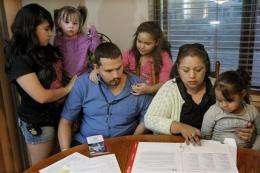
In Arizona, lawmakers stopped paying for some kinds of transplants, including livers for people with hepatitis C. When the cuts took effect Oct. 1, Medicaid patient Francisco Felix, who needs a liver, suddenly had to raise $500,000 to get a transplant.
The 32-year-old's case took a dramatic turn in November when a friend's wife died, and her liver became available. Felix was prepped for surgery in hopes financial donations would come in. When the money didn't materialize, the liver went to someone else, and Felix went home. His doctor told him he has a year before he'll be too sick for a transplant.
"They are taking away his opportunity to live," said his wife, Flor Felix. "It's impossible for us or any family to get that much money." The family is collecting donations through a website and plans a yard sale this weekend, she said.
The choices are difficult for states that have already cut payments to doctors and hospitals to the bone.
"If we don't see an economic recovery where state revenues rebound, they're really going to be very strained on how they can make ends meet," said Diane Rowland, executive director of the Kaiser Commission on Medicaid and the Uninsured.
States may consider lowering payment rates to nursing homes or home health agencies or further reducing payments to doctors, Rowland said.
"The problem here is the program is pretty lean, and payment rates are pretty low," she said. Patients can't find care because fewer doctors accept the low payments.
Prescription drug coverage in states is an optional benefit, another possible place to cut, Rowland said. "But if you cut back on people's psychotropic drugs, is that penny-wise and pound-foolish? Do they end up in institutions where Medicaid pays more for their care?"
In Illinois, late payments became the rule.
Tom Miller closed his pharmacy in rural southern Illinois this summer and is going through bankruptcy, largely because the state was chronically late making Medicaid payments to him. Most of his former customers are in the program.
With the state sometimes months behind in payments, he couldn't pay his suppliers. Five workers lost their jobs when his business closed.
"You can only fight it for so long," said Miller, 54. He now works as a pharmacist in a hospital. He misses his old clients, the families he grew to know.
"I was in my third generation. I've had moms who had kids. I saw the kids raised, and they had their own children," he said. As a neighborhood pharmacist, "you're their friend. You're family."
©2010 The Associated Press. All rights reserved. This material may not be published, broadcast, rewritten or redistributed.


