Heart prevention in people with diabetes using vitamin B1
December 6, 2010

Heart prevention in people with diabetes using vitamin B1

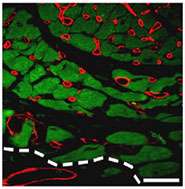
Following a heart attack, new vessels formed around the infarct to help re-establish the blood flow to the damaged heart: cardiac cells stained green; vessel stained red; demarcation of infarct by dotted line

Diabetes leaves the heart more vulnerable to stress as less oxygen and nutrients are delivered to the heart and other organs. Heart damage can be caused by high levels of glucose entering cardiovascular cells, which forms toxins that accelerate the ageing of the cell.

Around 50 per cent of people with diabetes die from , and this complication is the leading cause of death among people with diabetes. Researchers warn that with increasing prevalence of diabetes (around one in twenty people in the UK are now diagnosed with the condition), diabetes will result in a new epidemic of unless new treatments are developed.

Heart prevention in people with diabetes using vitamin B1

Formation of new vessels is diminished in diabetes…

Heart prevention in people with diabetes using vitamin B1

…but restored by dietary supplementation with vitamin B1, thus allowing a better recovery from the infarct

A team of researchers at the University of Bristol gave a synthetic derivative of vitamin B1 called benfotiamine to mice with and without diabetes. They found that treating mice with Type 1 or Type 2 diabetes with benfotiamine from the early stages of diabetes can delay progression to heart failure. They also found that the vitamin B1 derivative improved survival and healing after heart attacks in Type 1 mice (and even in the mice without diabetes too). Foods rich in vitamin B1 include Marmite, yeast and quorn, but it is not yet known whether changes to diet alone would provide enough of the vitamin to see the same effects as supplements achieved in mice.

Previous Diabetes UK-funded research at the University of Warwick was the first to show that people with Type 1 and Type 2 diabetes have around 75 per cent lower levels of vitamin B1 than people without diabetes. It is thought that this may not be due to diet, but due to the rate at which the vitamin is cleared from the body. Small scale clinical trials of people with Type 2 diabetes have also discovered a link between taking vitamin B1 supplements and a reduction in the signs of kidney disease.

The latest research has been published in the Journal of Molecular and Cellular Cardiology. Professor Paolo Madeddu who led this research at the University of Bristol said "Supplementation with benfotiamine from early stages of diabetes improved the survival and healing of the hearts of diabetic mice that have had heart attacks, and helped prevent cardiovascular disease in mice with both Type 1 and . We conclude that benfotiamine could be a novel treatment for people with diabetes, and the next step in this research will be testing whether similar effects are seen in humans."

Dr. Victoria King, Head of Research at Diabetes UK said “Diabetes UK is pleased to have supported this research and is encouraged by these promising results which now need to be tested and confirmed in human trials. We would like to note that it’s still too early to draw any firm conclusions about the role of vitamin B1 in the prevention of complications and we would not advise that people look to vitamin supplements to reduce their risk of cardiovascular complications at this stage. Taking your prescribed medication, eating a healthy balanced diet and taking regular physical activity are key to good diabetes management and therefore reducing your risk of diabetes associated complications.”

More information: Benfotiamine improves functional recovery of the infarcted heart via activation of pro-survival G6PD/Akt signaling pathway and modulation of neurohormonal response by Rajesh Katare, et al. in the Journal of Molecular and Cellular Cardiology.

Provided by University of Bristol search and more info website

Filter


Move the slider to adjust rank threshold, so that you can hide some of the comments.


Display comments: newest first

Bob_B
Dec 06, 2010

Rank: 5 / 5 (1)
The title is heartless and mean spirited. "Heart prevention in people with diabetes using vitamin B1"

Which pharma company is selling B1 to remove our diabetes infected hearts?

Rank 5 /5 (1 vote)
Relevant PhysicsForums posts

More news stories

Of mice and mental models: Neuroscientific implications of risk-optimized behavior in the mouse

(Medical Xpress) -- Regardless of an organism’s biological complexity, every encephalized animal continuously makes under-informed behavioral choices that can have serious consequences. Despite its ubiquity, ...

Medicine & Health / Neuroscience

created 21 hours ago | popularity not rated yet | comments 0 | with audio podcast feature

Skp2 activates cancer-promoting, glucose-processing Akt

HER2 and its epidermal growth factor receptor cousins mobilize a specialized protein to activate a major player in cancer development and sugar metabolism, scientists report in the May 25 issue of Cell.

Medicine & Health / Cancer

created 15 hours ago | popularity not rated yet | comments 0 | with audio podcast

Tongue analysis software uses ancient Chinese medicine to warn of disease

For 5,000 years, the Chinese have used a system of medicine based on the flow and balance of positive and negative energies in the body. In this system, the appearance of the tongue is one of the measures used to classify ...

Medicine & Health / Other

created 13 hours ago | popularity 1 / 5 (1) | comments 0 | with audio podcast

Cancer may require simpler genetic mutations than previously thought

Chromosomal deletions in DNA often involve just one of two gene copies inherited from either parent. But scientists haven't known how a deletion in one gene from one parent, called a "hemizygous" deletion, can contribute ...

Medicine & Health / Cancer

created 19 hours ago | popularity not rated yet | comments 0 | with audio podcast

First study to suggest that the immune system may protect against Alzheimer's changes in humans

Recent work in mice suggested that the immune system is involved in removing beta-amyloid, the main Alzheimer's-causing substance in the brain. Researchers have now shown for the first time that this may apply in humans.

Medicine & Health / Alzheimer's disease & dementia

created 20 hours ago | popularity 5 / 5 (3) | comments 0 | with audio podcast


Dragon arrives at space station in historic 1st (Update 2)

The privately bankrolled Dragon capsule made a historic arrival at the International Space Station on Friday, triumphantly captured by astronauts wielding a giant robot arm.

Landmark calculation clears the way to answering how matter is formed

(Phys.org) -- An international collaboration of scientists, including Thomas Blum, associate professor of physics, is reporting in landmark detail the decay process of a subatomic particle called a kaon – ...

High-speed method to aid search for solar energy storage catalysts

Eons ago, nature solved the problem of converting solar energy to fuels by inventing the process of photosynthesis.

It's in the genes: Research pinpoints how plants know when to flower

Scientists believe they've pinpointed the last crucial piece of the 80-year-old puzzle of how plants "know" when to flower.

Researchers solve structure of human protein critical for silencing genes

In a study published in the journal Cell on May 24, Cold Spring Harbor Laboratory (CSHL) scientists describe the three-dimensional atomic structure of a human protein bound to a piece of RNA that "guides" the pr ...

MIT researchers devise new means to synchronize a group of robots (w/ Video)

(Phys.org) -- For several years, roboticists have been working out ways to get a group of robots to perform synchronized activities as demonstrated most often in dance routines. It’s not just about trying ...