How the eye builds circuits to detect motion
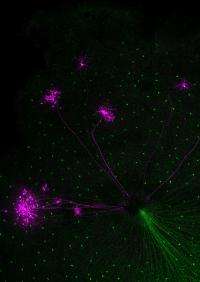
Green ganglion cells connect to surrounding starburst amacrine cells (magenta).
In a competitive scientific race, scientists from the Friedrich Miescher Institute for Biomedical Research (FMI) have been among the first to explain how the eye creates circuits to analyze motion. The detection of motion in the retina is based on circuit asymmetry, a fundamental computational principle in the brain. They showed that early after birth, nerve circuits in the retina go through a rapid transition from symmetric to asymmetric circuit states. This rapid switch is independent of visual inputs and likely to be genetically predetermined. Their results are published today on-line in Nature.
The brain works asymmetrically. Generally known is the fact that the left half of the brain performs different computations than the right half. But it does not end there, asymmetry is also found on a cellular level. Nerve cells in our eyes that react to movements from right to left are not active, when something moves from left to right and vice versa. Movement is only recorded in one direction. What is more, similar asymmetries are the basis for many brain computations. However, how and when this asymmetry develops was not known.
Neurobiologists from the Friedrich Miescher Institute for Biomedical Research of the Novartis Research Foundation have been able to describe for the first time in detail the development of asymmetry in the retina. Their results are published online today in Nature together with independently gained results from a group from the University of California, Berkeley. "Though we knew about the asymmetry in the retina and brain for half a century, it only became possible about 3 years ago - with the advent of new technologies - to gain mechanistic insights into how this is set up during development", commented Botond Roska, group leader at the FMI.
In the retina morphologically identical starburst amacrine neurons sit around a retinal ganglion cell like children in a circle around their teacher in the middle. The FMI scientists could show that at an early stage, all the amacrine cells connect to the ganglion cell and send their signal. The ganglion cell in turn reacts to all these inputs. Or, to extend the metaphor, it is as if all the children are talking simultaneously with the teacher in the middle, who is listening to all of them. But rather suddenly the circuit then switches behavior, and the ganglion cell reacts to only some of the amacrine neurons on one side, neglecting others on the other side. In the mouse, this shift happens between day 6 and day 8 after birth, at a time when the eyes of the mouse are still closed. This switch is selective for inhibitory synaptic signals rather than positive ones, but the molecular details still need to be disentangled
"Our findings indicate that asymmetry is not set up from the beginning, the circuit starts symmetrically and waits for a "switch signal" which initiates a transition to an asymmetric final state. How this process is controlled on a molecular level, we still need to figure out," said Roska.
More information: Yonehara K., et al. (2010) Spatially asymmetric reorganization of inhibition establishes a motion sensitive circuit. Nature http://dx.doi.org/ … /nature09711
Provided by Friedrich Miescher Institute for Biomedical Research
-
From lemons to lemonade: Reaction uses carbon dioxide to make carbon-based semiconductor,
28 comments
-
Thioridazine kills cancer stem cells in human while avoiding toxic side-effects of conventional cancer treatments,
3 comments
-
SpaceX private rocket blasts off for space station (Update),
41 comments
-
Climate scientists say they have solved riddle of rising sea,
30 comments
-
Scotland passes turbine test to harness tidal power,
40 comments
-
A question about drug tolerance
May 23, 2012
-
Poor nutrition leading to overeating?
May 23, 2012
-
Math and dyslexia?
May 21, 2012
-
portable metabolism meter?
May 21, 2012
-
Rare medical conditions on 20/20 tonight
May 18, 2012
-
"Good" Cholesterol in Doubt
May 17, 2012
- More from Physics Forums - Medical Sciences
More news stories
Of mice and mental models: Neuroscientific implications of risk-optimized behavior in the mouse
(Medical Xpress) -- Regardless of an organism’s biological complexity, every encephalized animal continuously makes under-informed behavioral choices that can have serious consequences. Despite its ubiquity, ...
Skp2 activates cancer-promoting, glucose-processing Akt
HER2 and its epidermal growth factor receptor cousins mobilize a specialized protein to activate a major player in cancer development and sugar metabolism, scientists report in the May 25 issue of Cell.
14 hours ago |
not rated yet |
0
|
Tongue analysis software uses ancient Chinese medicine to warn of disease
For 5,000 years, the Chinese have used a system of medicine based on the flow and balance of positive and negative energies in the body. In this system, the appearance of the tongue is one of the measures used to classify ...
12 hours ago |
1 / 5 (1) |
0
|
Cancer may require simpler genetic mutations than previously thought
Chromosomal deletions in DNA often involve just one of two gene copies inherited from either parent. But scientists haven't known how a deletion in one gene from one parent, called a "hemizygous" deletion, can contribute ...
18 hours ago |
not rated yet |
0
|
First study to suggest that the immune system may protect against Alzheimer's changes in humans
Recent work in mice suggested that the immune system is involved in removing beta-amyloid, the main Alzheimer's-causing substance in the brain. Researchers have now shown for the first time that this may apply in humans.
Medicine & Health / Alzheimer's disease & dementia
19 hours ago |
5 / 5 (3) |
0
|
Dragon arrives at space station in historic 1st (Update 2)
The privately bankrolled Dragon capsule made a historic arrival at the International Space Station on Friday, triumphantly captured by astronauts wielding a giant robot arm.
Landmark calculation clears the way to answering how matter is formed
(Phys.org) -- An international collaboration of scientists, including Thomas Blum, associate professor of physics, is reporting in landmark detail the decay process of a subatomic particle called a kaon ...
High-speed method to aid search for solar energy storage catalysts
Eons ago, nature solved the problem of converting solar energy to fuels by inventing the process of photosynthesis.
It's in the genes: Research pinpoints how plants know when to flower
Scientists believe they've pinpointed the last crucial piece of the 80-year-old puzzle of how plants "know" when to flower.
Researchers solve structure of human protein critical for silencing genes
In a study published in the journal Cell on May 24, Cold Spring Harbor Laboratory (CSHL) scientists describe the three-dimensional atomic structure of a human protein bound to a piece of RNA that "guides" the pr ...
MIT researchers devise new means to synchronize a group of robots (w/ Video)
(Phys.org) -- For several years, roboticists have been working out ways to get a group of robots to perform synchronized activities as demonstrated most often in dance routines. Its not just about trying ...