Brain changes in people at genetic risk for Alzheimer's revealed in MRI scans
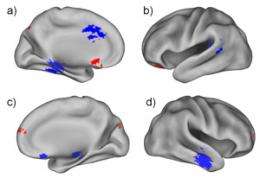
People with a known, high risk for Alzheimer’s disease develop abnormal brain function even before the appearance of telltale amyloid plaques that are characteristic of the disease, according to a new study.
Researchers at Washington University School of Medicine in St. Louis report in the Dec. 15 issue of The Journal of Neuroscience that these patients had a particular form of the apolipoprotein E (APOE) gene called APOE4. The findings suggest that the gene variant affects brain function long before the brain begins accumulating the amyloid that will eventually lead to dementia.
“We looked at a group of structures in the brain that make up what’s called the default mode network,” says lead author Yvette I. Sheline, MD. “In particular, we are interested in a part of the brain called the precuneus, which may be important in Alzheimer’s disease and in pre-Alzheimer’s because it is one of the first regions to develop amyloid deposits. Another factor is that when you look at all of the structural and functional connections in the brain, the most connected structure is the precuneus. It links many other key brain structures together.”
The research team conducted functional MRI scans on 100 people whose average age was 62. Just under half of them carried the APOE4 variant, which is a genetic risk factor for late-onset Alzheimer’s disease. Earlier PET scans of the study subjects had demonstrated that they did not have amyloid deposits in the brain. Amyloid is the protein that makes up the senile plaques that dot the brains of Alzheimer’s patients and interfere with cognitive function.
Participants in the study also underwent spinal puncture tests that revealed they had normal amyloid levels in their cerebrospinal fluid.
“Their brains were ‘clean as a whistle,’” says Sheline, a professor of psychiatry, of radiology and of neurology and director of Washington University’s Center for Depression, Stress and Neuroimaging. “As far as their brain amyloid burden and their cerebrospinal fluid levels, these individuals were completely normal. But the people who had the APOE4 variant had significant differences in the way various brain regions connected with one another.”
Sheline’s team focused on the brain’s default mode network. Typically, the default network is active when the mind rests. Its activity slows down when an individual concentrates.
Subjects don’t need to perform any particular tasks for researchers to study the default mode network. They simply relax in the MRI scanner and reflect or daydream while the machine measures oxygen levels and blood flow in the brain.
“We make sure they don’t go to sleep,” Sheline says. “But other than not sleeping, study participants had no instructions. They were just lying there at rest, and we looked at what their brains were doing.”
This is the latest in a series of studies in which Sheline and her colleagues have looked at brain function in people at risk for Alzheimer’s disease. Initially, her team compared the default mode networks in the brains of people with mild Alzheimer’s disease to the same structures in the brains of those who were cognitively normal. In that study, her team found significant differences in how the network functioned.
Then, using PET imaging to identify cognitively normal people who had amyloid deposits in their brains in a second study, they compared those cognitively normal people whose PET scans indicated that their brains contained amyloid to others whose PET scans showed no evidence of amyloid. Again, the default mode network operated differently in those with amyloid deposits.
In the current study, there was no evidence of dementia or amyloid deposits. But still, in those with the APOE4 variant, there was irregular functioning in the default mode network.
APOE4 is the major genetic risk factor for sporadic cases of Alzheimer’s disease. Other genes that pass on inherited, early-onset forms of the disease have been identified, but APOE4 is the most important genetic marker of the disease identified so far, Sheline says.
The study subjects, all of whom participate in studies through the university’s Charles F. and Joanne Knight Alzheimer’s Disease Research Center, will be followed to see whether they eventually develop amyloid deposits. Sheline anticipates many will.
“I think a significant number of them eventually will be positive for amyloid,” she says. “We hope that if some people begin to accumulate amyloid, we’ll be able to look back at our data and identify particular patterns of brain function that might eventually be used to predict who is developing Alzheimer’s disease.”
The goal is to identify those with the highest risk of Alzheimer’s and to develop treatments that interfere with the progression of the disease, keeping it from advancing to the stage when amyloid begins to build up in the brain and, eventually, dementia sets in.
“The current belief is that from the time excess amyloid begins to collect in the brain, it takes about 10 years for a person to develop dementia,” Sheline says. “But this new study would suggest we might be able to intervene even before amyloid plaques begin to form. That could give us an even longer time window to intervene once an effective treatment can be developed.”
More information: Sheline YI, et al. APOE4 allele disrupts resting state fMRI connectivity in the absence of amyloid plaques or decreased CSF Aß42. The Journal of Neuroscience, vol. 30(50). pp. 17035-17040. Dec. 15, 2010


