Team finds mutation involved in macular degeneration
Nov 26, 2010
Team finds mutation involved in macular degeneration
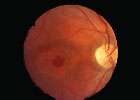
Retinal photograph of right eye, showing mottled changes in the macular region. Credit: Wellcome Images.

Researchers from the Wellcome Trust Centre for Cell-Matrix Research in Manchester have revealed more about how a particular genetic change significantly raises the risk of developing age-related macular degeneration.

This disease, the major cause of blindness in the Western world, is preceded by the build-up of small yellow particles (drusen) in the . This leads to the death of photoreceptor cells and thus loss of central vision. Professor Tony Day, Dr Simon Clark and Professor Paul Bishop found that the Y402H polymorphism of the CFH gene altered the function of complement factor H, a key that helps prevent damage to the body.

This coding change reduces the protein’s ability to bind to the part of the retina where drusen accumulate, suggesting a potential mechanism through which age-related develops. The finding could help us develop new therapeutic strategies for treating or preventing the condition.

Explore further: Study reveals new mechanism for estrogen suppression of liver lipid synthesis

More information: Clark SJ et al. Impaired binding of the AMD-associatecomplement factor H 402H allotype to Bruch’s membrane in human retina. J Biol Chem 2010;285(39):30192-202.

add to favorites email to friend print save as pdf

Related Stories

New cause of blindness discovered by scientists

Sep 21, 2010

University of Manchester scientists have discovered a new cause of age-related macular degeneration (AMD), a condition that affects more than 50 million people worldwide and results in blindness.

Why Popeye only has eyes for spinach

Sep 25, 2006

Eating spinach could protect your eyes from the leading cause of blindness in western society, say experts at The University of Manchester.

Recommended for you

Scientists discover molecule triggers sensation of itch

May 23, 2013

Scientists at the National Institutes of Health report they have discovered in mouse studies that a small molecule released in the spinal cord triggers a process that is later experienced in the brain as ...

Discarded immune cells induce the relocation of stem cells

May 23, 2013

Spanish researchers have discovered that the daily clearance of neutrophils from the body stimulates the release of hematopoietic stem cells from the bone marrow into the bloodstream, according to a report published today ...

User comments : 0

More news stories

Heart failure accelerates male 'menopause'

Heart failure accelerates the aging process and brings on early andropausal syndrome (AS), according to research presented today at the Heart Failure Congress 2013. AS, also referred to as male 'menopause', was four times ...

Feds fight morning-after pill age ruling in NY

(AP)—Department of Justice lawyers have again asked a federal appeals court in New York to delay lifting age restrictions and prescription requirements on an emergency contraceptive popularly known as the morning-after ...