Phantom images stored in flexible network throughout brain
(PhysOrg.com) -- Brain research over the past 30 years has shown that if a part of the brain controlling movement or sensation or language is lost because of a stroke or injury, other parts of the brain can take over the lost function – often as well as the region that was lost.
New research at the University of California, Berkeley, shows that this holds true for memory and attention as well, though – at least for memory – the intact brain helps out only when needed and conducts business as usual when it's not.
These results support the hypothesis that memory is not stored in one place, but rather, is distributed in many regions of the brain, which means that damage to one storage area is easier to compensate for.
"It's not just specific regions, but a whole network, that's supporting memory," said Bradley Voytek, a UC Berkeley postdoctoral fellow in the Helen Wills Neuroscience Institute and first author of two recent journal articles describing EEG (electroencephalogram) studies of people with strokes. Voytek recently completed his Ph.D. in neuroscience at UC Berkeley.
"The view has always been, if you lose point A, point B will be on all the time to take over," said co-author Dr. Robert Knight, UC Berkeley professor of psychology and head of the Wills Institute. "Brad has shown that's not true. It actually only comes on if it's needed.
"Most of the time, it acts like a normal piece of brain tissue. It only kicks into hyperdrive when the bad part of the brain is particularly challenged, and it does it in less than a second. This is a remarkably fluid neural plasticity, but it isn't the standard 'B took over for A,' it's really 'B will take over if and when needed.'"
One of the papers, published Nov. 3 in the online edition of Neuron and scheduled for the Nov. 4 print issue of the journal, describes a study of stroke patients who have lost partial function in their prefrontal cortex, the area at the top front of each hemisphere of the brain that governs memory and attention.
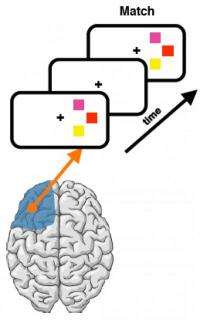
Voytek put electrodes on the scalps of six stroke patients as well as six controls with normal prefrontal cortex function, and showed each patient a series of pictures to test his or her ability to remember images for a brief time, so-called visual working memory. Visual working memory is what allows us to compare two objects, keeping one in memory while we look at another, as when we choose the ripest of two bananas.
"We presented each subject with a really quick flash of a visual stimulus and then showed them a second one a little while later, and they had to say whether it was the same as the first," Voytek explained. "The idea is that you're building a representation of your visual world somehow in your brain – and we don't know how that happens – so that later you can compare this internal phantom representation you're holding in your mind to a real world visual stimulus, something you actually see. These patients can't do that as well."
EEGs provide millisecond measurements of brain activity, though they do not pinpoint active areas as precisely as other techniques, such as functional magnetic resonance imaging (fMRI). On the other hand, fMRI averages brain activity over seconds, making it impossible to distinguish split-second brain processes or even tell which occur first.
The neuroscientists discovered that when images were shown to the eye opposite the lesion (output of the left eye goes to the right hemisphere, and vice versa), the damaged prefrontal cortex did not respond, but the intact prefrontal cortex on the same side as the image responded within 300 to 600 milliseconds.
"EEG, which is very good for looking at the timing of activity in the brain, showed that part of the brain is compensating on a subsecond basis," Voytek said. "It is very rapid compensation: Within a second of challenging the bad side, the intact side of the brain is coming online to pick up the slack."
"This has implications for what physicians measure to see if there's effective recovery after stroke," Knight said, "and suggests that you can take advantage of this to train the area you would like to take over from a damaged area instead of just globally training the brain."
In a second paper that appeared online Oct. 4 in the journal Proceedings of the National Academy of Sciences, Voytek and Knight looked at visual working memory in patients with damage not only to the prefrontal cortex, but also to the basal ganglia. The basal ganglia are a pair of regions directly below the brain's cortex that are involved in motor control and learning and that are impaired in patients with Parkinson's disease.
The patients with stroke damage to the prefrontal cortex had, as suspected, problems when images were presented to the eye on the side opposite the lesion. Those with basal ganglia damage, however, had problems with visual working memory no matter which part of the visual field was shown the image.
"The PNAS paper shows that the basal ganglia lesions cause a more broad network deficit, whereas the prefrontal cortex lesions cause a more within-hemisphere deficit in memory," Voytek said. "This demonstrates, again, that memory is a network phenomenon rather than a specifically regional phenomenon."
"If you take out one basal ganglia, the logic would be that you would be Parkinsonian on half your body. But you're not," Knight said. "One basal ganglia on one side is able to somehow control fluid movement on both sides."
"Brad's data show that for cognitive control, it's just the opposite. One small basal ganglia lesion on one side has global effects on both sides of your body," he added. "This really points out that for this deep subcortical basal ganglia area, you need all of it to function normally. I don't think anybody would have really suspected that."
Knight hopes to conduct follow up studies using direct recordings from electrodes in the brain to further explore the various brain regions involved in visual memory and other types of memory and attention governed by the prefrontal cortex.
"Cognition and memory are the highest forms of human behavior," Knight said. "It is not just about raising or lowering your hand, or whether you can or cannot see. These are the things that make us human, and that is what makes it so interesting for us."


