Partial reversal of aging achieved in mice
November 29, 2010 By Richard Saltus
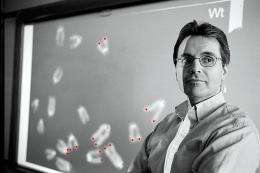
Researchers led by Ronald A. DePinho (above), a Harvard Medical School professor of genetics, say their work shows for the first time a dramatic reversal of many aspects of age-related degeneration in mice, a milestone in aging science achieved by engineering mice with a controllable telomerase gene. The projection of chromosomes seen here shows telomeres (highlighted in red) on their ends. Photo by Kris Snibbe.
(PhysOrg.com) -- Harvard scientists at Dana-Farber Cancer Institute say they have for the first time partially reversed age-related degeneration in mice, resulting in new growth of the brain and testes, improved fertility, and the return of a lost cognitive function.
In a report posted online by the journal Nature in advance of print publication, researchers led by Ronald A. DePinho, a Harvard Medical School (HMS) professor of genetics, said they achieved the milestone in aging science by engineering mice with a controllable telomerase gene. The telomerase enzyme maintains the protective caps called telomeres that shield the ends of chromosomes.
As humans age, low levels of telomerase are associated with progressive erosion of telomeres, which may then contribute to tissue degeneration and functional decline in the elderly. By creating mice with a telomerase switch, the researchers were able to generate prematurely aged mice. The switch allowed the scientists to find out whether reactivating telomerase in the animals would restore telomeres and mitigate the signs and symptoms of aging. The work showed a dramatic reversal of many aspects of aging, including reversal of brain disease and infertility.
While human applications remain in the future, the strategy might one day be used to treat conditions such as rare genetic premature aging syndromes in which shortened telomeres play an important role, said DePinho, senior author of the report and the director of Dana-Farbers Belfer Institute for Applied Cancer Science. Whether this would impact on normal aging is a more difficult question, he added. But it is notable that telomere loss is associated with age-associated disorders and thus restoration of telomeres could alleviate such decline. The first author is Mariela Jaskelioff, a research fellow in medicine in DePinhos laboratory.
Importantly, the animals showed no signs of developing cancer. This remains a concern because cancer cells turn on telomerase to make themselves virtually immortal. DePinho said the risk can be minimized by switching on telomerase only for a matter of days or weeks which may be brief enough to avoid fueling hidden cancers or cause new ones to develop. Still, he observed, it is an important issue for further study.
In addition, DePinho said these results may provide new avenues for regenerative medicine, because they suggest that quiescent adult stem cells in severely aged tissues remain viable and can be reactivated to repair tissue damage.
If you can remove the underlying damage and stresses that drive the aging process and cause stem cells to go into growth arrest, you may be able to recruit them back into a regenerative response to rejuvenate tissues and maintain health in the aged, he said. Those stresses include the shortening of telomeres over time that causes cells and tissues to fail.
Loss of telomeres sends a cascade of signals that cause cells to stop dividing or self-destruct, stem cells to go into retirement, organs to atrophy, and brain cells to die. Generally, the shortening of telomeres in normal tissues shows a steady decline, except in the case of cancer, where they are maintained.
The experiments used mice that had been engineered to develop severe DNA and tissue damage as a result of abnormal, premature aging. These animals had short, dysfunctional telomeres and suffered a variety of age-related afflictions that progressed in successive generations of mice. Among the conditions were testes reduced in size and depleted of sperm, atrophied spleens, damage to the intestines, and shrinkage of the brain along with an inability to grow new brain cells.
We wanted to know: If you could flip the telomerase switch on and restore telomeres in animals with entrenched age-related disease, what would happen? explained DePinho. Would it slow down aging, stabilize it, or even reverse it?
Rather than supply the rodents with supplemental telomerase, the scientists devised a way to switch on the animals own dormant telomerase gene, known as TERT. They engineered the endogenous TERT gene to encode a fusion protein of TERT and the estrogen receptor. This fusion protein would only become activated with a special form of estrogen. With this setup, scientists could give the mice an estrogen-like drug at any time to stimulate the TERT-estrogen receptor fusion protein and make it active to maintain telomeres.
Against this backdrop, the researchers administered the estrogen drug to some of the mice via a time-release pellet inserted under the skin. Other animals, the controls, were given a pellet containing no active drug.
After four weeks, the scientists observed remarkable signs of rejuvenation in the treated mice. Overall, the mice exhibited increased levels of telomerase and lengthened telomeres, biological changes indicative of cells returning to a growth state with reversal of tissue degeneration, and increase in size of the spleen, testes, and brain. It was akin to a Ponce de León effect, noted DePinho, referring to the Spanish explorer who sought the mythical Fountain of Youth.
When we flipped the telomerase switch on and looked a month later, the brains had largely returned to normal, said DePinho. More newborn nerve cells were observed, and the fatty myelin sheaths around nerve cells which had become thinned in the aged animals increased in diameter. In addition, the increase in telomerase revitalized slumbering brain stem cells so they could produce new neurons.
To show that all this new activity actually caused functional improvements, the scientists tested the mices ability to avoid a certain area where they detected unpleasant odors that they associated with danger, such as scents of predators or rotten food. They had lost that survival skill as their olfactory nerve cells atrophied, but after the telomerase boost, those nerves regenerated and the mice regained their crucial sense of smell.
One of the most amazing changes was in the animals testes, which were essentially barren as aging caused the death and elimination of sperm cells, recounted DePinho. When we restored telomerase, the testes produced new sperm cells, and the animals fecundity was improved their mates gave birth to larger litters.
The telomerase boost also lengthened the rodents life spans compared to their untreated counterparts but they did not live longer than normal mice, said the researchers.
The authors concluded, This unprecedented reversal of age-related decline in the central nervous system and other organs vital to adult mammalian health justifies exploration of telomere rejuvenation strategies for age-associated diseases.
Provided by
Harvard University
-
From lemons to lemonade: Reaction uses carbon dioxide to make carbon-based semiconductor,
28 comments
-
Every black hole contains a new universe: A physicist presents a solution to present-day cosmic mysteries,
216 comments
-
New silicon memory chip developed,
16 comments
-
Thioridazine kills cancer stem cells in human while avoiding toxic side-effects of conventional cancer treatments,
3 comments
-
SpaceX private rocket blasts off for space station (Update),
41 comments
-
A question about drug tolerance
May 23, 2012
-
Poor nutrition leading to overeating?
May 23, 2012
-
Math and dyslexia?
May 21, 2012
-
portable metabolism meter?
May 21, 2012
-
Rare medical conditions on 20/20 tonight
May 18, 2012
-
"Good" Cholesterol in Doubt
May 17, 2012
- More from Physics Forums - Medical Sciences
More news stories
Tongue analysis software uses ancient Chinese medicine to warn of disease
For 5,000 years, the Chinese have used a system of medicine based on the flow and balance of positive and negative energies in the body. In this system, the appearance of the tongue is one of the measures used to classify ...
2 hours ago |
not rated yet |
0
|
Of mice and mental models: Neuroscientific implications of risk-optimized behavior in the mouse
(Medical Xpress) -- Regardless of an organism’s biological complexity, every encephalized animal continuously makes under-informed behavioral choices that can have serious consequences. Despite its ubiquity, ...
Skp2 activates cancer-promoting, glucose-processing Akt
HER2 and its epidermal growth factor receptor cousins mobilize a specialized protein to activate a major player in cancer development and sugar metabolism, scientists report in the May 25 issue of Cell.
4 hours ago |
not rated yet |
0
|
Most occupational injury and illness costs are paid by the government and private payers
UC Davis researchers have found that workers' compensation insurance is not used nearly as much as it should be to cover the nation's multi-billion dollar price tag for workplace illnesses and injuries. Instead, almost 80 ...
2 hours ago |
not rated yet |
0
Flesh-Eating bacteria no cause for panic, experts say
(HealthDay) -- Despite scary headlines by the score, most people don't have to fear that they'll be the next victim of the so-called flesh-eating bacteria disease, experts say.
Medicine & Health / Diseases, Conditions, Syndromes
5 hours ago |
not rated yet |
0
It's in the genes: Research pinpoints how plants know when to flower
Scientists believe they've pinpointed the last crucial piece of the 80-year-old puzzle of how plants "know" when to flower.
High-speed method to aid search for solar energy storage catalysts
Eons ago, nature solved the problem of converting solar energy to fuels by inventing the process of photosynthesis.
Researchers solve structure of human protein critical for silencing genes
In a study published in the journal Cell on May 24, Cold Spring Harbor Laboratory (CSHL) scientists describe the three-dimensional atomic structure of a human protein bound to a piece of RNA that "guides" the pr ...
Dragon makes history with space station docking
The private company SpaceX made history Friday with the docking of its Dragon capsule to the International Space Station, the most impressive feat yet in turning routine spaceflight over to the commercial ...
Yahoo kills 'Livestand' just 6 months after debut
(AP) -- Yahoo is killing a tablet magazine called Livestand just six months its debut on the iPad.
Math predicts size of clot-forming cells
UC Davis mathematicians have helped biologists figure out why platelets, the cells that form blood clots, are the size and shape that they are. Because platelets are important both for healing wounds and in strokes and other ...
Nov 29, 2010
Rank: 2.3 / 5 (26)
Hopefully we solve energy, environment, and food production before we abate, remove, or reverse aging.
Nov 29, 2010
Rank: 4.8 / 5 (21)
The drawbacks are enourmous -- humans that live to be 180 on an planet we don;t live in harmony with already. THe issue is pollution... not food, not even water -- we only use 20% of habitable land -- the issue is we abuse the heck out of that 20% and if we used 60% we might destroy the world way too quickly at our current rate.
Nov 29, 2010
Rank: 3.7 / 5 (9)
Nov 29, 2010
Rank: 2.5 / 5 (19)
Hopefully we solve energy, environment, and food production before we abate, remove, or reverse aging."
Then kill yourself to make more resources available to others.
Nov 29, 2010
Rank: 3.6 / 5 (14)
Nov 29, 2010
Rank: 4.2 / 5 (13)
Do you realise how much time money and effort is invested in each new generation? To go from an infant to a productive member of society costs society an arm and a leg.
To top it off, this investment is a depreciating one thanks to age related effects. Much more econimical to stop aging. Then nearly 99% of the population will be the working class, rather than a majority being depenant on it.
Also you may be supprised to find that when people aren't gaurenteed to die, they tend to care more about their environment.
Nov 29, 2010
Rank: 1.6 / 5 (29)
"No man is an island,
Entire of itself.
Each is a piece of the continent,
A part of the main.
If a clod be washed away by the sea,
Europe is the less.
As well as if a promontory were.
As well as if a manner of thine own
Or of thine friend's were.
Each man's death diminishes me,
For I am involved in mankind.
Therefore, send not to know
For whom the bell tolls,
It tolls for thee."
-We're toast.
Nov 29, 2010
Rank: 4.4 / 5 (7)
Not so, china for one will certainly offer this to their work force, the majorit of which are above retirement age.
Think about it, the first country who implements it will have a HUGE econimical advantage.
Nov 29, 2010
Rank: 1.7 / 5 (27)
A pulling back, a turning down, a great and permanent reduction in Thruput, as it is no longer necessary to generate innovation and spread civilization. And it's danger to the planet has become critical.
Nov 29, 2010
Rank: 4.5 / 5 (2)
Nov 29, 2010
Rank: 3 / 5 (1)
Nov 29, 2010
Rank: 4.7 / 5 (3)
Nov 29, 2010
Rank: 3.3 / 5 (3)
Please excuse my optimism - don't know whats come over me!
Nov 29, 2010
Rank: 3 / 5 (1)
If we give humans the ablility to live lets say 40 - 50 more years ... Then the demise of money has to happen. You will have millionaires that will be presented with the oppertunity to become a billionaire/trillionaire in their own lifetime.
Companies would become much more powerful, able to keep the leadership in place for 2 generations or more
And if we are able to sufficiently slow down aging then whats to say that the mind can stay nimble that long even if the body is willing.
Nov 29, 2010
Rank: 1.6 / 5 (26)
Nov 29, 2010
Rank: not rated yet
retirement is now defined contribution -- we have done away with defined benefit plans.
The difference if you ar eunaware is that DC means you puts a set amount away for retirement -- we used to have DB which meant that you hit a certain number of years with a company and you were guranteed a % of your salary with health benefits
needless to say DB plans are unsustainable - and we are waiting for the people on them to die off -- while DC plans are not dependant on anything but someone working for themselves and putting money away.
Nov 29, 2010
Rank: 1 / 5 (3)
@lariann
I always figured that the characters on Star Trek had a big issue -- they should have been really long lived.
if space travel was viable then why not have anyone that wished to extend there lifespan sent into space - to do whatever - especially men. Why men - well they can contribute to procreation as long as they live... women have a definite timespan with which to procreate.
Having men that are 4 generations behind adding the genetic code - doesn't sit well with me. WOuldn;t this stagnate evolution in our species - making us less able to adapt to a changing environment?
So keep a pure stock of humans on Earth ... and if you don;t want to die you have to help out humanity in space.
Nov 29, 2010
Rank: 5 / 5 (7)
Evolution has changed. Tinkering with telomerase is just one aspect of the control we have over our own genetics. WE decide where evolution is going now - not random events or enviromental change. Of course there is still much to learn, but thats where we are going. It will be an accelerating process as well. I expect an explosion of new species all steming from humanity.
Nov 29, 2010
Rank: 2.3 / 5 (37)
http://www.timeso...4696.ece
http://www.medica...4484.php
-Youre also assuming that human evolution over the last 50k yrs or so was somehow 'natural', and not some form of domestication?
-That being the process of adapting to the unnatural foods and environments we were creating; as well as living in the context of millions of years of chronic tribal warfare?
http://www.theatl...l/58643/
http://www.hhmi.o...hn3.html
http://en.wikiped..._warfare
And finally, the possibility of directed Efforts of culling the most contentious and headstrong?
Nov 29, 2010
Rank: 5 / 5 (3)
The only thing that needs to be solved is the population growth rate, which is a problem whether we figure out immortality or not.
Develop contraceptives for men, improve women's contraceptives, and give them all away for free.
Nov 29, 2010
Rank: 1 / 5 (1)
Nov 29, 2010
Rank: 2.7 / 5 (3)
And how exactly do you propose that we make that happen?
I am confident that we will conquer death. We will develop the ability to customize babies for health, intelligence, and strength. But only the ultra-rich will be able to afford it. A caste of rich immortals, driven purely by greed and Libertarian/Randian politics, with their own unquestioningly loyal personal robot armies, vs a caste of poor mortals, exploited as slaves until they die off from diseases the rich are immune to. Sounds like a great future.
Nov 29, 2010
Rank: 5 / 5 (5)
You people missed this. More productive, but not longer lives would be a boon to society. Think about how much of health care is expended on maintaining people with degenerative diseases.
Nov 29, 2010
Rank: 4.8 / 5 (4)
Why must this tech automatically be assumed expensive? It seems to me that genetic therapies should actually be quite cheap. Your cells would do most of the work after all.
Nov 29, 2010
Rank: 4.7 / 5 (3)
Nov 29, 2010
Rank: not rated yet
This is an excellent point. Many people justify things they do, based upon the fact they are going to die. .....Or the fact they think the world is going to end anyways.
Nov 29, 2010
Rank: 1.9 / 5 (13)
Nov 29, 2010
Rank: 5 / 5 (3)
Necessity is the mother of invention. We won't fix energy and food and etc. until we absolutely have to. It seems to be a trait of our species. We are a species of procrastinators. This is good. Like they said, the human trials are far off. Perhaps the prospect of extending life spans will prompt others in our society to plan for tomorrow. When people may live for 200 years, they may take actions now to ensure their happiness in the far off future.
Nov 29, 2010
Rank: 3.8 / 5 (4)
Kurtzweill addressed this point. He stated that the price for increasing your life just a couple of years will be extraordinary at first. But then it will get cheaper as it gets more effective. The average person won't be too bummed at losing out on 2 years for a small fortune. As it becomes desirable, it will become affordable.
Nov 29, 2010
Rank: 3.7 / 5 (6)
Now there's a great development, finally. After 5 decades of the wussification and pussification of the Western male by militant feminism, the ability to grow some bigger cojones is way past due.
Nov 29, 2010
Rank: 3.7 / 5 (3)
So at best this might allow you to remain healthy into old age, but it will not make you live to be 180. For that, they might need to combine the effects of calorie restriction (by working out the mechanism of action, rather than starving oneself).
Nov 29, 2010
Rank: 4 / 5 (2)
Huh. What is to STOP the researchers from re introducing the wonder drug(s) to renew them? Perhaps by renewing treatments every so often, they become immortal. The going theory is, as long as the telomerase based enzymes do not run out, there is no death of that cell. Just LOOK at cancer cells for your proof! After human trails, this could be the 1st leg of life extension to 100 and beyond.
Nov 30, 2010
Rank: 4.8 / 5 (5)
Nov 30, 2010
Rank: 4 / 5 (1)
I agree, that didn't make any sense-if they were able to reverse aging in the genetically aged mice, they should be able to keep stimulating them with their telomerase drug and extend their lifespan indefinitely. I was a bit disappointed when they said they only lived as long as normal mice.
Even if that's all they can achieve-at the very least we'll be quite healthy right up until we die at the normal age. However I believe this advance should extend our lifespan significantly.
I just wish they would quickly move on to humans. I'm sure there would be plenty of geriatrics who'd be willing guinea pigs for this treatment-they know they'll be dead soon anyways, they have nothing to lose and perhaps a chance to be young again.
But I liked this article because this is the first real glimpse we've had into the possibility of 'curing' aging. Even if I couldn't live forever or 1000 years, an extra 50 would be really nice. I think in another 20 years they might be able to do it.
Nov 30, 2010
Rank: 3 / 5 (1)
Fantastic.
Of course, there will also be terrible consequences too, but it seems like a nice development over, say, weapons research.
Nov 30, 2010
Rank: 3 / 5 (1)
I disagree. We already refuse to face our overpopulation problem and slowing it down is only making it worse, we would be much better off if it threatened to explode overnight.
This experiment does nothing for the longevity of the living, it would require germline modifications which would only help newborns. Don't expect everyone to rush out and make their kids immortal.
I view immortality as being our savior. It would create an immense leisure class that would consume but not produce, a boon for workers creating their own wealth to eventually join the leisure class.
Physical immortality is no guarantee of immortality. Statistically, we would all eventually have a fatal accident. Immortality would lead to boredom for many and they would take more chances. Suicide rates would go up as people got older.
I personally can't wait for an immortality serum, expected it before now.
Dec 01, 2010
Rank: not rated yet
I imagine it would change the entire world. Change our way of life forever. There won't be separate classes, all will live forever. Machines will do the work, we will learn, explore, and create to our hearts content.
It could be. Imagine having a body made of nanites that simply reassemble. You could have backups of your conscious made at regular intervals. Any untimely demise simply restores the last version of you.
I disagree. You are thinking to short term, and limiting yourself to this solar system. If we live forever intergalactic travel is the next frontier.
We may have missed the Big Bang...but I for one would like to see the closing act.
Dec 01, 2010
Rank: not rated yet
Dec 01, 2010
Rank: not rated yet
Dec 01, 2010
Rank: 5 / 5 (1)
Dec 02, 2010
Rank: 4 / 5 (4)
Almost as boring as not spelling out words like 'you' and 'you're'
Dec 05, 2010
Rank: 1 / 5 (1)
life will become ever more precious. killing will become the method of population control and suicide will be the answer for many.
new ideas will be less frequent and established power structures for long term control will profit.
evolution of the body will lessen and certain minds will achieve extraordinary wisdom and experience.
Dec 06, 2010
Rank: not rated yet
Dec 06, 2010
Rank: not rated yet
There may have to be laws to help force people to work for their retirement but it would be worth it in the long run. I would feel a lot better about working 50 years if I knew I would enjoy a 100 year retirement.
Dec 06, 2010
Rank: not rated yet
If you are as robust at 60 as you are at 30, heart surgery, hip replacements, other surgical procedures, and a great many medications are on the table that would otherwise kill you.
Dec 06, 2010
Rank: 1 / 5 (1)
YOU guys missed something else.
They only turned on the telemorase for four weeks. Then it went back to OFF. They did not try to test whether the mice could live longer than normal mice. Pretty much all they did was take mice with pre-mature aging and turn off the pre-mature part. Even though they could have could have taken it farther they did not.
Not yet anyway.
I suspect the people claiming this is bad are young. To me its damn well time someone tested this. If I had been in that field I would have wanted to test it many years ago. I suppose the techniques needed are only now becoming available.
If nothing else this sort of thing could fix the problems with Social Security and vastly decrease the the total cost of the medical system. Most of the money on medicine goes to people at the end of life.
Ethelred
Dec 06, 2010
Rank: not rated yet
Ethelred
Dec 06, 2010
Rank: not rated yet