Mysteries of colour vision revealed as scientists map out eye's neural network
(PhysOrg.com) -- Scientists, using sophisticated recording equipment, have mapped the neural circuitry involved in processing colour vision in humans for the first time.
The breakthrough by researchers at the Salk Institute for Biological Studies in California, and the University of California reveals how the different cone photoreceptor cells within the retina communicate with the output cells to build up a colour picture.
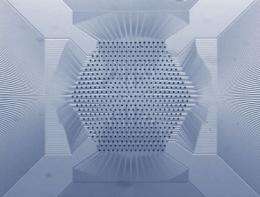
Dr Keith Mathieson, a research fellow within the in the School of Physics & Astronomy at the University of Glasgow but currently based at Stanford University and the University of California Santa Cruz, played a key role in the research through leading the development of the 519-electrode array used to measure activity in the cells analysed in this study.
He said: “To develop new therapies for vision-related problems it is necessary to fully understand how the retina works. This research gives us a much greater insight into the circuitry of the retina and is an important development for neuroscience.”
Vision is possible thanks in part to the retina, which is a layered structure of neural tissue with input cells (photoreceptors), processing cells and output (ganglion) cells.
The photoreceptors are made up of two types: rods and cones, which see in black and white and colour respectively. Colour perception arises from the comparison of signals received by different cone cells, which differentiate between wavelengths (colours) of light. How these signals are combined by the retina and transmitted by the ganglion cells to the brain has been the subject of debate for years.
Now the puzzle has been solved as researchers reveal for the first time the pattern of connectivity between the cone receptor cells and the ganglion cells.
The electrode array, which made this study possible, was developed over five years at the James Watt Nanofabrication Centre in conjunction with the University of California at Santa Cruz and AGH Krakow.
The system records neural signals at high speed (over ten million samples each second) and with fine spatial detail, sufficient to detect even a locally complete population of the tiny and densely spaced output cells known as ‘midget’ retinal ganglion cells.
Dr Mathieson added: “The electrode array we developed enabled us to measure the retinal output signals of hundreds of cells simultaneously and create a map of the input-output relationship at an unprecedented resolution and scale.”
Dr Deborah Gunning, who helped develop this technology over the course of her PhD studies at Glasgow, said “This is an exciting example of interdisciplinary science with experts in neuroscience, nanoengineering, physics and electronics combining to perform cutting-edge science.”
As a consequence of the technology's success, Dr Gunning has gone on to win a prestigious RAEng/EPSRC fellowship, where she plans to diversify and study the fundamental behaviour of networks of neurons in more complex structures in the brain.
The research paper, 'Functional connectivity in the retina at the resolution of photoreceptors' is published in the latest edition of the journal Nature.


