Researchers link cerebral malaria to epilepsy, behavior disorders
November 16, 2010

Researchers link cerebral malaria to epilepsy, behavior disorders

Enlarge

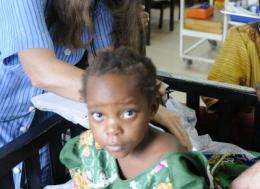
A young child is examined at Queen Elizabeth Central Hospital in Blantyre, Malawi, in Africa. Credit: MSU University Relations

Almost a third of cerebral malaria survivors developed epilepsy or other behavioral disorders in the most comprehensive study to date of the disease in African children, solidifying the link between malaria and neuropsychiatric disorders that affect hundreds of thousands of children.

The research – led by Gretchen Birbeck, an associate professor of neurology and ophthalmology in Michigan State University's College of Osteopathic Medicine – appears in the current edition of The Lancet Neurology.

Cerebral malaria is a severe form of malaria affecting the brain, occurring predominantly in children, with a mortality rate of 15-25 percent. It affects about one million children every year, primarily in sub-Saharan Africa.

"Our findings show that children with cerebral malaria are at risk of developing several adverse neurological outcomes including , disruptive behavior disorders and disabilities characterized by motor, sensory or language deficits," said Birbeck, also director for the International Neurologic & Psychiatric Epidemiology Program. "Specifically, the modifiable risk factors for these disorders in children with cerebral malaria are acute seizures and extreme fevers."

Since most of the neurologic effects did not present themselves immediately, they were not evident at the time of the child's discharge from the hospital after the initial malaria illness.

"But if the findings of our study are generalized, then about 135,000 African children younger than 5 years develop epilepsy due to cerebral malaria-induced brain injury each year, and cerebral malaria may be one of the more common causes of epilepsy in malaria-endemic regions," she said.

The study looked at several hundred children during a nearly five-year period in Blantyre, Malawi; it was the first-ever prospective study of cerebral malaria survivors that included a control group. The study was funded by the National Institutes of Health and the Wellcome Trust.

The impact of the findings on African society is immeasurable, Birbeck said.

"The long-term loss of human potential from these disorders is mind-boggling," she said. "Yes, these children are surviving the malaria, but their quality of life and what they contribute to society is severely hampered. There is a huge burden of post-malaria neurological disorders."

But Birbeck said there are steps that can be taken.

"We need to be more aggressive in treating the two major risk factors: seizures and high fever," she said, adding that the next step will be to start clinical trials to identify treatments aimed at better seizure and fever control.

Previous studies of neurological consequences related to cerebral malaria have been limited by poor retention rates, lack of follow-up and assessments that were stopped when the results of neurological examinations were normal.

Also, cerebral malaria is challenging to diagnose definitively. However, researchers from MSU and the University of Liverpool in England previously had discovered that diagnosing malaria retinopathy – a set of abnormalities in the eye's retina – greatly enhances the ability to diagnose cerebral malaria. Thus, as part the study published in The Lancet Neurology, Birbeck and her team only looked at with retinopathy-positive cerebral malaria.

Terrie Taylor, an MSU University Distinguished Professor and co-author on the paper, spends six months each year battling malaria at the Queen Elizabeth Central Hospital in Blantyre, Malawi.

"The challenge now is to devise better treatments during the episode in hopes of minimizing the risk of epilepsy in years to come," she said.

Birbeck said MSU's continued and dedicated presence in Africa is what allows such research to be done.

"The long-term relationships that have been established with ministries of health, medical schools and investigators allow us to bring our expertise to the table," she said.

Provided by Michigan State University search and more info website


Rank 5 /5 (2 votes)
Relevant PhysicsForums posts
  • A question about drug tolerance
    createdMay 23, 2012
  • Poor nutrition leading to overeating?
    createdMay 23, 2012
  • Math and dyslexia?
    createdMay 21, 2012
  • portable metabolism meter?
    createdMay 21, 2012
  • Rare medical conditions on 20/20 tonight
    createdMay 18, 2012
  • "Good" Cholesterol in Doubt
    createdMay 17, 2012
  • More from Physics Forums - Medical Sciences

More news stories

Of mice and mental models: Neuroscientific implications of risk-optimized behavior in the mouse

(Medical Xpress) -- Regardless of an organism’s biological complexity, every encephalized animal continuously makes under-informed behavioral choices that can have serious consequences. Despite its ubiquity, ...

Medicine & Health / Neuroscience

created 13 hours ago | popularity not rated yet | comments 0 | with audio podcast feature

Skp2 activates cancer-promoting, glucose-processing Akt

HER2 and its epidermal growth factor receptor cousins mobilize a specialized protein to activate a major player in cancer development and sugar metabolism, scientists report in the May 25 issue of Cell.

Medicine & Health / Cancer

created 7 hours ago | popularity not rated yet | comments 0 | with audio podcast

Tongue analysis software uses ancient Chinese medicine to warn of disease

For 5,000 years, the Chinese have used a system of medicine based on the flow and balance of positive and negative energies in the body. In this system, the appearance of the tongue is one of the measures used to classify ...

Medicine & Health / Other

created 4 hours ago | popularity not rated yet | comments 0 | with audio podcast

Cancer may require simpler genetic mutations than previously thought

Chromosomal deletions in DNA often involve just one of two gene copies inherited from either parent. But scientists haven't known how a deletion in one gene from one parent, called a "hemizygous" deletion, can contribute ...

Medicine & Health / Cancer

created 10 hours ago | popularity not rated yet | comments 0 | with audio podcast

Flesh-Eating bacteria no cause for panic, experts say

(HealthDay) -- Despite scary headlines by the score, most people don't have to fear that they'll be the next victim of the so-called flesh-eating bacteria disease, experts say.

Medicine & Health / Diseases, Conditions, Syndromes

created 7 hours ago | popularity not rated yet | comments 0


It's in the genes: Research pinpoints how plants know when to flower

Scientists believe they've pinpointed the last crucial piece of the 80-year-old puzzle of how plants "know" when to flower.

High-speed method to aid search for solar energy storage catalysts

Eons ago, nature solved the problem of converting solar energy to fuels by inventing the process of photosynthesis.

Researchers solve structure of human protein critical for silencing genes

In a study published in the journal Cell on May 24, Cold Spring Harbor Laboratory (CSHL) scientists describe the three-dimensional atomic structure of a human protein bound to a piece of RNA that "guides" the pr ...

Dragon arrives at space station in historic 1st (Update 2)

The privately bankrolled Dragon capsule made a historic arrival at the International Space Station on Friday, triumphantly captured by astronauts wielding a giant robot arm.

Landmark calculation clears the way to answering how matter is formed

(Phys.org) -- An international collaboration of scientists, including Thomas Blum, associate professor of physics, is reporting in landmark detail the decay process of a subatomic particle called a kaon – ...

MIT researchers devise new means to synchronize a group of robots (w/ Video)

(Phys.org) -- For several years, roboticists have been working out ways to get a group of robots to perform synchronized activities as demonstrated most often in dance routines. It’s not just about trying ...