Predicting fracture risk with new imaging technology
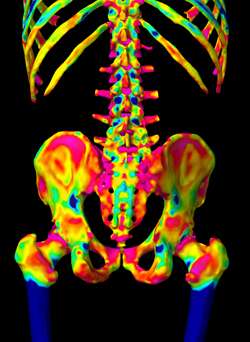
Skeleton thickness
A new method for identifying which bones have a high risk of fracture, and for monitoring the effectiveness of new bone-strengthening drugs and techniques, has been developed by scientists at the University of Cambridge.
The method, developed by Dr. Graham Treece and Dr. Andrew Gee of the Department of Engineering and Dr Ken Poole of the Department of Medicine, uses CT imaging to accurately measure the thickness of the cortical bone - the hard outer layer of compact bone which surrounds the spongy trabecular bone. The thickness of cortical bone is a key indicator of the risk of fracture.
This work is expected to lead to advances in the treatment and management of osteoporosis, a condition that affects one in two women and one in five men over the age of 50 in the UK.
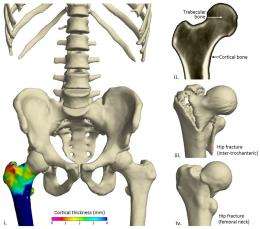
Osteoporosis results in a decline in bone strength and thinning of the cortical bone, so that often the remaining bone is no thicker than an eggshell by the time an individual is in their 80s. At certain key points, this thinning can lead to bones that are so weak that a stumble, trip or fall can lead to a fracture.
Currently, the key technology used to assess a patient's risk of fracture is a bone mineral density test, which uses dual-energy x-ray absorptiometry (DXA) to estimate mineral levels contained in bone. An alternative is multi-detector computed tomography (MDCT), which provides more comprehensive 3D imaging of bone structure, but not at a sufficient enough resolution to provide accurate sub-millimetre measurement.
The method developed by Drs Treece and Poole increases the accuracy of cortical bone measurements to the extent that clinicians can map changes in thickness over time, and produces accurate measurements of thicknesses as low as 0.3 mm.
Utilising data from a CT scan and a mathematical model of the scanning process, thousands of cortical bone measurements are obtained. This produces 3D thickness maps, which allows the identification of dangerously thin areas, Successive imaging allows maps to be produced depicting changes in the cortical bone over time in all areas of the skeleton so that the progress of osteoporosis treatments can be monitored.
"Osteoporosis is a condition which will become more and more common as the population ages," said Dr. Andrew Walsh of Cambridge Enterprise, the University's commercialisation group. "This exciting technology has the potential to improve the treatment of patients suffering from osteoporosis as well as to support the development of new drugs."
Dr. Poole presented this work at the Annual Meeting of the American Society for Bone and Mineral Research, held recently in Toronto. It will be further demonstrated at the annual meeting of the Radiological Society of North America, to be held in Chicago this November.
Provided by
University of Cambridge
-
From lemons to lemonade: Reaction uses carbon dioxide to make carbon-based semiconductor,
28 comments
-
Every black hole contains a new universe: A physicist presents a solution to present-day cosmic mysteries,
215 comments
-
New silicon memory chip developed,
16 comments
-
Thioridazine kills cancer stem cells in human while avoiding toxic side-effects of conventional cancer treatments,
3 comments
-
SpaceX private rocket blasts off for space station (Update),
41 comments
-
A question about drug tolerance
May 23, 2012
-
Poor nutrition leading to overeating?
May 23, 2012
-
Math and dyslexia?
May 21, 2012
-
portable metabolism meter?
May 21, 2012
-
Rare medical conditions on 20/20 tonight
May 18, 2012
-
"Good" Cholesterol in Doubt
May 17, 2012
- More from Physics Forums - Medical Sciences
More news stories
Skp2 activates cancer-promoting, glucose-processing Akt
HER2 and its epidermal growth factor receptor cousins mobilize a specialized protein to activate a major player in cancer development and sugar metabolism, scientists report in the May 25 issue of Cell.
3 minutes ago |
not rated yet |
0
|
Early physical therapist treatment associated with reduced risk of healthcare utilization and reduced overall healthcare
A new study published in Spine shows that early treatment by a physical therapist for low back pain (LBP), as compared to delayed treatment, was associated with reduced risk of subsequent healthcare utilization and lower ...
1 minute ago |
not rated yet |
0
|
Pancreatectomy OK without downstaging from therapy
(HealthDay) -- Pancreatectomy improves median survival in pancreatic cancer patients even when presurgical neoadjuvant therapy does not lead to radiographic downstaging of tumors, according to a study published ...
1 hour ago |
not rated yet |
0
Flesh-Eating bacteria no cause for panic, experts say
(HealthDay) -- Despite scary headlines by the score, most people don't have to fear that they'll be the next victim of the so-called flesh-eating bacteria disease, experts say.
Medicine & Health / Diseases, Conditions, Syndromes
30 minutes ago |
not rated yet |
0
Of mice and mental models: Neuroscientific implications of risk-optimized behavior in the mouse
(Medical Xpress) -- Regardless of an organism’s biological complexity, every encephalized animal continuously makes under-informed behavioral choices that can have serious consequences. Despite its ubiquity, ...
Math predicts size of clot-forming cells
UC Davis mathematicians have helped biologists figure out why platelets, the cells that form blood clots, are the size and shape that they are. Because platelets are important both for healing wounds and in strokes and other ...
Dragon arrives at space station in historic 1st (Update 2)
The privately bankrolled Dragon capsule arrived at the International Space Station for a historic docking Friday, captured by astronauts wielding a giant robot arm.
MIT researchers devise new means to synchronize a group of robots (w/ Video)
(Phys.org) -- For several years, roboticists have been working out ways to get a group of robots to perform synchronized activities as demonstrated most often in dance routines. Its not just about trying ...
Landmark calculation clears the way to answering how matter is formed
(Phys.org) -- An international collaboration of scientists, including Thomas Blum, associate professor of physics, is reporting in landmark detail the decay process of a subatomic particle called a kaon ...
Researchers demonstrate possible primitive mechanism of chemical info self-replication
(Phys.org) -- When scientists think about the replication of information in chemistry, they usually have in mind something akin to what happens in living organisms when DNA gets copied: a double-stranded molecule ...
Copy of the genetic makeup travels in a protein suitcase
Scientists from the Institute for Physical and Theoretical Chemistry at the University of Bonn have succeeded for the first time in the real time filming of the transport of an important information carrier in biological ...
