Fast food restaurants dish up unhealthy marketing to youth: report
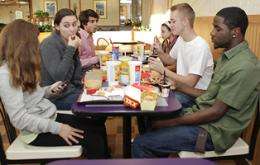
(PhysOrg.com) -- Children as young as age 2 are seeing more fast food ads than ever before, and restaurants rarely offer parents the healthy kids’ meal choices, according to a new study from Yale’s Rudd Center for Food Policy & Obesity.
The new evaluation, the most comprehensive study of fast food nutrition and marketing ever conducted, shows that fast food marketers target children across a variety of media and in restaurants. In addition, the study finds that restaurants provide largely unhealthy defaults for the side dishes and drinks that come with kids’ meals. The detailed findings of this study will be presented in Denver today during the American Public Health Association’s annual meeting.
The report’s authors studied marketing efforts of 12 of the nation’s largest fast food chains, and examined the calories, fat, sugar and sodium in more than 3,000 kids’ meal combinations and 2,781 menu items. Their evaluation of marketing practices revealed that the fast food industry spent more than $4.2 billion on marketing and advertising in 2009, focusing extensively on television, the Internet, social media sites and mobile applications.
"Despite pledges to improve their marketing practices, fast food companies seem to be stepping up their efforts to target kids," said lead researcher Jennifer L. Harris, Ph.D., M.B.A., director of marketing initiatives at the Rudd Center. "Today, preschoolers see 21% more fast food ads on TV than they saw in 2003, and somewhat older children see 34% more."
Key study findings include:
Unhealthy foods and beverages still dominate restaurant menus:
• Out of 3,039 possible kids’ meal combinations, only 12 meet the researchers’ nutrition criteria for preschoolers. Only 15 meet nutrition criteria for older children.
• Teens ages 13-17 purchase 800-1,100 calories in an average fast food meal, roughly half of their recommended total daily calories.
• At least 30% of the calories in menu items purchased by children and teens are from sugar and saturated fat.
• At most fast food restaurants, a single meal contains at least half of young people’s daily recommended sodium.
The restaurant environment does not help steer people toward the healthier selections:
• Most fast food restaurants have at least one healthy side dish and beverage option for a kids’ meal, but the healthy options are rarely offered as the default.
• Even though McDonald’s and Burger King show only healthy sides and beverages in child-targeted advertising, the restaurants automatically serve french fries with kids’ meals at least 86% of the time, and soft drinks at least 55% of the time.
• Companies facing increasing pressure about portion sizes are renaming, rather than eliminating, their biggest sides and drinks. At Burger King, for example, a 42-ounce “King” drink is now the “large” option; the former “large” 32-ounce drink is now a “medium”; the former “medium” 21-ounce drink is now a “small”; and the former “small” 16-ounce drink is now the “value” option.
Marketing to youth is effective:
• Forty percent of children ages 2-11 ask their parents to go to McDonald’s at least once a week, and 15% of preschoolers ask to go every day. 84% of parents report taking their child ages 2-11 to a fast food restaurant at least once in the past week.
• The average preschooler sees almost three ads per day for fast food; children ages 6-11 see three-and-a-half ads; and teens ages 12-17 see almost five ads per day.
• Children’s food choices are affected by secondhand exposure to ads for foods and beverages targeted to adults. More than 60% of fast food ads viewed by children were for foods other than kids’ meals. Accordingly, older children (ages 6-11) are more likely to order an item from the dollar menu or a combo meal (27%) than to order a kids’ meal (21%).
Youth exposure to fast food ads is dramatic, increasing:
• Compared with 2007, in 2009 preschoolers saw 21% more ads for McDonald’s, 9% more for Burger King, and 56% more for Subway. Children (ages 6-11) saw 26% more ads for McDonald’s, 10% more for Burger King, and 59% more for Subway.
• Fast food advertising targeting preschoolers focuses on building brand loyalty rather than promoting specific food items.
• McDonalds’ 13 websites get 365,000 unique child visitors ages 2-11 and 294,000 unique teen visitors ages 12-17 each month. Targeted marketing for fast food starts as young as age 2 through websites such as McDonalds’ Ronald.com.
Companies target African American and Hispanic youth:
• Hispanic preschoolers see 290 Spanish-language fast food TV ads each year. McDonald’s is responsible for one-quarter of young people’s exposure to Spanish-language fast food advertising.
• African American children and teens see at least 50% more fast food ads than their white peers. McDonald’s and KFC, in particular, specifically target African American youth with TV advertising, targeted websites, and banner ads.
• African American children see nearly twice as many calories as white children see in fast food TV ads every day.
“Our results show that the fast food industry’s promises to market less unhealthy food to young people are not enough,” added study co-author Kelly Brownell, Ph.D., director and co-founder of the Rudd Center. “If they truly wish to be considered partners in public health, fast food restaurants need to drastically reduce the total amount of marketing that children and teens see for fast food and the iconic brands that sell it.”
Researchers measured youth exposure to marketing and advertising messages from all restaurants by using syndicated data from The Nielsen Company, comScore, Inc., and Arbitron Inc. When this information was unavailable, independent studies were implemented, along with content analyses and audits inside the restaurants.
The report was supported by grants from the Robert Wood Johnson Foundation and the Rudd Foundation.
More information: The full report and tools for consumers and researchers are available at www.fastfoodmarketing.org


