Evolutionary bestseller in image processing
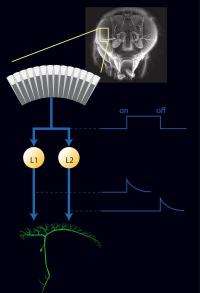
Each individual eye in the fly's compound eye perceives "on" and "off" contrast changes. This information is split up right behind each individual eye (blue arrow). The L1 cells only transmit information about "on" edges ("light on"), the L2 cells only about "off" edges ("light off") to the output cells (green). Credit: Max Planck Institute of Neurobiology / Schorner
The eye is not just a lens that takes pictures and converts them into electrical signals. As with all vertebrates, nerve cells in the human eye separate an image into different image channels once it has been projected onto the retina. This pre-sorted information is then transmitted to the brain as parallel image sequences. Scientists from the Max Planck Institute of Neurobiology in Martinsried have now discovered that fruit flies process optical information in a similar way. The evidence suggests that this type of wiring is an effective energy-saving mechanism and is therefore deployed by a diverse range of animal species. (Nature, November 11, 2010)
How does the mind perceive the world? This is not a trivial question: for many animal species, "seeing" is one of the most important senses. Every second, the eyes record a huge number of impressions which are converted by the photoreceptor cells into electrical signals. In vertebrates, image processing begins in the retina of the eye. Here, the nerve cells separate out the visual information in images featuring different content before transmitting them to the brain.
To understand something as complex as "seeing", scientists examine a somewhat simpler but extremely efficient system the fruit fly's brain. Despite their tiny size, fruit flies are ideal candidates for such research: they are masters of visual processing; the number of nerve cells involved is manageable, which means that each individual cell can be examined; and genetic tools make it possible to block individual cells and analyse their role in the system.
Scientists at the Max Planck Institute of Neurobiology have now discovered surprising parallels in the neuronal processing of fruit flies and vertebrates. The fly also transmits images directly from the sensory cells to various image channels. The information is then transmitted via a series of other cells to large, motion-sensitive nerve cells. These output cells of the motion vision system are responsible for visual flight control.
Scientists ascertained the early separation into different images by blocking certain cells using genetic engineering. They then exposed the flies to moving striped patterns in an LED arena and recorded the electrical responses of the large output cells. The various contrast changes, which occur as a result of the stripe movement, are perceived by the eye's photoreceptors. However, five nerve cells the lamina cells L1 to L5 are located directly behind every sensory cell. "We had been wondering for a long time why there are so many cells, which of them transmit information to the motion vision system, and what kind of information this is," reports Alexander Borst, who headed up the study. His team suppressed the activity of individual lamina cells while the flies watched the moving patterns. The experiments revealed that L1 and L2 cells are the main input channels into the flies' motion vision system. It got exciting as the team discovered that the cells transmit only certain partial information: L1 only responds if a dark/bright edge passes by (light on), while L2 only transmits information about a moving bright/dark edge (light off). This represents a clear parallel with the eyes of vertebrates, where ON and OFF bipolar cells, as they are known, also respond only to specific contrast changes.
"It can be no coincidence that we find this separation of contrast information in all vertebrates and now also in flies," surmises Alexander Borst. The neurobiologist already has a theory as to why this wiring has been maintained so consistently throughout evolution: it allows the brain to save energy. If only one cell relayed the information about the various contrast changes, it would have to maintain a basic membrane voltage, which would intensify in a "light on" situation and weaken in a "light off" situation. Such a basic membrane voltage requires energy. Having two cells is therefore more efficient, as only one needs to be active when "its" contrast change occurs.
More information: Maximilian Jösch, Bettina Schnell, Shamprasad Varija Raghu, Dierk F. Reiff & Alexander Borst, ON- and OFF-pathways in Drosophila motion vision, Nature, online publication, November 11, 2010
Provided by
Max-Planck-Gesellschaft
-
From lemons to lemonade: Reaction uses carbon dioxide to make carbon-based semiconductor,
28 comments
-
Every black hole contains a new universe: A physicist presents a solution to present-day cosmic mysteries,
215 comments
-
New silicon memory chip developed,
16 comments
-
Thioridazine kills cancer stem cells in human while avoiding toxic side-effects of conventional cancer treatments,
3 comments
-
SpaceX private rocket blasts off for space station (Update),
41 comments
-
A question about drug tolerance
May 23, 2012
-
Poor nutrition leading to overeating?
May 23, 2012
-
Math and dyslexia?
May 21, 2012
-
portable metabolism meter?
May 21, 2012
-
Rare medical conditions on 20/20 tonight
May 18, 2012
-
"Good" Cholesterol in Doubt
May 17, 2012
- More from Physics Forums - Medical Sciences
More news stories
New device allows pacemaker patients to safely undergo MRIs
For many, it's a medical conundrum: The very pacemaker keeping their heart in rhythm prevents them from undergoing an MRI to diagnose other ailments, because interaction between the two devices could prove deadly.
Medicine & Health / Cardiology
1 hour ago |
not rated yet |
0
|
Common therapies for basal cell carcinoma offer similar survival
(HealthDay) -- For patients with superficial basal cell carcinoma (sBCC), treatment with imiquimod or photodynamic therapy (PDT) results in similar long-term tumor-free survival, according to a review published ...
39 minutes ago |
not rated yet |
0
Pancreatectomy OK without downstaging from therapy
(HealthDay) -- Pancreatectomy improves median survival in pancreatic cancer patients even when presurgical neoadjuvant therapy does not lead to radiographic downstaging of tumors, according to a study published ...
9 minutes ago |
not rated yet |
0
One-fifth of healthy middle-aged men have low-grade murmur
(HealthDay) -- More than one-fifth of healthy middle-aged men have a low-grade systolic heart murmur that confers a nearly five-fold higher risk of future aortic valve replacement (AVR), according to a study ...
Medicine & Health / Cardiology
49 minutes ago |
not rated yet |
0
Of mice and mental models: Neuroscientific implications of risk-optimized behavior in the mouse
(Medical Xpress) -- Regardless of an organism’s biological complexity, every encephalized animal continuously makes under-informed behavioral choices that can have serious consequences. Despite its ubiquity, ...
Dragon arrives at space station in historic 1st (Update 2)
The privately bankrolled Dragon capsule arrived at the International Space Station for a historic docking Friday, captured by astronauts wielding a giant robot arm.
MIT researchers devise new means to synchronize a group of robots (w/ Video)
(Phys.org) -- For several years, roboticists have been working out ways to get a group of robots to perform synchronized activities as demonstrated most often in dance routines. Its not just about trying ...
Landmark calculation clears the way to answering how matter is formed
(Phys.org) -- An international collaboration of scientists, including Thomas Blum, associate professor of physics, is reporting in landmark detail the decay process of a subatomic particle called a kaon ...
Copy of the genetic makeup travels in a protein suitcase
Scientists from the Institute for Physical and Theoretical Chemistry at the University of Bonn have succeeded for the first time in the real time filming of the transport of an important information carrier in biological ...
Cancer may require simpler genetic mutations than previously thought
Chromosomal deletions in DNA often involve just one of two gene copies inherited from either parent. But scientists haven't known how a deletion in one gene from one parent, called a "hemizygous" deletion, can contribute ...
Researchers demonstrate possible primitive mechanism of chemical info self-replication
(Phys.org) -- When scientists think about the replication of information in chemistry, they usually have in mind something akin to what happens in living organisms when DNA gets copied: a double-stranded molecule ...