Electrical brain stimulation improves math skills
November 4, 2010

Electrical brain stimulation improves math skills

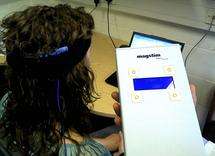
A volunteer wearing the electric stimulation equipment

By applying electrical current to the brain, researchers reporting online on November 4 in Current Biology, have shown that they could enhance a person's mathematical performance for up to 6 months without influencing their other cognitive functions. The findings may lead to treatments for the estimated 20 percent of the population with moderate to severe numerical disabilities (for example, dyscalculia) and for those who lose their skill with numbers as a result of stroke or degenerative disease, according to the researchers.

"I am certainly not advising people to go around giving themselves electric shocks, but we are extremely excited by the potential of our findings," said Roi Cohen Kadosh of the University of Oxford. "We've shown before that we can temporarily induce dyscalculia [with another method of brain stimulation], and now it seems we might also be able to make someone better at maths. will most likely not turn you into Albert Einstein, but if we're successful, it might be able to help some people to cope better with maths."

The researchers used a method of brain stimulation known as transcranial direct current stimulation (TDCS). TDCS is a in which a weak current is applied to the brain constantly over time to enhance or reduce the activity of neurons. The technique has gotten attention in the last decade for its potential to improve various functions in people with neurological deficits, for instance in those who have suffered a .

In the new study, the researchers applied TDCS specifically to the , a portion of the brain that is crucial for numerical understanding. The study participants had normal mathematical abilities but were asked to learn a series of artificial numbers—symbols that they had never seen before that they were told represented numbers—while they received the noninvasive brain stimulation. The researchers then tested participants' ability to automatically process the relationship of those artificial numbers to one another and to map them correctly in space using standard testing methods for numerical competence.

The results of the tests showed that the improved study participants' ability to learn the new numbers. and that those improvements lasted 6 months post training.

Now that they know the TDCS treatment can improve number processing in people with normal mathematical ability, the researchers plan to test its use in those with severe numerical disabilities. If it works, that could have important consequences, Cohen Kadosh said, as people with severe numerical disabilities often cannot manage basic tasks like understanding food labels or counting change in a supermarket. Poor numerical ability has also been linked to unemployment and low income, depression, low self-esteem, and other problems, he said.

More information: The paper ‘Modulating neuronal activity produces specific and long lasting changes in numerical competence’ by Roi Cohen Kadosh and colleagues is published in Current Biology on 4 November 2010.

Provided by Cell Press search and more info website

4.8 /5 (13 votes)  

Filter


Move the slider to adjust rank threshold, so that you can hide some of the comments.


Display comments: newest first

Magus
Nov 04, 2010

Rank: 5 / 5 (1)
I've got a big math test coming up I need to charge my brain again.
Royale
Nov 04, 2010

Rank: 3 / 5 (2)
haha.. yep.. working at a school seeing how many parents medicate their kids nowadays, i wouldnt be surprised if they find a way to name low math scores a 'condition' and have their kids go in for a quick brain zap every 6 months..
teledyn
Nov 04, 2010

Rank: 3 / 5 (1)
The Krell had a machine like this a long time ago: http://www.youtub...kfKySHuA ... but it destroyed them.
ziphead
Nov 04, 2010

Rank: 3 / 5 (4)
quick! lick your fingers and stick'em into power outlets everybody!

maybe this is a ploy to get rid of idiots on the planet.
photonica
Nov 05, 2010

Rank: 3.7 / 5 (3)
There are so many stupid people that it is beginning to look a lot like the movie, "IDIOCRACY". No amount of electrical stimulation would help their math score.
KwasniczJ
Nov 05, 2010

Rank: 1.6 / 5 (7)
This effect is known for long time from electrotherapy.It's usually followed with certain lost of long-therm memory. It seems, it just makes brain more permeable for synthesing of new ideas by deleting of perceptions like sneding of trees. Tic-for-tat, you know that.

http://en.wikiped...mulation
Rank 4.8 /5 (13 votes)
Relevant PhysicsForums posts
  • A question about drug tolerance
    createdMay 23, 2012
  • Poor nutrition leading to overeating?
    createdMay 23, 2012
  • Math and dyslexia?
    createdMay 21, 2012
  • portable metabolism meter?
    createdMay 21, 2012
  • Rare medical conditions on 20/20 tonight
    createdMay 18, 2012
  • "Good" Cholesterol in Doubt
    createdMay 17, 2012
  • More from Physics Forums - Medical Sciences

More news stories

New device allows pacemaker patients to safely undergo MRIs

For many, it's a medical conundrum: The very pacemaker keeping their heart in rhythm prevents them from undergoing an MRI to diagnose other ailments, because interaction between the two devices could prove deadly.

Medicine & Health / Cardiology

created 39 minutes ago | popularity not rated yet | comments 0 | with audio podcast

Common therapies for basal cell carcinoma offer similar survival

(HealthDay) -- For patients with superficial basal cell carcinoma (sBCC), treatment with imiquimod or photodynamic therapy (PDT) results in similar long-term tumor-free survival, according to a review published ...

Medicine & Health / Cancer

created 9 minutes ago | popularity not rated yet | comments 0

One-fifth of healthy middle-aged men have low-grade murmur

(HealthDay) -- More than one-fifth of healthy middle-aged men have a low-grade systolic heart murmur that confers a nearly five-fold higher risk of future aortic valve replacement (AVR), according to a study ...

Medicine & Health / Cardiology

created 19 minutes ago | popularity not rated yet | comments 0

Cancer patients share web info with docs for insight, advice

(HealthDay) -- Cancer patients' primary goal in talking with their doctors about information they've found on the Internet is to get more insight and advice on the online information, new research indicates.

Medicine & Health / Health

created 59 minutes ago | popularity not rated yet | comments 0

Of mice and mental models: Neuroscientific implications of risk-optimized behavior in the mouse

(Medical Xpress) -- Regardless of an organism’s biological complexity, every encephalized animal continuously makes under-informed behavioral choices that can have serious consequences. Despite its ubiquity, ...

Medicine & Health / Neuroscience

created 4 hours ago | popularity not rated yet | comments 0 | with audio podcast feature


Dragon arrives at space station in historic 1st (Update 2)

The privately bankrolled Dragon capsule arrived at the International Space Station for a historic docking Friday, captured by astronauts wielding a giant robot arm.

MIT researchers devise new means to synchronize a group of robots (w/ Video)

(Phys.org) -- For several years, roboticists have been working out ways to get a group of robots to perform synchronized activities as demonstrated most often in dance routines. It’s not just about trying ...

Copy of the genetic makeup travels in a protein suitcase

Scientists from the Institute for Physical and Theoretical Chemistry at the University of Bonn have succeeded for the first time in the real time filming of the transport of an important information carrier in biological ...

Cancer may require simpler genetic mutations than previously thought

Chromosomal deletions in DNA often involve just one of two gene copies inherited from either parent. But scientists haven't known how a deletion in one gene from one parent, called a "hemizygous" deletion, can contribute ...

Astronauts capture SpaceX's Dragon for station dock

Astronauts aboard the International Space Station reached out and caught SpaceX's Dragon capsule for docking at the orbiting lab on Friday in a historic first for commercial spaceflight.

Neck strength, cervical spine mobility don't predict pain

(HealthDay) -- Neither isometric neck muscle strength nor passive mobility of the cervical spine, two physical capacity parameters found to be associated with neck pain in other studies, predicts later neck ...