New device may reduce swallowing health risk in patients with Parkinson's disease
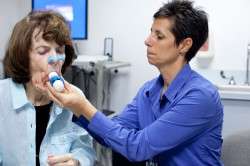
(PhysOrg.com) -- A hand-held device that strengthens the muscles involved in swallowing can address a serious symptom of Parkinson's disease, according to a new University of Florida study.
In what researchers believe is the largest randomized trial of a behavioral swallowing treatment in patients with Parkinson’s disease, scientists found that about one-third of the volunteers who used the device improved their ability to swallow. The findings appear in the Nov. 23 issue of the journal Neurology, the medical journal of the American Academy of Neurology.
Nearly 1 million Americans have Parkinson’s disease, according to the Parkinson’s Disease Foundation. Finding solutions to their swallowing problems is important because their most common cause of death is pneumonia caused by inhaling foreign material, such as food, during swallowing.
“The many muscles involved in swallowing progressively weaken in patients with Parkinson’s disease and become uncoordinated in the same way that patients lose coordination and strength in their arms and legs,” said Michelle Troche, the study’s lead investigator and a clinical lecturer and speech pathologist in the UF College of Public Health and Health Professions’ department of speech, language and hearing sciences.
It also becomes more difficult for patients to sense material in their airways and cough hard enough to expel it, she said.
For the study, researchers trained participants with Parkinson’s disease to exhale into an Expiratory Muscle Strength Training, or EMST, device. In previous studies, EMST has improved swallowing and cough function in patients with multiple sclerosis and in elderly, sedentary adults.
“EMST uses the basic exercise theory behind any strength training program,” said co-investigator Christine Sapienza, a professor and chairwoman of the department of speech, language and hearing sciences. “This small device capitalizes on that concept of overload with a calibrated pressure release valve that won’t open until you generate a great enough lung pressure. The patient or clinician can vary how much pressure is needed to open the valve on the device. The greater the pressure you need, the stronger the muscles have to be. It acts much like a pin on a weight machine and uses the same concept to strengthen the muscles involved in swallowing and breathing.”
Sapienza developed the device along with UF researchers Paul Davenport, a professor and interim chairman of the department of physiological sciences in the College of Veterinary Medicine, and A. Daniel Martin, a professor in the department of physical therapy.
“Their efforts are pioneering and it is likely that this study will stand the test of time as a landmark in Parkinson’s disease swallowing research,” said research collaborator Dr. Michael Okun, a co-director of UF’s Movement Disorders Center and an associate professor of neurology with the College of Medicine and UF’s McKnight Brain Institute.
Participants in the Parkinson’s disease study were divided into two groups of 30. In one group participants used the EMST device with proper calibration. The other participants used a device that looked exactly the same but did not work to strengthen the muscles. Neither the participants nor the study therapists knew who had the real device and who had the sham device. Participants used the devices in their homes for 20 minutes a day, five days a week for four weeks. Therapists visited once a week to make sure participants used the device correctly. Following the study period, participants in the sham group received the EMST treatment.
The researchers measured participants’ swallowing function before and after treatment with a standardized swallow safety scale, the Penetration-Aspiration scale, developed in part by UF faculty member John Rosenbek, also with the department of speech, language and hearing sciences. Researchers used videofluoroscopy to obtain motion X-ray images of the participants’ swallowing muscles as they swallowed liquid.
One-third of participants who used the device with calibration had significantly improved swallow safety scores compared to 14 percent of the participants in the sham group. The researchers also found that for patients in the treatment group, there was greater movement in the muscles that lift the voice box out of the way during swallowing. Quality-of-life measures related to swallowing improved in both the treatment and sham groups.
“The fact that EMST is a home-based treatment is of particular importance as many individuals with Parkinson’s disease cannot travel the long distance to attend clinic or hospital therapy sessions,” said Stephanie Daniels, a visiting associate professor at the University of Houston and an assistant professor at Baylor College of Medicine, who was not involved in the study. “Very few swallowing treatment studies have incorporated the rigorous research design used in this study. We need more studies such as this to support the different treatment approaches used in swallowing rehabilitation.”
Sapienza has a potential financial interest in Aspire Products LLC, the manufacturer of EMST. Portions of the study were funded by the Veterans Affairs Rehabilitation Research and Development, the Michael J. Fox Foundation and the National Institutes of Health. The UF Movement Disorders Center receives support from the National Parkinson Foundation Center of Excellence.


