Coaching with compassion can 'light up' human thoughts (w/ Video)
Coaching happens just about everywhere, and every day, with learning as the goal. Effective coaching can lead to smoothly functioning organizations, better productivity and potentially more profit. In classrooms, better student performance can occur. Doctors or nurses can connect more with patients. So, doing coaching right would seem to be a natural goal, and it has been a major topic of research at Case Western Reserve University’s Weatherhead School of Management since 1990.
For all the energy and money spent on coaching, there is little understanding about what kind of interactions can contribute to or detract from effectiveness. Ways of coaching can and do vary widely, due to a lack of understanding of the psycho-physiological mechanisms which react to positive or negative stimulus.
Internally funded research at Case Western Reserve has documented reactions in the human brain to compassionate and critical coaching methods. The results start to reveal the mechanisms by which learning can be enhanced through coaching with compassion (a method that emphasizes the coached individual’s own goals).
“We're trying to activate the parts of the brain that would lead a person to consider possibilities,” said Richard Boyatzis, distinguished university professor, and professor of organizational behavior, cognitive science and psychology. “We believe that would lead to more learning. By considering these possibilities we facilitate learning.”
Boyatzis and Anthony Jack, assistant professor of cognitive science, philosophy and psychology, have used functional magnetic resonance imaging (fMRI) to show neural reactions based on different coaching styles. Their research builds on previous knowledge of Intentional Change Theory, which holds that positive and negative emotional attractors create psycho-physiological states that drive a person to think about change.
Boyatzis, a faculty member at Weatherhead School of Management, and Jack, director of the university’s Brain, Mind and Consciousness Lab, say coaches should seek to arouse a Positive Emotional Attractor (PEA), which causes positive emotion and arouses neuroendocrine systems that stimulate better cognitive functioning and increased perceptual accuracy and openness in the person being coached, taught or advised. Emphasizing weaknesses, flaws, or other shortcomings, or even trying to “fix” the problem for the coached person, has an opposite effect.
“You would activate the Negative Emotional Attractor (NEA), which causes people to defend themselves, and as a result they close down,” Boyatzis says. "One of the major reasons people work is for the chance to learn and grow. So at every managerial relationship, and every boss-subordinate relationship, people are more willing to use their talents if they feel they have an opportunity to learn and grow.”
What Boyatzis and Jack set out to do was to observe brain images which reflect coaching tone. Undergraduate volunteers met with two academic coaches, who intentionally used different interviewing methods. One encouraged envisaging a positive future, and the other set a more standard tone by focusing on a person’s failings and what he or she ought to do.
About a week after each coaching session, Boyatzis and Jack brought the students to the brain scanner. The students were shown video clips, which were designed to approximate a video conference. The same coaches who met the students previously appeared on video and sought responses. The students in a scanner answered using a keypad. That design meant there was an ongoing interaction between the students and the academic coaches they had met briefly before.
Half the questions offered during the fMRI session had a similar emotional tone to those in the first coaching session, either positively focused on the future, or more negatively focused on the difficulties the student might be experiencing. The other half were neutral in tone -- issues about which the students most likely have ambivalent feelings. The neutral questions allowed Boyatzis and Jack to better see how the interpersonal relationship was affecting the neural response.
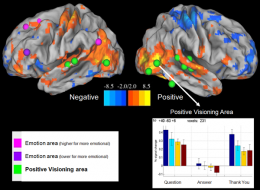
“We know that people respond much better to a coach they find inspiring and who shows compassion for them, rather than one who they perceive to be judging them. Sure enough, we found a trend in the same direction even for the neutral questions. Students tended to activate the areas associated with visioning more with the compassionate coach, even when the topics they were thinking about weren't so positive,” Jack said.
“We were really struck by one particular finding in the visual cortex, where we saw a lot more activity in the more positive condition than in the more negative condition,” Jack explained. The brain areas observed are associated with imagination and operate at the intersection of basic visual processing and emotion. Jack says the fMRI images show the neural signatures of visioning, a critical process for motivating learning and behavioral change.
“By spending 30 minutes talking about a person’s desired, personal vision, we could light up (activate) the parts of the brain 5-7 days later that are associated with cognitive, perceptual and emotional openness and better functioning,” Boyatzis said. “The major implication is that people typically coach others in higher education, medicine and management with a bias toward the NEA and correcting what the person is doing that is wrong. Our study suggests that this closes down future, sustainable change, as we expected.”
Coaching with Compassion: An fMRI Study of Coaching to the Positive or Negative Emotional Attractor was presented at a recent Academy of Management Annual Meeting in Montreal and awarded as a Best Paper.
“Everyone’s got to look at weaknesses and take them on,” Jack says. “But often the focus is so much on the bottom line that we worry ourselves into the ground. It is more important to focus on what gets you going in the morning and gets you wanting to work hard and stay late.”


