Combo high-tech CT scans just as good as older imaging to detect coronary artery disease
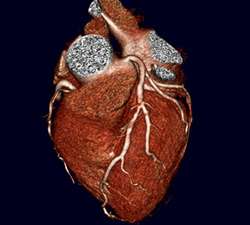
Heart imaging specialists at Johns Hopkins have shown that a combination of CT scans that measure how much blood is flowing through the heart and the amount of plaque in surrounding arteries are just as good as tests that are less safe, more complex and more time-consuming to detect coronary artery disease and its severity.
"Our findings should reassure cardiologists and patients that the newer, state-of-the-art CT scans are just as good as established older technologies in diagnosing the presence and severity of coronary artery disease," says cardiologist and lead study investigator Richard George, M.D. George will present his latest study findings Nov. 16 at the American Heart Association's (AHA) annual Scientific Sessions in Chicago.
"In addition, the newer CT scans have the added advantages of being easier on the patient, taking less time to perform, using less radiation, and providing physicians with all the information they need in one test," says George, an assistant professor and director of the CT Perfusion Laboratory at the Johns Hopkins University School of Medicine and its Heart and Vascular Institute.
The Hopkins team's findings were a result of a direct comparison study in 50 men and women with suspected arterial blockages who were given both the new combination CT scans along with traditional SPECT nuclear imaging tests and other diagnostic procedures.
The combination CT scans consisted of a regular, high-tech CT angiogram, or CTA, to map any plaque buildup in the heart's arteries, and a so-called CT perfusion imaging test, or CTP, to gauge any slowdown in arterial blood flow.
The test is completed within a half-hour, giving physicians a clear picture of how much plaque has built up inside any particular small artery and whether such narrowing and subsequent hardening have compromised the heart's blood supply. SPECT testing requires at least two hours to allow a chemical tracer of blood flow to be absorbed and then imaged.
Each year, nearly 800,000 American men and women with coronary artery disease suffer a heart attack, resulting in more than 150,000 deaths.
"This combo test really simplifies the diagnosis of coronary artery disease, providing the first comprehensive evaluation of atherosclerosis in the blood vessels and whether any such detected disease puts a patient at greater overall risk of heart attack in the near or long term," says senior study investigator and cardiologist João Lima, M.D.
"If older people are feeling symptoms of heart disease, but not showing reduced blood flow in the heart, then they and their physicians can breathe a sigh of relief because we know that aggressive or invasive therapies are not required," adds Lima, a professor of medicine and radiology at Johns Hopkins.
The new study involved men and women from the Baltimore region who were examined at The Johns Hopkins Hospital because of chest pain, a symptom typically associated with an arterial blockage.
The Hopkins team emphasized that the CTP test can be accurately performed using the most advanced CT technology available, the 320 CT scanner, which can produce 3-D images of blood vessels no bigger than the average width of a toothpick (1.5 millimeters), and was first installed in North America at Johns Hopkins in 2007.
Study participants also underwent traditional SPECT testing, long considered the gold standard imaging test for coronary disease. Nineteen patients with suspected narrowing of their coronary arteries also underwent a direct inspection of the blood vessels with a catheter that injects a contrast dye as seen by X-ray pictures, called an invasive coronary angiogram (ICA).
Results showed that CTA plus CTP identified 71 percent of those who had reduced blood flow shown by SPECT alone, and correctly identified patients without a slowdown of blood flow 90 percent of the time.
CTP was 100 percent as effective as the combination of CTA and SPECT in detecting people with severely clogged arteries, and correctly identified patients without a clogged artery 82 percent of the time. In determining the actual vessel at risk of clogging, CTP found 83 percent of the same vessel territories as ICA and SPECT, and excluded 85 percent of the vessels that did not have narrowing.
Researchers say the results were even more closely matched in patients who had a direct inspection by coronary angiogram as well as a SPECT test. In those patients, the CTA-CTP combination identified 90 percent of the same people with severely clogged arteries, and accurately ruled out clogged arteries 89 percent of the time. For specific blood vessels, CTA-CTP was 75 percent as sensitive for the same clogged blood vessel and 91 percent as specific.
Experts measured average radiation exposures as 4.5 milliSieverts for CTA and 7 milliSieverts for CTP, which was less than the average 13 milliSieverts for SPECT.
Lima says as many as one-fifth of the 1.3 million invasive cardiac catheterizations performed each year nationwide to fix suspected blockages actually show that no such blockage existed, a problem that needs to be solved with better diagnostic tests, such as CTA with CTP.
The CT device being used in the study is an Aquilion One, a 320 detector row CT scanner manufactured by Toshiba. The 320-CT scanning device has at least five times the cardiac coverage of the 64-CT scanners in widespread use elsewhere.
The scanner's software compares ratios of brightly dyed blood flows between the innermost and outermost layers of heart muscle, where the effects of arterial narrowing first appear.
As part of CTP imaging, each patient is injected with a chemical dye containing iodine, known to light up on screen when struck by the scanner's X-rays. Lower concentrations of iodine show up as darker regions, indicating constrained and reduced blood flow, the underlying cause of chest pain, than brighter regions where blood flow is more uniform and free flowing.
To enhance the image, injections of adenosine, which causes the blood-pumping organ to beat faster, are used to speed up blood flow to the heart.


