New characteristics of premature aging protein discovered
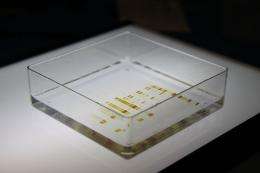
Glavy Lab gel culture
(PhysOrg.com) -- Dr. Joseph Glavy at Stevens Institute of Technology studies the smallest and most basic elements of life. The Assistant Professor of Chemical Biology runs the Glavy Lab, where advanced student scientists study the nuclear pore complexes (NPCs) in cells, observing the minutest mechanisms of life as they unfold during mitosis. The Glavy Lab's formal purpose is to study the NPC at the molecular level in the pursuit of the unknown or unexpected in the well-studied but not always well-understood nuclei of living cells.
His team has uncovered a disease-related protein outside of its known range and published the results in the August 2010 issue of Cell Cycle. The article's co-authors, Dr. Simarna Kaur, Tommy White, and Amanda DiGuilio are current or recent students of Stevens Institute of Technology.
The NPC is a supramolecular assembly that provides gateways for molecular trafficking between DNA with a cell's nucleus and the cytoplasm within the cell membrane walls in eukaryotic cells. Protein, RNA, ions, and other small molecules are transported through the NPC on their way into the nucleus. The composition of the NPC is about thirty proteins, called nucleoporins (Nups), which are arranged quasi-symmetrically and in subcomplexes that break apart during mitosis in some cells.
Dr. Glavy investigated interactions within the NPC of mammalian cells while a post-doctoral researcher at Rockefeller University in New York City. Unlike other living cells, the mammalian cell NPC breaks down around DNA during mitosis, allowing specific Nup subcomplexes to be isolated and studied in the lab, but also leaving room for something to go wrong in the reorganization of the nucleus . Focused on the very specific Nup 107-160 subcomplex, the Glavy Lab had been looking for what might go wrong during mitosis.
But rather than genetic mutations, the lab discovered something far more important within Nup 107-160: the Werner Helicase Interacting Protein 1 (WHIP). WHIP's moniker derives from its interaction with Werner protein, which maintains genome stability and conversely is responsible for the progeria disease Werner's Syndrome. This adult-onset disease causes premature aging and increased susceptibility to other old-age diseases such as cancer, heart disease, and diabetes.
The initial discovery of WHIP within the NPC, when it had been associated with the Werner protein, prompted further exploration to deduce the role of WHIP during mitosis. The scientists isolated the NPC subcomplex and used immunofluorescence and immunoblotting to detect the presence and movement of WHIP during mitosis. They discovered WHIP interacting within the NPC autonomous of Werner protein, demonstrating a novel relation.
In addition to its connection with gene-stabilizing Werner protein, WHIP may play an independent, unique role in the cell cycle. Beyond supporting DNA replication, WHIP may also function to detect genetic damage. The authors look forward to future work that will further understanding of this protein's role in maintaining genome stability, and in completing some of that important work themselves.
It may be years before the Glavy Lab's insights into WHIP can be turned into therapies for sufferers of Werner Syndrome and other progeria diseases, but this new look into the workings of the body creates hope for future treatments and other advances in biology and medicine.
"Cell biology is a growing, multi-disciplinary field that is establishing a foundation of knowledge for the future," says Dr. Glavy. "We are beginning to establish tangible relations between biology and disease and advancing towards an understanding of gene repair and expression that might help with drug development in the future."
Provided by Stevens Institute of Technology
-
From lemons to lemonade: Reaction uses carbon dioxide to make carbon-based semiconductor,
28 comments
-
Every black hole contains a new universe: A physicist presents a solution to present-day cosmic mysteries,
215 comments
-
New silicon memory chip developed,
16 comments
-
Thioridazine kills cancer stem cells in human while avoiding toxic side-effects of conventional cancer treatments,
2 comments
-
SpaceX private rocket blasts off for space station (Update),
41 comments
-
A question about drug tolerance
May 23, 2012
-
Poor nutrition leading to overeating?
May 23, 2012
-
Math and dyslexia?
May 21, 2012
-
portable metabolism meter?
May 21, 2012
-
Rare medical conditions on 20/20 tonight
May 18, 2012
-
"Good" Cholesterol in Doubt
May 17, 2012
- More from Physics Forums - Medical Sciences
More news stories
Inherited DNA change explains overactive leukemia gene
A small inherited change in DNA is largely responsible for overactivating a gene linked to poor treatment response in people with acute leukemia.
4 minutes ago |
not rated yet |
0
|
First study to suggest that the immune system may protect against Alzheimer's changes in humans
Recent work in mice suggested that the immune system is involved in removing beta-amyloid, the main Alzheimer's-causing substance in the brain. Researchers have now shown for the first time that this may apply in humans.
Medicine & Health / Alzheimer's disease & dementia
51 minutes ago |
not rated yet |
0
|
Implantable pain disk may help those with cancer
An estimated 3.5 million cancer patients around the globe are in severe pain from their disease, but many get no relief.
Medicine & Health / Medical research
13 minutes ago |
not rated yet |
0
|
Physicians definitively links irritable bowel syndrome and bacteria in gut
An overgrowth of bacteria in the gut has been definitively linked to Irritable Bowel Syndrome in the results of a new Cedars-Sinai study which used cultures from the small intestine. This is the first study to use this "gold ...
Medicine & Health / Diseases, Conditions, Syndromes
57 minutes ago |
not rated yet |
0
|
WHO target to cut early chronic illness deaths
The World Health Organization announced on Friday it was set to approve a new target to reduce premature deaths from chronic illnesses such as heart disease by a quarter by 2025.
38 minutes ago |
not rated yet |
0
Copy of the genetic makeup travels in a protein suitcase
Scientists from the Institute for Physical and Theoretical Chemistry at the University of Bonn have succeeded for the first time in the real time filming of the transport of an important information carrier in biological ...
A new invading sea crab reaches the Ebro Delta
Originally endemic to the Atlantic Coast of North America, over the past 30 years Dyspanopeus sayi has been involuntarily introduced in the UK, France, the Netherlands, the Black Sea and the Adriatic Sea. A ...
Phone contact with nurses linked with better outcomes for women with gestational diabetes
Among women with gestational diabetes mellitus, referral to a telephone-based nurse management program was associated with lower risk of high baby birth weight and increased postpartum glucose testing, according to Kaiser ...
Beyond oil, can Alaska be tapped as a source for renewable energy?
Alaska has massive hydro, wind, geothermal and other renewable resources, but the state's rural villages are chained to diesel and suffer oppressive energy costs they say threaten their existence. Lawmakers, energy experts ...
'Transformer' protein makes different sized transport pods
These spheres may look almost identical, but subtle differences between them revealed a molecular version of the robots from Transformers. Each sphere is a vesicle, a pod that cells use to transport materials ...
Managing biodiversity data from local government
Local governments around the world have a new tool to help share and use vast amounts of biodiversity knowledge collected in the course of their work.