Cadmium, lead found in drinking glasses
(AP) -- Drinking glasses depicting comic book and movie characters such as Superman, Wonder Woman and the Tin Man from "The Wizard of Oz" exceed federal limits for lead in children's products by up to 1,000 times, according to laboratory testing commissioned by The Associated Press.
The decorative enamel on the superhero and Oz sets - made in China and purchased at a Warner Brothers Studios store in Burbank - contained between 16 percent and 30.2 percent lead. The federal limit on children's products is 0.03 percent.
The same glasses also contained relatively high levels of the even-more-dangerous cadmium, though there are no federal limits on that toxic metal in design surfaces.
In separate testing to recreate regular handling, other glasses shed small but notable amounts of lead or cadmium from their decorations. Federal regulators have worried that toxic metals rubbing onto children's hands can get into their mouths. Among the brands on those glasses: Coca-Cola, Walt Disney, Burger King and McDonald's.
The Coca-Cola Co., which had been given AP's test results last week, announced Sunday evening that after retesting it was voluntarily recalling 88,000 glasses over concerns regarding the mainly red glass in a four-glass set.
The AP testing was part of the news organization's ongoing investigation into dangerous metals in children's products and was conducted in response to a recall by McDonald's of 12 million glasses this summer because cadmium escaped from designs depicting four characters in the latest "Shrek" movie.
The New Jersey manufacturer of those glasses said in June that the products were made according to standard industry practices, which includes the routine use of cadmium to create red and similar colors. That same company, French-owned Arc International, made the glasses that Coca-Cola said it was pulling.
To assess potential problems with glass collectibles beyond the "Shrek" set, AP bought and analyzed new glasses off the shelf, and old ones from online auctions, thrift shops and a flea market. The buys were random.
The fact it was so easy to find glasses that appeal to kids and appear to violate the federal lead law suggests that contamination in glassware is wider than one McDonald's promotion.
The irony of the latest findings is that AP's original investigation in January revealed that some Chinese manufacturers were substituting cadmium for banned lead in children's jewelry; that finding eventually led to the McDonald's-Shrek recall; now, because of the new testing primarily for cadmium in other glassware, lead is back in the spotlight as well.
AP's testing, conducted by ToyTestingLab of Rhode Island, found that the enamel used to color the Tin Man had the highest lead levels, at 1,006 times the federal limit for children's products. Every Oz and superhero glass tested exceeded the government limit: The Lion by 827 times and Dorothy by 770 times; Wonder Woman by 533 times, Superman by 617 times, Batman by 750 times and the Green Lantern by 677 times.
Federal regulators will decide whether the superhero and Oz glasses are "children's products" and thus subject to strict lead limits; if U.S. Consumer Product Safety Commission staffers conclude the glasses to fall outside that definition, the lead levels would be legal.
Judging by the agency's own analysis, obtained by the AP under the Freedom of Information Act, the Oz and superhero glasses appeal to kids.
"Licensed characters based on action superhero themes or friendship themes are very popular" with children ages 6 to 8, CPSC staff wrote when explaining why the "Shrek" glasses, which featured the cartoon ogre and his friends, would end up in children's hands.
Warner Brothers said, "It is generally understood that the primary consumer for these products is an adult, usually a collector."
However, on Warner Brothers' website, the superhero glasses are sold alongside kids' T-shirts with similar images and a school lunch box. An online retailer, http://www.retroplanet.com , describes the 10-ounce glasses as "a perfect way to serve cold drinks to your children or guests."
The importer, Utah-based Vandor LLC, said it "markets its products to adult collectors." The company said less than 10,000 of each set had been sold and that the products were made under contract in China.
The company said that superhero and "Oz" glasses both passed testing done for Vandor by a CPSC-accredited lab, including the same lead content test that ToyTestingLab did for AP - a test only required of children's products. Spokeswoman Meryl Rader did not answer when asked why a test specific to children's products would be performed on glasses the company said were not intended for kids.
"The results were well within the legal limits" of 0.03 percent lead, Rader wrote in an e-mail. The company would not share those results.
Informed in general terms of AP's results, CPSC spokesman Scott Wolfson said that the agency would pursue action against any high-lead glasses determined to be children's products. The agency has authority to enforce lead levels for glasses going back decades, he said.
AP's testing showed Vandor's Chinese manufacturer also relied on cadmium. That toxic metal comprised up to 2.5 percent of the decorative surface of the Oz and superhero glasses, nearly double the levels found in the recalled "Shrek" glasses. But the CPSC only limits how much cadmium escapes from the designs, not how much cadmium the designs contain. Even that regulation is new: The CPSC used the "Shrek" glasses to establish a standard for how much cadmium coming out of children's glassware creates a health hazard.
Five of the glasses that AP tested, including one ordered from the online Coca-Cola store, shed at least as much cadmium as the CPSC found on the "Shrek" glasses. While those five could have been deemed a health hazard under the CPSC guidelines used for the recall, recent revisions tripled the allowable amount of cadmium and the agency may no longer consider them a problem. The agency has said its upward revision means the "Shrek" glasses did not need to be recalled.
The all-red Coke glass shed three times more cadmium than the Puss in Boots "Shrek" glass that worried federal regulators the most last summer. Coke Zero and Diet Coke glasses from the same set did not exhibit the same problem in AP tests.
In announcing that it was voluntarily recalling 22,000, four-glass sets "for quality reasons," the company said the glass designed to look like a red can of Coca-Cola "did not meet our quality expectations. While recent tests indicated some cadmium in the decoration on the outside of the glass, the low levels detected do not pose a safety hazard or health threat." It said the three other designs in the set - Coke Zero, Diet Coke and Sprite - did not cause concern.
"The Coca-Cola Company has an unwavering commitment to quality, and at times we may withdraw products from the market for quality reasons, even if there is no safety concern or legal requirement to do so," the company said. "We apologize to our consumers for the inconvenience."
The company said consumers who purchased the glasses from Coke's online store will receive an automatic credit; customers who bought the glasses in retail stores will be instructed on what to do starting Nov. 30.
The glasses were "designed for the general adult population," were manufactured in the United States and have been on the market since March, the company said. Last week, Coke said previous testing showed the glasses "complied with all relevant regulations, including with respect to cadmium."
In all, AP scrutinized 13 new glasses and 22 old ones, including glasses sold during McDonald's promotion for a 2007 "Shrek" movie. The used glasses date from the late 1960s to 2007, mostly from promotions at major fast-food restaurants. Thousands of such collectibles are available at online auction sites; countless others are kept in American kitchen cabinets, and used regularly by children and adults.
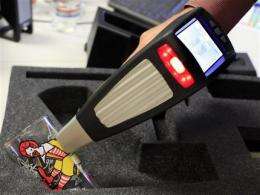
First, AP screened them using a state-of-the-art Olympus Innov-X gun that shoots X-rays into a glass and delivers an estimate of how much lead, cadmium or various other elements are present.
The glasses were then sent to ToyTestingLab, which is accepted by the CPSC as an accredited laboratory for a range of procedures.
The glasses were tested according to the procedure that the safety commission used in the "Shrek" recall. The decorated surface of each glass was stroked 30 times with water-soaked wipes, with each stroke representing a hand touch. The wipes were then analyzed for how many micrograms of lead, cadmium or other elements they collected.
Finally, for seven of the superhero and Oz glasses the lab extracted samples of the decorations. That colored enamel was analyzed for its total lead content.
"I was extremely surprised at the levels," said Paul Perrotti, ToyTestingLab's director, of the total content test. He said his lab has seen glasses that fail to meet government standards, "But not 30 percent lead."
Despite what Perrotti described as "grossly high" levels, the wipe testing picked up very little lead coming out from these seven glasses. His staff had to use a diamond-tipped grinder to remove the colors, suggesting the enamel was strongly bonded to the glass.
Perrotti and glass engineers interviewed by AP said the surface of the glasses AP tested could break down with repeated use, scouring and trips to the dishwasher, making the metals more accessible.
Following a cascade of problems with products manufactured in China, Congress in 2008 passed strict new limits that effectively ban lead in any children's product. The underlying materials in these products - including the baked-in enamel - cannot be more 0.03 percent lead.
Lead has long been known to reduce IQ in kids; recent research suggests cadmium also can damage young brains. Cadmium also is a carcinogen that can harm kidneys and bones, especially if it accumulates over time.
Cadmium, however, also happens to be an indispensable pigment for an important part of the color palette - without it there is no "fire engine red" (think Superman's cape and Dorothy's slippers). Lead on the other hand is not essential.
A lot of a toxic metal in a glass does not necessarily mean a health hazard. Most of the 35 lab-tested glasses were safe under normal conditions - their decorations shed very low or no detectable amounts of lead or cadmium. Among those that did release higher levels in the wipe test, none gave off nearly enough to make someone immediately sick, according to AP's analysis of the results.
Instead, the concern is low levels of exposure over weeks or months, whether kids also are eating a sandwich or licking their fingers.
In addition to the seven contaminated Oz and superhero glasses, 10 others raised concern over longer-term contact - two for both lead and cadmium, five for lead only and three for cadmium only. According to widely used computer modeling, the contamination that came off three of the glasses could measurably increase a child's blood lead level.
If half of what gets onto a child's hand enters their mouth, as the CPSC calculates, seven of the glasses would require fewer than 20 hand touches for kids age 6 and under to exceed U.S. Food and Drug Administration guidelines for the maximum amount of lead they should ingest in a day.
Most of the 10 additional glasses were released before 2000, including a Disney "Goofy" glass distributed by McDonald's that shed lead and cadmium, and three "Return of the Jedi" glasses from 1983 released by Burger King. One of the "Jedi" glasses hit the FDA lead level for 6-year-olds after just eight touches.
Both fast food chains said in statements that their glasses met applicable safety standards at the time they were manufactured. Disney, which ran several promotions with McDonald's for glassware AP tested, had no comment.
Using computer modeling, nationally recognized toxicologist Dr. Paul Mushak, who has advised government agencies including the CPSC and now operates a consulting practice in North Carolina, concluded that if half of what came off the glasses was ingested, it could raise a 5- to 6-year-old's blood lead level by 11 percent on the high end and 4 percent on average.
The blood level changes didn't alarm Mushak, but he expressed concern because lead from the glasses would be absorbed into the bones, only to be released much later in life, for example in menopausal women.
Mushak suggested that the safety commission's wipe test could underestimate real-world exposure, because it uses water on the wipes, a very mild approach. AP's testing showed that when glasses were subjected to a wipe wetted with artificial sweat, the amounts of lead or cadmium that came off were up to four times higher than water wipes.
Members of the association representing the U.S. glassware industry say the glasses are safe and strongly protest that the wipe test does not accurately reflect how much lead or cadmium escapes in the real world.
Myra Warne, executive director of the Society of Glass and Ceramic Decorated Products, said she is frustrated that the CPSC used it, rather than a more commonly used method developed by the FDA.
"As we are aware, government agencies don't always (or perhaps often) share their insight and knowledge with one another which is likely why CPSC and others are fixated on improper test protocol for our products," she wrote in an e-mail.
©2010 The Associated Press. All rights reserved. This material may not be published, broadcast, rewritten or redistributed.


