Modeling autism in a dish
November 11, 2010

Modeling autism in a dish

Enlarge

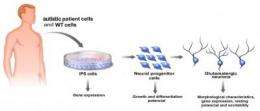
Human induced pluripotent stem (iPS) cells derived from patients with Rett syndrome allow researchers to replicate autism in the lab and study the molecular pathogenesis of the disease. Credit: Illustration: Courtesy of Jamie Simon, Salk Institute for Biological Studies

A collaborative effort between researchers at the Salk Institute for Biological Studies and the University of California, San Diego, successfully used human induced pluripotent stem (iPS) cells derived from patients with Rett syndrome to replicate autism in the lab and study the molecular pathogenesis of the disease.

Their findings, published in the Nov. 12, 2010, issue of Cell, revealed disease-specific cellular defects, such as fewer functional connections between Rett neurons, and demonstrated that these symptoms are reversible, raising the hope that, one day, autism maybe turn into a treatable condition.

"Mental disease and particularly autism still carry the of bad parenting," says lead author Alysson Muotri, Ph.D., an assistant professor in the Department of Molecular and Cellular Medicine at the University of California, San Diego School of Medicine. "We show very clearly that autism is a biological disease that is caused by a developmental defect directly affecting ."

Rett syndrome is the most physically disabling of the . Primarily affecting girls, the symptoms of Rett syndrome often become apparent just after they have learned to walk and say a few words. Then, the seemingly normal development slows down and eventually the infants regress, loosing speech and motor skills, developing stereotypical movements and autistic characteristics.

Almost all cases of the disease are caused by a single mutation in the MeCP2 gene, which is involved in the regulation of global , leading to a host of symptoms that can vary widely in their severity.
Modeling autism in a dish
Enlarge

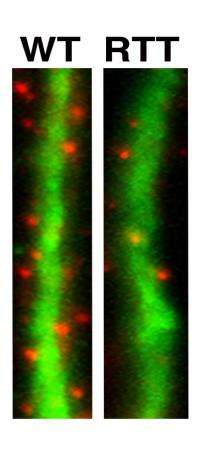
Neurons generated from Rett-iPS cells form fewer synapses, the specialized signal transmission points between brain cells. Synapses are shown in red and dendrites, which function as signal receivers, are shown in green. Credit: Image: Courtesy of Dr. Carol Marchetto, Salk Institute for Biological Studies.

"Rett syndrome is sometimes considered a 'Rosetta Stone' that can help us to understand other developmental neurological disorders since it shares with other conditions such as autism and schizophrenia," says first author Carol Marchetto, Ph.D., a postdoctoral researcher in the Laboratory of Genetics at the Salk Institute.

In the past, scientists had been limited to study the brains of people with autistic spectrum disorders via imaging technologies or postmortem brain tissues. Now, the ability to obtain iPS cells from patients' skin cells, which can be encouraged to develop into the cell type damaged by the disease gives scientists an unprecedented view of autism.

"It is quite amazing that we can recapitulate a psychiatric disease in a Petri Dish," says lead author Fred Gage, Ph.D., a professor in the Salk's Laboratory of Genetics and holder of the Vi and John Adler Chair for Research on Age-Related Neurodegenerative Diseases. "Being able to study Rett neurons in a dish allows us to identify subtle alterations in the functionality of the neuronal circuitry that we never had access to before."

Marchetto started with skin biopsies taken from four patients carrying four different mutations in the MeCP2 gene and a healthy control. By exposing the skin cells to four reprogramming factors, she turned back the clock, triggering the cells to look and act like embryonic stem cells. Known at this point as induced pluripotent stem cells, the Rett-derived cells were indistinguishable from their normal counterparts.

It was only after she had patiently coaxed the iPS cells to develop into fully functioning neurons—a process that can take up to several months—that she was able to discern differences between the two. Neurons carrying the MeCP2 mutations had smaller cell bodies, a reduced number of synapses and dendritic spines, specialized structures that enable cell-cell communication, as well as electrophysical defects, indicating that things start to go wrong early in development.

Since insulin-like growth factor 1 (IGF-1)—a hormone which, among other things, has a role in regulating cell growth and neuronal development—was able to reverse some of the symptoms of Rett syndrome in a mouse model of disease, the Salk researchers tested whether IGF-1 could restore proper function to human Rett neurons grown in culture.

"IGF-1 treatment increased the number of synapses and spines reverting the neuronal phenotype closer to normal," says Gage. "This suggests that the autistic phenotype is not permanent and could be, at least partially, reversible."

Muotri is particularly excited about the prospect of finding a drug treatment for Rett syndrome and other forms of autism: "We now know that we can use disease-specific iPS to recreate mental disorders and start looking for new drugs based on measurable molecular defects."

Provided by Salk Institute search and more info website


Rank 5 /5 (1 vote)
Relevant PhysicsForums posts
  • A question about drug tolerance
    createdMay 23, 2012
  • Poor nutrition leading to overeating?
    createdMay 23, 2012
  • Math and dyslexia?
    createdMay 21, 2012
  • portable metabolism meter?
    createdMay 21, 2012
  • Rare medical conditions on 20/20 tonight
    createdMay 18, 2012
  • "Good" Cholesterol in Doubt
    createdMay 17, 2012
  • More from Physics Forums - Medical Sciences

More news stories

Of mice and mental models: Neuroscientific implications of risk-optimized behavior in the mouse

(Medical Xpress) -- Regardless of an organism’s biological complexity, every encephalized animal continuously makes under-informed behavioral choices that can have serious consequences. Despite its ubiquity, ...

Medicine & Health / Neuroscience

created 43 minutes ago | popularity not rated yet | comments 0 | with audio podcast feature

Researchers identify key brain cell in antidepressant action

(Medical Xpress) -- Antidepressant medications such as Prozac have helped improve mood and lessen anxiety in millions of people with major depression. But scientists know surprisingly little about how these drugs work.

Medicine & Health / Medical research

created 59 minutes ago | popularity not rated yet | comments 0 | with audio podcast

New prostate cancer screening guidelines face a tough sell, study suggests

(Medical Xpress) -- Recent recommendations from the U.S. Preventive Services Task Force (USPSTF) advising elimination of routine prostate-specific antigen (PSA) screening for prostate cancer in healthy men are likely to encounter ...

Medicine & Health / Cancer

created 1 hour ago | popularity not rated yet | comments 0

Questionable research practices surprisingly common

(Medical Xpress) -- Not all scientific misconduct is flat-out fraud. Much falls into the murkier realm of “questionable research practices.” A new study finds that in one field, psychology, these practices are surprisingly ...

Medicine & Health / Psychology & Psychiatry

created 56 minutes ago | popularity not rated yet | comments 0 | with audio podcast

Energy levels link sleep control mechanisms

Sleep, or lack of it, can determine level of cognitive performance which is linked with accidents as well as increased risk of serious health problems. Links between cell energy levels, gene transcription ...

Medicine & Health / Medical research

created 34 minutes ago | popularity not rated yet | comments 0


Researchers demonstrate possible primitive mechanism of chemical info self-replication

(Phys.org) -- When scientists think about the replication of information in chemistry, they usually have in mind something akin to what happens in living organisms when DNA gets copied: a double-stranded molecule ...

Looking out for the Myanmar snub-nosed monkey

A new genetic study has shed light on how the newly discovered Myanmar snub-nosed monkey evolved.

Alibaba.com $2.5B privatization bid approved

(AP) -- Chinese e-commerce firm Alibaba Group's $2.5 billion bid to take its Hong Kong-listed unit private was cleared Friday by minority shareholders, easing the way for CEO Jack Ma to gain more control over his company's ...

SKA super telescope to be built in Australia, South Africa

Australia and South Africa will share the location for the world's most powerful radio telescope, the Square Kilometre Array's scientific consortium announced on Friday.

Researchers successfully test solar desalination system for arid land agriculture

Ben-Gurion University of the Negev (BGU) researchers have created a man-made oasis in the desert with the successful application of a solar-powered desalination system that provides water for irrigation in arid regions. The ...

ESA: Unveiling Venus

With Venus about to get its day in the Sun — very much literally — the European Space Agency has assembled an excellent video about our planetary neighbor.