Researchers fight America's 'other drug problem'
November 17, 2010

Researchers fight America's 'other drug problem'

Enlarge

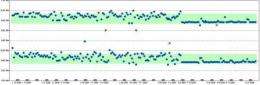
The graph depicts a patient’s medication-taking habits: the scattered dots illustrate irregular adherence (before the intervention), followed by consistent dots that depict improved adherence immediately after beginning the Continuous Self-Improvement strategy. Credit: MU

Medications do not have a chance to fight health problems if they are taken improperly or not taken at all. Non-adherence to medications costs thousands of lives and billions of dollars each year in the United States alone, according to the New England Healthcare Institute. Now, researchers at the University of Missouri have developed an intervention strategy that is three times more effective than previously studied techniques at improving adherence in patients.

Cynthia Russell, associate professor in the MU Sinclair School of Nursing, found that patients who used a Continuous Self-Improvement strategy drastically improved their . The strategy focuses on counseling patients to understand how taking medications can fit into their daily routines. Nurses meet with patients and discuss their daily schedules to identify optimal times to take medications and safe places to store their medications.

"Continuous Self-Improvement is a personalized strategy, and the scheduling is different for every patient," Russell said. "Finding the right place and time for patients to take medications can be as simple as storing the pill bottles in their cars so their medication will be available for them to take during the morning commute to work."

In the study, kidney transplant patients were given pill bottles with caps that automatically recorded the date and time whenever they were opened. Each month, a nurse reviewed the results in illustrated reports with the patients and discussed how they could improve their adherence. The researchers found significant improvements among patients' adherence rates. The results indicate the technique is three times more effective than previously studied techniques.

Russell recommends that patients meet with nurses to implement the strategy a few months after procedures, when they have returned to their normal routines. During follow-up appointments, patients can discuss potential problems and strategies for taking their medications.

"Ideally, all patients should use electronic monitoring pill bottles because it enables them to see computerized graphs of their previous month's medication schedules and medication taking," Russell said. "We found that patients enjoyed seeing their results at each meeting and were interested in receiving the feedback."

An estimated 35 percent of kidney transplant patients do not take their medications daily and 75 percent do not take their medications at the correct times. It is important for transplant to take medications correctly because incorrect dosages could result in side-effects, rejection of the organs or death.

Provided by University of Missouri-Columbia search and more info website


Rank not rated yet
Relevant PhysicsForums posts
  • A question about drug tolerance
    createdMay 23, 2012
  • Poor nutrition leading to overeating?
    createdMay 23, 2012
  • Math and dyslexia?
    createdMay 21, 2012
  • portable metabolism meter?
    createdMay 21, 2012
  • Rare medical conditions on 20/20 tonight
    createdMay 18, 2012
  • "Good" Cholesterol in Doubt
    createdMay 17, 2012
  • More from Physics Forums - Medical Sciences

More news stories

Of mice and mental models: Neuroscientific implications of risk-optimized behavior in the mouse

(Medical Xpress) -- Regardless of an organism’s biological complexity, every encephalized animal continuously makes under-informed behavioral choices that can have serious consequences. Despite its ubiquity, ...

Medicine & Health / Neuroscience

created 13 minutes ago | popularity not rated yet | comments 0 | with audio podcast feature

Rockefeller scientists pioneer new method to determine mechanisms of drug action

(Medical Xpress) -- Knowing that a drug works is great. Knowing how it works is a luxury. And until now, determining a drug’s mechanism of action has been a tedious and difficult process for scientists.

Medicine & Health / Medical research

created 48 minutes ago | popularity not rated yet | comments 0 | with audio podcast

Researchers identify key brain cell in antidepressant action

(Medical Xpress) -- Antidepressant medications such as Prozac have helped improve mood and lessen anxiety in millions of people with major depression. But scientists know surprisingly little about how these drugs work.

Medicine & Health / Medical research

created 29 minutes ago | popularity not rated yet | comments 0 | with audio podcast

Routine care for Crohn's disease in children should include measurement of bone age

(Medical Xpress) -- Measuring bone age should be a standard practice of care for pediatric patients with Crohn’s disease, in order to properly interpret growth status and improve treatment, according to a new study from ...

Medicine & Health / Inflammatory disorders

created 45 minutes ago | popularity not rated yet | comments 0 | with audio podcast

New prostate cancer screening guidelines face a tough sell, study suggests

(Medical Xpress) -- Recent recommendations from the U.S. Preventive Services Task Force (USPSTF) advising elimination of routine prostate-specific antigen (PSA) screening for prostate cancer in healthy men are likely to encounter ...

Medicine & Health / Cancer

created 29 minutes ago | popularity not rated yet | comments 0


Landmark calculation clears the way to answering how matter is formed

(Phys.org) -- An international collaboration of scientists, including Thomas Blum, associate professor of physics, is reporting in landmark detail the decay process of a subatomic particle called a kaon – ...

Researchers demonstrate possible primitive mechanism of chemical info self-replication

(Phys.org) -- When scientists think about the replication of information in chemistry, they usually have in mind something akin to what happens in living organisms when DNA gets copied: a double-stranded molecule ...

Synthetic nano-waste does not disappear

(Phys.org) -- Tiny particles of cerium oxide do not burn or change in the heat of a waste incineration plant. They remain intact on combustion residues or in the incineration system, as a new study by Swiss ...

Building a better solar panel -- one molecule at a time

(Phys.org) -- One of the fundamental building blocks in modern chemistry, an organometallic chemical compound called ferrocene, has never been structurally defined - until now.

Get ready for the transit of Venus

Scientists and amateur astronomers around the world are preparing to observe the rare occurrence of Venus crossing the face of the Sun on 5-6 June, an event that will not be seen again for over a hundred years.

Earliest musical instruments in Europe 40,000 years ago

The first modern humans in Europe were playing musical instruments and showing artistic creativity as early as 40,000 years ago, according to new research from Oxford and Tübingen universities.