
This image shows the detailed anatomical features of the brain that Radovitzky and his colleagues analyze using models that simulate explosive blasts. Image: Michelle Nyein
(PhysOrg.com) -- More than half of all combat-related injuries sustained by U.S. troops are the result of explosions, and many of those involve injuries to the head. According to the U.S. Department of Defense, about 130,000 U.S. service members deployed in Iraq and Afghanistan have sustained traumatic brain injuries -- ranging from concussion to long-term brain damage and death -- as a result of an explosion. A recent analysis by a team of researchers led by MIT reveals one possible way to prevent those injuries -- adding a face shield to the helmet worn by military personnel.
In a paper to be published Monday in the Proceedings of the National Academy of Sciences, Raul Radovitzky, an associate professor in MIT's Department of Aeronautics and Astronautics, and his colleagues report that adding a face shield to the standard-issue helmet worn by the vast majority of U.S. ground troops could significantly reduce traumatic brain injury, or TBI. The extra protection offered by such a shield is critical, the researchers say, because the face is the main pathway through which pressure waves from an explosion are transmitted to the brain.
In assessing the problem, Radovitzky, who is also the associate director of MIT's Institute for Soldier Nanotechnologies, and his research team members recognized that very little was known about how blast waves interact with brain tissue or how protective gear affects the brain's response to such blasts. So they created computer models to simulate explosions and their effects on brain tissue. The models integrate with unprecedented detail the physical aspects of an explosion, such as the propagation of the blast wave, and the anatomical features of the brain, including the skull, sinuses, cerebrospinal fluid, and layers of gray and white matter.
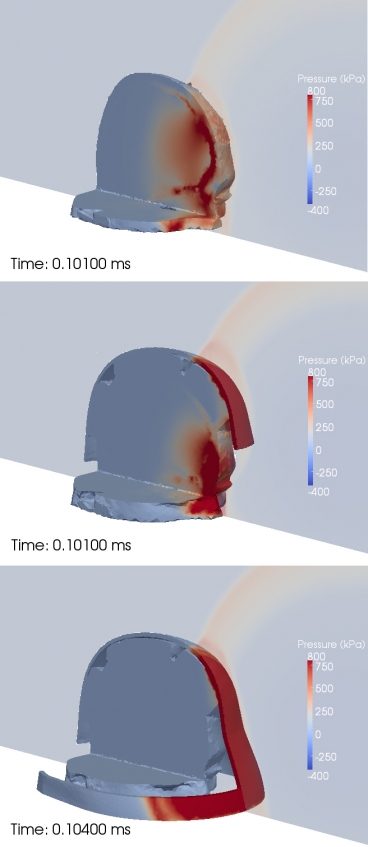
These images show the pressure waves that are transmitted to the brain tissue for the three simulation scenarios considered by Radovitzsky’s team: unprotected head (top), head with helmet (middle), and head with helmet and face shield (bottom). The face shield clearly prevents the direct transmission of blast energy into the brain. Images: Michelle Nyein
"There is a community studying this problem that is in dire need of this technology," says Radovitzky, who is releasing the computer code for the creation of the models to the public this week. In doing so, he hopes the models will be used to identify ways to mitigate TBI, which has become prominent because advances in protective gear and medicine have meant that more service members are surviving blasts that previously would have been fatal.
To create the models, Radovitzky collaborated with David Moore, a neurologist at the Defense and Veterans Brain Injury Center at Walter Reed Army Medical Center, who used magnetic resonance imaging to model features of the head. The researchers then added data collected from colleagues' studies of how the brain tissue of pigs responds to mechanical events, such as shocks. They also included details about what happens to the chemical energy that is released upon detonation (outside the brain) that instantly converts into thermal, electromagnetic and kinetic energy that interacts with nearby material, such as a soldier's helmet.
The researchers recently used the models to explore one possibility for enhancing the helmet currently worn by most ground troops, which is known as the Advanced Combat Helmet, or ACH: a face shield made of polycarbonate, a type of transparent armor material. They compared how the brain would respond to the same blast wave simulated in three scenarios: a head with no helmet, a head wearing the ACH, and a head wearing the ACH with a face shield. In all three simulations, the blast wave struck the person from the front.
The analysis revealed that although the ACH — as currently designed and deployed — slightly delayed the arrival of the blast wave, it didn't significantly mitigate the wave's effects on brain tissue. After the researchers added a conceptual face shield in the third simulation, the models showed a significant reduction in the magnitude of stresses on the brain because the shield impeded direct transmission of blast waves to the face.
Radovitzky hopes that the models will play a major role in developing protective gear not only for the military, but also for researchers studying the effects of TBI in the civilian population as a result of car crashes and sports injuries. While the study was limited to a single set of blast characteristics, future simulations will study different kinds of blast conditions, such as angle and intensity, as well as the impact of blast waves on the neck and torso, which have been suggested as a possible indirect pathway for brain injury.
More information:
"In silico investigation of intracranial blast mitigation with relevance to military traumatic brain injury," by Nyein, M., Jason, A., Yu. L., Pita, C., Joannopoulos, J., Moore, D., Radovitzky, R. Proceedings of the National Academy of Sciences, 22 November, 2010.
(for the code, please email: tbi-modeling(at)mit.edu)
Provided by Massachusetts Institute of Technology


