Portable breast scanner allows cancer detection in the blink of an eye
Oct 27, 2010

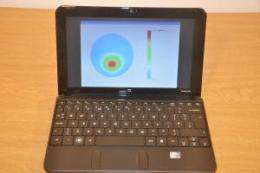
(PhysOrg.com) -- Professor Zhipeng Wu has invented a portable scanner based on radio frequency technology, which is able to show in a second the presence of tumours – malignant and benign – in the breast on a computer.

Using radio frequency or microwave technology for breast cancer detection has been proven by researchers in the US, Canada and UK. However, up to now, it can take a few minutes for an image to be produced, and this had to be done in a hospital or specialist care centre.

Now Professor Wu, from the University's School of Electrical and Electronic Engineering, says concerned patients can receive real-time video images in using the radio frequency scanner which would clearly and simply show the presence of a tumour.

Not only is this a quicker and less-intrusive means of testing, it also means can be tested at GP surgeries, which could help dramatically reduce waiting times and in some cases avoid unnecessary X-ray mammography. The scanner could also be used at home for continuous monitoring of breast health.

The patented real-time radio frequency scanner uses computer tomography and works by using the same technology as a mobile phone, but with only a tiny fraction of its power.

This makes it both safe and low-cost and the electronics can be housed in a case the size of a lunch box for compactness and portability. Other existing systems are much larger.

Breast cancer is the second biggest killer in women, accounting for 8.2% of all cancer deaths. October is National Breast Cancer Awareness month.

The usual way of detecting breast cancer up to now is mammography, which works well for women over the age of 50 and can give results of up to 95% accuracy.

But it is far less effective for younger women. The detection rate could be as low as 60% for women under the age of 50, which accounts for 20% of all breast cancer cases.

At that stage it is even more important get accurate diagnosis. Early diagnosis and treatment could save thousands of lives.

The main difference between the two methods is that mammography works on density, while radio frequency technique works on dielectric contrasts between normal and diseased breast tissues.

In Professor Wu's design, as soon as the breast enters the cup an image appears on screen.

The presence of a tumour or other abnormality will show up in red as the sensor detects the difference in tissue contrasts at radio frequencies. Malignant tissues have higher permittivity and conductivity and therefore appear differently than normal ones to a screen.

Up to 30 images are generated every second, meaning a breast scan could be over in a far shorter time than they are currently.

Professor Wu said: "The system we have is portable and as soon as you lie down you can get a scan – it's real-time.

"The real-time imaging minimises the chance of missing a breast during scanning.

"Other systems also need to use a liquid or gel as a matching substance, such as in an ultrasound, to work but with our system you don't need that – it can be done simply in oil, milk, water or even with a bra on.

"Although there is still research to be done, the system has great potential to bring a new way for breast cancer diagnosis.

"This will benefit millions of women in both developed and developing countries bearing in mind that one in nine women may develop in their lifetime."

Professor Wu submitted his innovation of the sensor system to the IET Innovation Awards. The technology has been shortlisted in both Electronics and Measurement in Action categories. The winners will be announced in November.

Explore further: Small cancer risk following CT scans in childhood and adolescence confirmed

Related Stories

Magnetic resonance imaging improves breast cancer diagnosis

Mar 28, 2007

Women who have been diagnosed with breast cancer in one breast have a higher risk of contracting the disease in their opposite breast as well. A thorough examination of the opposite breast using mammography and ultrasound ...

Breast cancer tumors grow faster in younger women

May 08, 2008

A new approach to estimating tumour growth based on breast screening results from almost 400,000 women is published today BioMed Central’s open access journal, Breast Cancer Research. This new model can also estimate the pr ...

New breast cancer test under study

Jul 22, 2008

Whether a painless, portable device that uses electrical current rather than X-ray to look for breast cancer could be an alternative to traditional mammograms is under study at the Medical College of Georgia.

No need for gene screens in breast cancer families

Jul 23, 2008

Research reported today should provide relief to women who are worried after a relative's breast cancer diagnosis. The study in the open access journal BMC Cancer shows that a family history of breast cancer does not give a ...

Recommended for you

Changing cancer's environment to halt its spread

5 hours ago

By studying the roles two proteins, thrombospondin-1 and prosaposin, play in discouraging cancer metastasis, a trans-Atlantic research team has identified a five-amino acid fragment of prosaposin that significantly reduces ...

Novel RNA-based classification system for colorectal cancer

5 hours ago

A novel transcriptome-based classification of colon cancer that improves the current disease stratification based on clinicopathological variables and common DNA markers is presented in a study published in PLOS Medicine this w ...

Low radiation scans help identify cancer in earliest stages

7 hours ago

A study of veterans at high risk for developing lung cancer shows that low-dose computed tomography (LDCT) can be highly effective in helping clinicians spot tiny lung nodules which, in a small number of patients, may indicate ...

User comments : 0

More news stories

If you can remember it, you can remember it wrong

(Medical Xpress)—Native peoples in regions where cameras are uncommon sometimes react with caution when their picture is taken. The fear that something must have been stolen from them to create the photo ...

B vitamins could delay dementia

(Medical Xpress)—Despite spending billions of dollars on research and development, drug companies have been unable to come up with effective treatments for dementia and Alzheimer's Disease (AD). Now, A. ...

Reducing caloric intake delays nerve cell loss

Activating an enzyme known to play a role in the anti-aging benefits of calorie restriction delays the loss of brain cells and preserves cognitive function in mice, according to a study published in the May ...

New sleeping pill poised to hit US markets

An experimental sleeping pill from US drug company Merck is effective at helping people fall and stay asleep, according to reviewers at the US Food and Drug Administration, which could soon approve the new drug.

Changing cancer's environment to halt its spread

By studying the roles two proteins, thrombospondin-1 and prosaposin, play in discouraging cancer metastasis, a trans-Atlantic research team has identified a five-amino acid fragment of prosaposin that significantly reduces ...

New method for producing clean hydrogen

Duke University engineers have developed a novel method for producing clean hydrogen, which could prove essential to weaning society off of fossil fuels and their environmental implications.