How memories are born
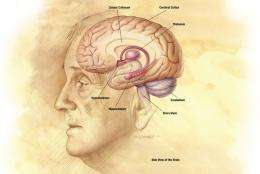
(PhysOrg.com) -- When we experience something new, or wish to remember something important, groups of cells deep inside the center of our brains fire in unison as a new memory is born.
The ability to encode memories is important if we wish to remember where we left our car keys, how to drive back to work in the morning, or the name of a new friend. But creating and storing new memories can be especially difficult for some older individuals and those with Alzheimer’s disease and other forms of dementia.
At the University of Connecticut, Professor Etan Markus, a behavioral neuroscientist in the Department of Psychology, has found a way to improve memory encoding in older rats by stimulating a part of the brain called the medial septum with a drug that activates neurotransmitters critical to the creation of new memories.
The research, published in the Journal of Neuroscience, could have implications for older individuals with memory deficits and Alzheimer’s patients, for whom one of the biggest concerns is their ability to remember their surroundings so they don’t get lost. The brains of rats and human beings are nearly identical in terms of developing and processing memory.
“How we get from one group of cells and a signal code for a location to the fact that I will or won’t remember who you are tomorrow is one of the things I find most interesting,” says Markus. “Here in my lab, we work with older animals to see what’s different.”
Markus cautions that his research is still preliminary and much more work needs to be done to clarify the medial septum’s interaction with the hippocampus – the mind’s nerve center for memory creation and spatial navigation – but he concedes that the initial results are encouraging.
Dr. Simona Sava, a former graduate student in the lab (now at the Department of Psychiatry at Harvard Medical School), joined Markus in the research, which was supported by a grant from the National Institutes of Health. UConn associate professors Monty Escabi and James Chrobak also assisted, as did graduate student Jamie Bunce. UConn’s Department of Psychology is part of the College of Liberal Arts and Sciences.
Markus’s research focuses on a memory process known as mapping and remapping. When rats and human beings create a new memory, they are effectively forming a representation, or “mapping” that location or moment and encoding it in their brains. Using advanced monitoring technologies, Markus has been able to actually “hear” place cells in a rat’s mind firing as the animal creates a memory and encodes its route through a maze. The burst of place cell activity the rat experiences when it searches for a food source is conveyed as a staccato series of “pops,” like tiny firecrackers, when picked up by the high-tech monitors in the lab.
“We know that older animals and people have a harder time creating new memories,” Markus says. “When the brain chooses to map or remap is important. You don’t want to remap every time you get in your car. But you probably want your representation of the environment to change if you found a faster way to get to work.”
Markus hypothesized that the medial septum modulates whether the hippocampus retrieves a prior memory (recalls an existing map) or encodes a new one through the activation of acetylcholine or ACh, which is a major neurotransmitter in the central nervous system. Levels of ACh are reduced in aging and have been linked to age-related memory problems.
To test this theory, the research team developed an experiment to see what happens to the brain representation when an older rat experiences a new route in a maze. The team also wanted to see what would happen if the rat repeated the route again, a few minutes later or the next day.
They learned that older rats that were exposed to a cholinergic drug – in this case Carbachol – developed maps faster and were able to retrieve the map better the next day than a control group of older rats not exposed to the drug.
Interestingly, Markus says, increasing ACh activity in the medial septum actually impaired younger rats and older rats that were already well-trained to follow a certain path to food in a maze. Markus says the exposure to Carbachol appears to have over-stimulated the mapping process so that their brains were re-mapping more than they should.
The medial septum research focused solely on the brain’s response to a new environment. As a follow up, Markus, together with graduate students Tara Jacobson and Brandy Schmidt and a number of undergraduate students, and in collaboration with Chrobak, is testing memory activity in older rats. The research team is currently determining the effects of Physostigmine (another cholinergic drug) on the rats’ ability to learn a new route. They predict that cholinergic stimulation will help older rats when they need to learn something new, but be detrimental if they need to remember something already stored in their brain.
When it comes to humans, prior research by other scientists involving the stimulation of the human cholinergic nervous system produced relatively poor results. Markus believes his recent research explains why.
“What we believe is that when you’re improving the bad stuff you’re also screwing up the good stuff,” Markus says. “This drug needs to be on board only in situations where there may be a memory deficit, and it’s most useful only the moment you need to learn something new.”


