Imaging study shows brain responds more to close friends
Oct 12, 2010
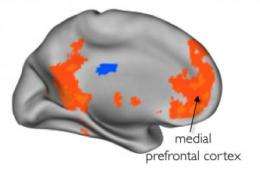
Brain regions that respond to information about friends are shown in orange and overlap a network of regions known to process personally relevant stimuli; regions that respond more to strangers are in blue. Notably, whether the person was perceived to be similar to the participant made no difference in brain response, suggesting that social alliances outweigh common interests. Credit: Courtesy, with permission: Krienen et al. The Journal of Neuroscience 2010.

People's brains are more responsive to friends than to strangers, even if the stranger has more in common, according to a study in the Oct. 13 issue of The Journal of Neuroscience. Researchers examined a brain region known to be involved in processing social information, and the results suggest that social alliances outweigh shared interests.

In a study led by graduate student Fenna Krienen and senior author Randy Buckner, PhD, of Harvard University, researchers investigated how the medial prefrontal cortex and associated signal someone's value in a social situation. Previous work has shown that perceptions of others' beliefs guide social interactions. Krienen and her colleagues wondered whether these regions respond more to those we know, or to those with whom we share similar interests.

"There are psychological and evolutionary arguments for the idea that the of 'similarity' and 'closeness' could get privileged treatment in the brain; for example, to identify insiders versus outsiders or kin versus non-kin," Krienen said. "However, these results suggest that social closeness is the primary factor, rather than social similarity, as previously assumed."

The researchers first imaged the of 32 participants as they judged how well lists of adjectives described their personalities. This helped to identify brain regions that respond to personally relevant information. In separate experiments, 66 different participants provided personality information about themselves and two friends — one friend whom they believed had similar preferences and one believed to be dissimilar.

The authors made up biographies of similar and dissimilar strangers for each volunteer based on their personality profiles. Then, while in a scanner, they played a game similar to the TV show "The Newlywed Game," in which participants predicted how another person would answer a question. For example, would a friend or stranger prefer an aisle or window seat on a flight?

The authors found activity in the increased when people answered questions about friends. Notably, whether the person had common interests made no difference in brain response.

"In all experiments, closeness but not similarity appeared to drive responses in medial prefrontal regions and associated regions throughout the brain," Krienen said. "The results suggest social closeness is more important than shared beliefs when evaluating others."

Read Montague, PhD, of Baylor College of Medicine, an expert on decision-making and computational neuroscience, said the study's large number of participants and experimental approach makes it a solid contribution to the field. "The authors address an important component of social cognition — the relevance of people close to us," Montague said.

Explore further: Controlling mood through the motions of mitochondria

add to favorites email to friend print save as pdf

Related Stories

How we remember each other

Apr 03, 2007

Researchers at McGill University’s Douglas Mental Health University Institute, in collaboration with a French team at the University of Paris, have used magnetic resonance imaging (MRI) to identify the part of the brain ...

Individuals with social phobia see themselves differently

Oct 06, 2008

Magnetic resonance brain imaging reveals that patients with generalized social phobia respond differently than others to negative comments about themselves, according to a report in the October issue of Archives of General Ps ...

Who am I? Adolescents' replies depend on others (w/ Video)

Jul 15, 2009

Ask middle-school students if they are popular or make friends easily, they likely will depend on social comparisons with their peers for an answer. Such reliance on the perceived opinions of others, or reflected ...

Imaging study provides glimpse of alcohol's effect on brain

Apr 29, 2008

New brain imaging research published this week shows that, after consuming alcohol, social drinkers had decreased sensitivity in brain regions involved in detecting threats, and increased activity in brain regions involved ...

Brain study suggests way to measure, treat autism

Feb 06, 2008

Researchers have pinpointed subtle deficits in the brains of people with autism spectrum disorder (ASD) that they say could aid more precise diagnoses and perhaps improve treatment of ASD. The researchers discovered characteristic ...

Recommended for you

Help at hand for people with schizophrenia

4 hours ago

How can healthy people who hear voices help schizophrenics? Finding the answer for this is at the centre of research conducted at the University of Bergen.

Controlling mood through the motions of mitochondria

20 hours ago

(Medical Xpress)—Regulating the distribution of power in neurons is done by a system that makes the national electric grid look simple by comparison. Each neuron has several thousand mitochondria confined ...

Depression common among children with temporal lobe epilepsy

May 23, 2013

A new study determined that children and adolescents with seizures involving the temporal lobe are likely to have clinically significant behavioral problems and psychiatric illness, especially depression. Findings published ...

User comments : 0

More news stories

Storm chasers: born to be wild?

(HealthDay)—We've all seen them: the surfers who race to the beach when a hurricane hits, the guy who decides to ride out the storm in his overmatched boat, the tornado chasers who fearlessly steer their ...

Modulating the immune system to combat metastatic cancer

Cancer cells spread and grow by avoiding detection and destruction by the immune system. Stimulation of the immune system can help to eliminate cancer cells; however, there are many factors that cause the immune system to ...

New fluorescent tools for cancer diagnosis

In recent years, microRNAs (miRNAs) and other non-coding RNAs are small molecules that help control the expression of specific proteins. In recent years they have emerged as disease biomarkers. miRNA profiles have been used ...

Dark, massive asteroid to fly by Earth on May 31

It's 1.7 miles long. Its surface is covered in a sticky black substance similar to the gunk at the bottom of a barbecue. If it impacted Earth it would probably result in global extinction. Good thing it is ...