Research aims to cut disparities in stroke care
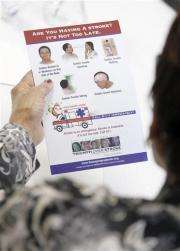
(AP) -- When her stroke hit, Edna Wooten somehow stopped her car. Then her grown daughter ignored her slurred protests and raced her to the hospital - in time for a drug to dissolve the blood clot causing her stroke.
Wooten was lucky: Too few stroke sufferers get that clot-busting treatment, especially black and Hispanic patients who are at highest risk of having a stroke and also may be particularly hesitant to seek fast care.
New research is targeting those underserved populations to better spread the word that "time is brain" - the faster you move the more brain you save.
"We basically scare people so much about stroke, it motivates them to denial," says Dr. Lewis Morganstern of the University of Michigan, an expert on stroke disparities. "What we haven't done a good job of is telling people there is an effective treatment, that people are in control of their own destiny."
That was the message stroke educator Shauna St. Clair of Georgetown University took to a senior center in a predominantly black neighborhood in the nation's capital last week, part of a project funded by the National Institutes of Health.
Most strokes are like a clogged pipe, St. Clair explained: Break up the clog and blood can resume feeding starving brain cells on the other side, which is what happened when Wooten, 61, was treated at a nearby hospital.
"Damaged brain cells we can fix. That's why we want you to get treatment as soon as possible," St. Clair told the rapt group. "If they stay damaged, they die."
About 795,000 Americans have a stroke every year. It is the nation's leading cause of disability and the No. 3 killer. Symptoms include: sudden numbness or weakness in the face, arm or leg, especially on one side; sudden trouble speaking or understanding speech, seeing or walking; a sudden super-severe headache.
While some strokes are caused by bleeding in the brain, the vast majority are ischemic strokes, the clot kind that the drug TPA can help treat - but only if it's given within a few hours of the first symptom.
Yet 14 years after TPA hit the market, overall only about 5 percent of U.S. patients get it. That's partly due to problems within the health care system - but also partly because only about a third of stroke sufferers get to the hospital in time for testing to tell if they're a good candidate.
Everyone needs to know to act fast if they experience or witness stroke symptoms. The new research comes because African-Americans have strokes at twice the rate of whites and are more likely to die. Hispanics are at increased risk of stroke as well. Worse, both populations tend to have strokes at much younger ages than whites.
Georgetown researchers tracked ischemic strokes for a year in Washington, and found black patients received TPA less often than whites in part because of slower hospital arrival - despite community surveys that found widespread knowledge about stroke symptoms.
"No, you can't wait to see if your symptoms go away," says Dr. Chelsea Kidwell, a Georgetown neurologist who heads the project. "No, you should not call your relative or friend. ... You've got to call 911."
The findings echo a major study that Morganstern leads in Corpus Christi, Texas, where Mexican-Americans were 40 percent less likely than whites to call 911 for a stroke.
The disconnect isn't surprising, says Dr. Walter Koroshetz, deputy director of the NIH's National Institute of Neurological Disorders and Stroke. The most common mistake among all populations when feeling a stroke symptom is to go rest.
Adding to the confusion are so-called mini-strokes, a TIA or "transient ischemic attack" where an artery is blocked for a few minutes, leaving no permanent damage. But it's a warning sign that a major stroke may be imminent, something prompt care to treat risk factors like high blood pressure might avert. Other studies have found half of people who have a TIA never tell a health provider.
It takes community-specific research to learn what act-fast messages work, Morganstern says. His Corpus Christi project recently taught middle-school students to call 911 if they witness someone having stroke symptoms, with homework assignments to teach their parents, too - thus reaching a hard-to-target population. Next, the project is designing ways that local Catholic churches can help with stroke education.
In Washington, Kidwell is working with ambulances to bypass the closest hospital for one of three certified "stroke centers" - hospitals with 24-hour special capabilities to give TPA.
The community education won't just target seniors but younger people who may witness a stroke, like the woman who told St. Clair she'd noticed her mother leaving church looking drunk - a loss of balance caused by a stroke.
And it will stress happy endings like Wooten's. She slept off a TIA two weeks earlier, and credits her daughter's love of TV hospital shows for recognizing the major stroke.
About an hour after getting the clot-buster, "it was like it never happened," says Wooten, who says her only lingering problem is a slight shake when her right hand holds something heavy. "I'm driving my car, I'm messing with my grandkids. Thank God I'm doing OK."
©2010 The Associated Press. All rights reserved. This material may not be published, broadcast, rewritten or redistributed.


