What do storm chasers really do? Two tornado scientists explain the chase and tools for studying twisters
Storm-chasing for science can be exciting and stressful—we know, because we do it. It has also been essential for developing today's understanding of how tornadoes form and how they behave.
In 1996 the movie "Twister" brought storm-chasing into the public imagination as scientists played by Helen Hunt and Bill Paxton raced ahead of tornadoes to deploy their sensors and occasionally got too close. That movie inspired a generation of atmospheric scientists.
With the new movie "Twisters" coming out on July 19, 2024, we've been getting questions about storm-chasing—or storm intercepts, as we call them.
Here are some answers about what scientists who do this kind of fieldwork are up to when they race off after storms.
What does a day of storm-chasing really look like?
The morning of a chase day starts with a good breakfast, because there might not be any chance to eat a good meal later in the day.
A ‘hook echo’ on radar, typically a curl at the back of a storm cell, is one sign that a tornado could form. The hook reflects precipitation wrapping around the back side of the updraft. Credit: National Severe Storms Lab
Vehicle-mounted equipment can act as mobile weather stations known as mesonets. These were used in the VORTEX2 research project. Dozens of scientists, including the authors, succeeded in recording the entire life cycle of a supercell tornado during VORTEX2 in 2009. Credit: Yvette Richardson
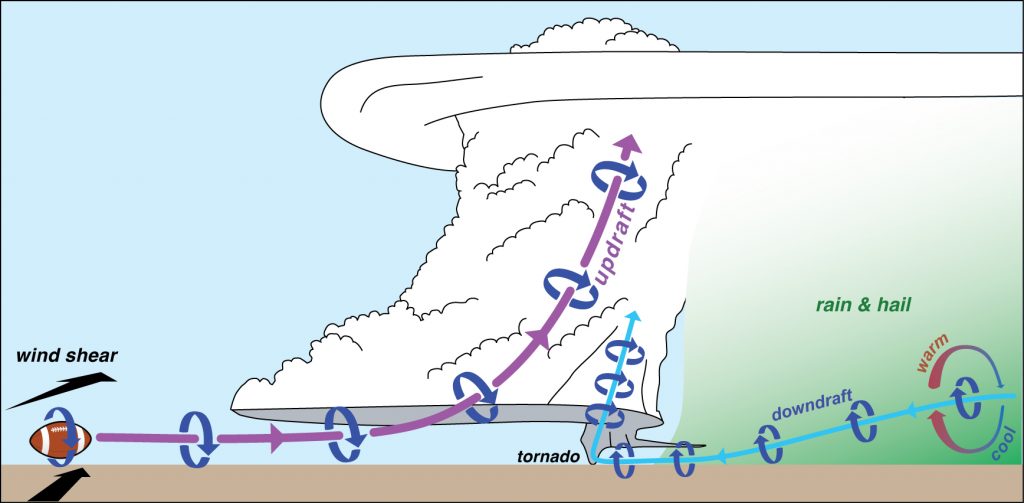
Formation of a tornado: Changes in wind speed and direction with altitude, known as wind shear, are associated with horizontal spin, similar to that of a football. As this spinning air is drawn into the storm’s updraft, the updraft rotates. A separate air stream descends through a precipitation-driven downdraft and acquires horizontal spin because of temperature differences along the air stream. This spinning air can be tilted into the vertical and sucked upward by the supercell’s updraft, contracting the spin near the ground into a tornado. Credit: Paul Markowski/Penn State