CERN observes melted nuclear matter for the first time
November 29th, 2010

CERN observes melted nuclear matter for the first time
Enlarge

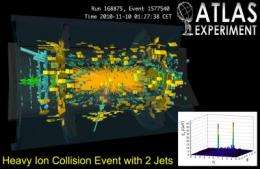
This is a picture of lead-lead collision measured in the ATLAS detector at CERN. The collision contains two powerful "jets" of particles. The new result of ATLAS shows that these can "melt" at the temperatures achieved in the lead collisions of the LHC. Credit: CERN

The experiments at CERN have entered a new phase and have obtained the first results. In the giant particle accelerator, LHC, collisions have until now been with protons. The new experiments have been made with lead ions, 208 times heavier than a proton, that are collided at colossal energies. Danish scientists from the Niels Bohr Institute take part in the ATLAS experiment, where new results show, for the first time that the constituents of nuclei can melt. This shows how we think the world looked around a billionth of a second after the Big Bang. The results are published in Physical Review Letter.

The ATLAS experiment at the LHC is built to explore the fundamental nature of the universe. This exploration is carried out in two ways. One way is using lead ion collisions where the properties of nuclear matter are are studied at extreme temperatures. The other is to use proton collisions, which permit detailed studies, not only of matter, but also also directly probe the fundamental forces of Nature, which govern the evolution of the universe.

Since Thursday November 4th CERN has been circulating bunches of lead ions in the 27 km (17 miles) underground LHC accelerator. Lead is a heavy element. The nucleus contains 208 particles of two varieties: protons and neutrons. The lead ions are accelerated to very high energies in the LHC accelerator.

Scientists of the Discovery center at the Niels Bohr Institute, University of Copenhagen have taken an active part in the build-up of the ATLAS experiment right from the beginning, 20 years ago. The experiment is now for the first time observing directly the effect on ordinary nucleons such as protons and neutrons when they traverse the hot primordial soup of the collisions.

At the first collisions that took place at 11.30 on Monday November 8th 2010, the combined energy of the collision reached 2750 GeV *208 (1 GeV= 1 billion electron Volt), 15 times the highest energy so far achieved anywhere.

"What we see is a collision between two lead ions in the ATLAS detector. We se two powerful 'jets', splashes of particles emitted into the detector at the moment of collision", Rasmus Mackeprang explains. As a scientist at the Niels Bohr Institute he can follow the experiments at CERN and immediately see when interesting results come out.

The protons and neutrons are 'dissolved' into their smaller constituents: quarks and gluons that fly away from the collision region. They will each form a tight 'shower' of new particles (such as protons and neutrons) that hit the detector at high energy. This behavior is well known and has been observed in different contexts since the 1970's.

What is new is, that at this picture ceases to be valid at the temperatures achievable at the LHC. Measurements show for the first time how some collisions are 'missing' jets that should be there. This means that only one jet from the collision survives and can be observed while the other one melts on its way through the collision region.

"This is the first time we directly observe the nuclei melt and dissolve into the state you might call the primordial soup of the universe" a very happy physicist, Rasmus Mackeprang explains. He adds that this feels as if being on a journey through time to the beginning of the universe.

Provided by University of Copenhagen

This PHYSorg Science News Wire page contains a press release issued by an organization mentioned above and is provided to you “as is” with little or no review from Phys.Org staff.

More news stories

Physicists close in on a rare particle-decay process

In the biggest result of its kind in more than ten years, physicists have made the most sensitive measurements yet in a decades-long hunt for a hypothetical and rare process involving the radioactive decay ...

Physics / General Physics

created 11 hours ago | popularity 5 / 5 (4) | comments 4 | with audio podcast

High-contrast, high-resolution CT scans now possible at reduced dose

Scientists have developed an X-ray imaging method that could drastically improve the contrast of computed tomography (CT) scans whilst reducing the radiation dose deposited during the scan. The new method ...

Physics / General Physics

created 10 hours ago | popularity 5 / 5 (1) | comments 0 | with audio podcast

European team bests Chinese record at teleporting distance (Corrected)

(Phys.org) -- A European team of physicists has bested the record set by a team of Chinese researchers last month for distance in teleporting quantum bits (qubits). Where the Chinese team accomplished their ...

Physics / Quantum Physics

created Jun 01, 2012 | popularity 3.9 / 5 (18) | comments 34 | with audio podcast report

Demonstration of "electronic ferroelectricity," new principle underlying electric polarization in organic ferroelectric

Researchers from the Institute of Materials Structure Science at KEK and RIKEN discovered a new phenomenon, “electronic ferroelectricity,” through electric polarization measurements and synchrotron X-ray diffraction ...

Physics / General Physics

created 16 hours ago | popularity 5 / 5 (1) | comments 0

Irish mathematicians explain why Guinness bubbles sink (w/ video)

(Phys.org) -- Why do the bubbles in a glass of stout beer such as Guinness sink while the beer is settling, even though the bubbles are lighter than the surrounding liquid? That’s been a puzzling question ...

Physics / General Physics

created May 29, 2012 | popularity 4.6 / 5 (13) | comments 21 | with audio podcast report


Higher taxes, smoke-free policies are reducing smoking in moms-to-be

It's estimated that almost 23% of women enter pregnancy as smokers and more than half continue to smoke during pregnancy, leading to excess healthcare costs at delivery and beyond. In one of the first studies to assess smoking ...

Post-stroke depression linked to functional brain impairment

Researchers studying stroke patients have found a strong association between impairments in a network of the brain involved in emotional regulation and the severity of post-stroke depression. Results of the study are published ...

Friction almost vanishes in microscale graphite

(Phys.org) -- In the phenomenon of superlubricity, two solid surfaces can slide past each other with almost no friction. The effect occurs when the solid surfaces have crystalline structures and their lattices ...

Reign of the giant insects ended with the evolution of birds, study finds

Giant insects ruled the prehistoric skies during periods when Earth's atmosphere was rich in oxygen. Then came the birds. After the evolution of birds about 150 million years ago, insects got smaller despite rising oxygen ...

Infectious disease may have shaped human origins, study says

An international team of researchers, led by scientists at the University of California, San Diego School of Medicine, suggest that inactivation of two specific genes related to the immune system may have ...

Giant black hole kicked out of home galaxy

(Phys.org) -- Astronomers have found strong evidence that a massive black hole is being ejected from its host galaxy at a speed of several million miles per hour. New observations from NASA's Chandra X-ray ...