News tagged with worms
Related topics: species , organisms , genes , proceedings of the national academy of sciences , protein
Stuxnet's origins decoded: Now we know who did it, but what does it mean?
Last week's New York Times adapted a portion of David Sanger's forthcoming "Confront and Conceal: Obama's Secret Wars and Surprising Use of American Power," which reveals that the United States has secretly conducted cyberattacks against Iran for several ...
8 hours ago |
3.7 / 5 (3) |
0
Global wave of Flame cyber attacks called staggering
(Phys.org) -- Kaspersky Lab has discovered complex malware that has been in operation for at least five years, collecting data from countries including both Israel and Iran. Kaspersky experts think the masterminds ...
How the worm knows where its nose is
For decades, scientists have studied Caenorhabditis elegans tiny, transparent worms to glean clues about how neurons develop and function. A new Harvard study suggests that the worms' nervous system is much m ...
May 16, 2012 |
5 / 5 (2) |
1
|
Ramnit's heist bags 45,000 Facebook passwords
(PhysOrg.com) -- Ramnit, the bank-thieving worm, is at it again, this time scoffing up Facebook accounts. The latest oh-look-another-threat is one that security watchers say could get ugly. Ramnit has grown ...
Immortal worms defy aging
Researchers from The University of Nottingham have demonstrated how a species of flatworm overcomes the ageing process to be potentially immortal.
Feb 27, 2012 |
4.8 / 5 (38) |
22
|
What makes a worm say 'yuck'
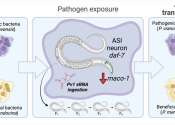
Researchers at Harvard-affiliated Massachusetts General Hospital (MGH) say they have uncovered a way that animals detect pathogens in their bodies that allows their systems to respond before cellular damage ...
May 15, 2012 |
5 / 5 (2) |
0
|
Tiny amounts of alcohol dramatically extend a worm's life, but why?
(PhysOrg.com) -- Minuscule amounts of ethanol, the type of alcohol found in alcoholic beverages, can more than double the life span of a tiny worm known as Caenorhabditis elegans, which is used frequently ...
Jan 20, 2012 |
4.8 / 5 (18) |
13
|
Silkworms spinning spider webs
(PhysOrg.com) -- A spiders silk is strong and more elastic and has a large range of possible medical applications. However, spiders have a history of being territorial and prone to cannibalism, so the idea ...
Protein analysis investigates marine worm community
(Phys.org) -- Techniques used by researchers from the Department of Energy's Oak Ridge National Laboratory to analyze a simple marine worm and its resident bacteria could accelerate efforts to understand more ...
May 09, 2012 |
not rated yet |
0
|
Worm seeks worm: Researchers find chemical cues driving aggregation in nematodes
(PhysOrg.com) -- Scientists have long seen evidence of social behavior among many species of animals, both on the earth and in the sea. Dolphins frolic together, lions live in packs, and hornets construct ...
Jan 12, 2012 |
not rated yet |
0
|
Gumby-like flexible robot crawls in tight spaces (w/ video)
Harvard scientists have built a new type of flexible robot that is limber enough to wiggle and worm through tight spaces.
Nov 28, 2011 |
4 / 5 (4) |
16
'Worm speak' uses chemicals to communicate
(PhysOrg.com) -- A species of small, transparent roundworms have a highly evolved language in which they combine chemical fragments to create precise molecular messages that control social behavior, reports ...
Jan 26, 2012 |
4.8 / 5 (13) |
4
|
Oldest fossils of large seaweeds, possible animals tell story about oxygen in an ancient ocean
Almost 600 million years ago, before the rampant evolution of diverse life forms known as the Cambrian explosion, a community of seaweeds and worm-like animals lived in a quiet deep-water niche under the sea ...
Space & Earth / Earth Sciences
Feb 16, 2011 |
4.4 / 5 (7) |
0
|
Humble worm helps Queensland and US scientists in nerve research
Australian and US scientists have developed a new technology for studying the genetics of a common roundworm used to understand nerve development and nerve degeneration.
May 01, 2012 |
5 / 5 (1) |
0
|
Why sex with a partner is better (w/ Video)
(PhysOrg.com) -- OK, it takes two for human reproduction, and now it seems that plants and animals that can rely on either a partner or go alone by self-fertilization give their offspring a better chance for ...
Oct 21, 2009 |
3.4 / 5 (18) |
1