Anthropologists find American heads are getting larger
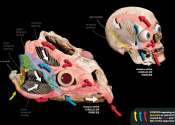
White Americans' heads are getting bigger. That's according to research by forensic anthropologists at the University of Tennessee, Knoxville.
May 30, 2012 |
3.5 / 5 (13) |
26
Change in developmental timing was crucial in the evolutionary shift from dinosaurs to birds: study
At first glance, it's hard to see how a common house sparrow and a Tyrannosaurus Rex might have anything in common. After all, one is a bird that weighs less than an ounce, and the other is a dinosaur that ...
Other Sciences / Archaeology & Fossils
May 27, 2012 |
4.9 / 5 (14) |
1
|
Facial structure of men and women has become more similar over time
Research from North Carolina State University shows that they really don't make women like they used to, at least in Spain. The study, which examined hundreds of Spanish and Portuguese skulls spanning four ...
Apr 04, 2011 |
4 / 5 (7) |
5
|
Neanderthal faces were not adapted to cold
(PhysOrg.com) -- New research into Neanderthal skulls suggests that facial features believed for over a century to be adaptations to extreme cold are unlikely to have evolved in response to glacial periods ...
Long lost cousin of T. rex identified by scientists
(PhysOrg.com) -- Scientists have identified a new species of gigantic theropod dinosaur, a close relative of T. rex, from fossil skull and jaw bones discovered in China.
Other Sciences / Archaeology & Fossils
Apr 01, 2011 |
3.6 / 5 (11) |
0
|
Researchers claim a third of dinosaurs might never have existed
(PhysOrg.com) -- A new ten-year study by US paleontologists suggests that up to a third of dinosaur fossils may have been incorrectly identified as new species, when they are actually juveniles of species ...
Immature skull led young Tyrannosaurs to rely on speed, agility to catch prey
While adult tyrannosaurs wielded power and size to kill large prey, youngsters used agility to hunt smaller game.
Other Sciences / Archaeology & Fossils
May 09, 2011 |
5 / 5 (4) |
0
|
Columbus cleared of bringing syphilis to Europe
(PhysOrg.com) -- A long-held theory has it that Christopher Columbus and his crew returned to Europe in 1493 from their trip to the Americas bringing syphilis with them, and research reported in PhysOrg in 2008 also suggested ...
Ancient 'Lucy' Species Ate A Different Diet Than Previously Thought
(PhysOrg.com) -- Research examining microscopic marks on the teeth of the "Lucy" species Australopithecus afarensis suggests that the ancient hominid ate a different diet than the tooth enamel, size and sh ...
Other Sciences / Archaeology & Fossils
Oct 22, 2009 |
3.8 / 5 (13) |
0
Research shows rats have best bite of rodent world
Scientists at the University of Liverpool have found that mice and rats have evolved to gnaw with their front teeth and chew with their back teeth more successfully than rodents that 'specialise' in one or ...
Apr 27, 2012 |
5 / 5 (2) |
4
|
Scientists Discover New Species of Tyrannosaur
New Mexico is known for amazing local cuisine, Aztec ruins and the Los Alamos National Laboratory. In the January issue of the Journal of Vertebrate Paleontology, paleontologists Thomas Williamson of the Ne ...
Other Sciences / Archaeology & Fossils
Feb 01, 2010 |
4.9 / 5 (9) |
0
|
Skulls show New World was settled twice: study
Two distinct groups from Asia settled in the New World and not one single migration as suggested by previous genetic studies, experts said Monday after comparing the skulls of early Americans.
Other Sciences / Archaeology & Fossils
Jun 14, 2010 |
4.7 / 5 (32) |
10
New 'shieldcroc' species of ancient crocodile discovered
A University of Missouri researcher has identified a new species of prehistoric crocodile. The extinct creature, nicknamed "Shieldcroc" due to a thick-skinned shield on its head, is an ancestor of today's ...
Other Sciences / Archaeology & Fossils
Jan 31, 2012 |
4.4 / 5 (7) |
0
|
Team Discovers New Dinosaur Species From Montana
A husband and wife team of American paleontologists has discovered a new species of dinosaur that lived 112 million years ago during the early Cretaceous of central Montana.
Other Sciences / Archaeology & Fossils
Oct 30, 2009 |
4.6 / 5 (8) |
0
Study says T. rex has most powerful bite of any terrestrial animal
Research at the University of Liverpool, using computer models to reconstruct the jaw muscle of Tyrannosaurus rex, has suggested that the dinosaur had the most powerful bite of any living or extinct terres ...
Other Sciences / Archaeology & Fossils
Feb 28, 2012 |
4.3 / 5 (9) |
3
|