Frontpage » Tag » saturn

News tagged with saturn

Researchers build computer model that explains lakes and storms on Saturn's moon Titan

Saturn's largest moon, Titan, is an intriguing, alien world that's covered in a thick atmosphere with abundant methane. With an average surface temperature of a brisk -297 degrees Fahrenheit (about 90 kelvins) ...

Space & Earth / Space Exploration

created Jan 04, 2012 | popularity 4 / 5 (7) | comments 1 | with audio podcast

What caused a giant arrow-shaped cloud on Saturn's moon Titan?

(PhysOrg.com) -- Why does Titan, Saturn's largest moon, have what looks like an enormous white arrow about the size of Texas on its surface?

Space & Earth / Space Exploration

created Aug 16, 2011 | popularity 4.5 / 5 (20) | comments 36 | with audio podcast

Enceladus rains water onto Saturn

(PhysOrg.com) -- ESA's Herschel space observatory has shown that water expelled from the moon Enceladus forms a giant torus of water vapour around Saturn. The discovery solves a 14-year mystery by identifying ...

Space & Earth / Space Exploration

created Jul 26, 2011 | popularity 4.8 / 5 (16) | comments 0 | with audio podcast

Tempest-from-hell seen on Saturn

(PhysOrg.com) -- Scientists analyzing data from NASA's Cassini spacecraft now have the first-ever, up-close details of a Saturn storm that is eight times the surface area of Earth.

Space & Earth / Space Exploration

created Jul 06, 2011 | popularity 5 / 5 (10) | comments 7 | with audio podcast

Strongest evidence yet indicates Enceladus hiding saltwater ocean

(PhysOrg.com) -- Samples of icy spray shooting from Saturn's moon Enceladus collected during Cassini spacecraft flybys show the strongest evidence yet for the existence of a large-scale, subterranean saltwater ...

Space & Earth / Space Exploration

created Jun 22, 2011 | popularity 4.3 / 5 (23) | comments 29 | with audio podcast

New solar system formation models indicate that Jupiter's foray robbed Mars of mass

(PhysOrg.com) -- Planetary scientists have long wondered why Mars is only about half the size and one-tenth the mass of Earth. As next-door neighbors in the inner solar system, probably formed about the same ...

Space & Earth / Astronomy

created Jun 05, 2011 | popularity 4.4 / 5 (10) | comments 5 | with audio podcast

Looking deep into a violent storm on Saturn

(PhysOrg.com) -- ESO’s Very Large Telescope (VLT) has teamed up with NASA’s Cassini spacecraft to study a rare storm in the atmosphere of the planet Saturn in more detail than has ever been possible ...

Space & Earth / Space Exploration

created May 19, 2011 | popularity 5 / 5 (8) | comments 1 | with audio podcast

Impact of comets could be responsible for Titan's atmosphere

(PhysOrg.com) -- Titan, Saturn's largest moon, may have had help with the creation of its nitrogen-rich atmosphere, according to a new study published in Nature Geoscience. Scientists believe that multip ...

Space & Earth / Space Exploration

created May 09, 2011 | popularity 4.2 / 5 (5) | comments 7 | with audio podcast report

A water ocean on Titan?

Oddities in the rotation of Saturn's largest moon Titan might add to growing evidence that it harbors an underground ocean, researchers suggest.

Space & Earth / Space Exploration

created May 05, 2011 | popularity 5 / 5 (23) | comments 57 | with audio podcast

Beams of electrons link Saturn with its moon Enceladus

(PhysOrg.com) -- Data from NASA's Cassini spacecraft have revealed that Enceladus, one of Saturn's diminutive moons, is linked to Saturn by powerful electrical currents - beams of electrons that flow back ...

Space & Earth / Space Exploration

created Apr 20, 2011 | popularity 4.4 / 5 (14) | comments 10 | with audio podcast

Falcon Heavy Rocket gets unveiled by SpaceX (Update)

(PhysOrg.com) -- Private spaceflight company, SpaceX, unveiled their massive 22 story big Falcon Heavy rocket capable of carrying a cargo capacity of 117,000 pounds. The 27-enginge Falcon Heavy is aimed to ...

Space & Earth / Space Exploration

created Apr 05, 2011 | popularity 4.9 / 5 (25) | comments 110 | with audio podcast report

Spacecrafts reveal mysteries of Jupiter and Saturn rings

(PhysOrg.com) -- In a celestial forensic exercise, scientists analyzing data from NASA's Cassini, Galileo and New Horizons missions have traced telltale ripples in Saturn and Jupiter's rings to specific collisions ...

Space & Earth / Space Exploration

created Mar 31, 2011 | popularity 4.2 / 5 (6) | comments 0 | with audio podcast

Giant ice volcano candidate found on Saturn moon Titan (w/ Video)

Astronomers have announced the discovery of a potential new ice volcano on Saturn's moon Titan.

Space & Earth / Space Exploration

created Dec 14, 2010 | popularity 4.9 / 5 (14) | comments 1 | with audio podcast

Demise of large satellite may have led to the formation of Saturn's rings and inner moons

Simulations performed at Southwest Research Institute may explain how Saturn's majestic rings and icy inner moons formed following the collision of a Titan-sized satellite with the planet, according to a paper ...

Space & Earth / Space Exploration

created Dec 12, 2010 | popularity 4.6 / 5 (15) | comments 8 | with audio podcast

Cassini finds oxygen-carbon dioxide atmosphere on Saturn's moon Rhea

(PhysOrg.com) -- In a flyby past Rhea, Saturn's second-largest moon, NASA's spacecraft Cassini has revealed the presence of a thin atmosphere of 70 percent oxygen and 30 percent carbon dioxide, which is apparently ...

Space & Earth / Space Exploration

created Nov 26, 2010 | popularity 4.7 / 5 (23) | comments 10 | with audio podcast report

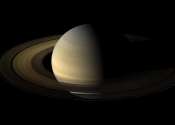
Saturn

Saturn is the sixth planet from the Sun and the second largest planet in the Solar System, after Jupiter. Saturn, along with Jupiter, Uranus and Neptune, is classified as a gas giant. Together, these four planets are sometimes referred to as the Jovian, meaning "Jupiter-like", planets.

Saturn is named after the Roman god Saturn (that became the namesake of Saturday), equated to the Greek Kronos (the Titan father of Zeus) the Babylonian Ninurta and to the Hindu Shani. Saturn's symbol represents the god's sickle (Unicode: ♄).

The planet Saturn is composed of hydrogen, with small proportions of helium and trace elements. The interior consists of a small core of rock and ice, surrounded by a thick layer of metallic hydrogen and a gaseous outer layer. The outer atmosphere is generally bland in appearance, although long-lived features can appear. Wind speeds on Saturn can reach 1,800 km/h, significantly faster than those on Jupiter. Saturn has a planetary magnetic field intermediate in strength between that of Earth and the more powerful field around Jupiter.

Saturn has a prominent system of rings, consisting mostly of ice particles with a smaller amount of rocky debris and dust. Sixty-one known moons orbit the planet, not counting hundreds of "moonlets" within the rings. Titan, Saturn's largest and the Solar System's second largest moon (after Jupiter's Ganymede), is larger than the planet Mercury and is the only moon in the Solar System to possess a significant atmosphere.

For more information about Saturn, read the full article at Wikipedia.
This text uses material from Wikipedia and is available under the GNU Free Documentation License.

Related topics: cassini spacecraft , nasa , moon , solar system , earth