News tagged with rats
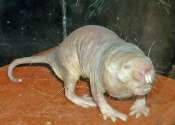
Mole rat dental structure similar to a shark
(PhysOrg.com) -- Sharks are capable of continually growing new teeth. As the teeth age, they fall out and new ones move forward similar to that of a tooth conveyor belt. Humans, and most mammals, on the other ...
What do animals 'know'? More than you may think
(PhysOrg.com) -- Rats use their knowledge to make decisions when faced with ambiguous situations, UCLA psychologists report.
Dec 09, 2011 |
5 / 5 (9) |
28
|
Lost World Found in Papua New Guinea Volcano
(PhysOrg.com) -- A BBC expedition exploring inside the crater of an extinct volcano in Papua New Guinea (PNG) has discovered a lost world of dozens of weird new species and rare animals, including new frogs, ...
Helping your fellow rat: Rodents show empathy-driven behavior
The first evidence of empathy-driven helping behavior in rodents has been observed in laboratory rats that repeatedly free companions from a restraint, according to a new study by University of Chicago neuroscientists.
Dec 08, 2011 |
4.9 / 5 (8) |
8
|
Scientists discover gene that 'cancer-proofs' rodent's cells
(PhysOrg.com) -- Despite a 30-year lifespan that gives ample time for cells to grow cancerous, a small rodent species called a naked mole rat has never been found with tumors of any kind—and now biologists ...
Oct 26, 2009 |
5 / 5 (47) |
13
Scientists make paralyzed rats walk again after spinal-cord injury
UCLA researchers have discovered that a combination of drugs, electrical stimulation and regular exercise can enable paralyzed rats to walk and even run again while supporting their full weight on a treadmill.
Medicine & Health / Neuroscience
Sep 20, 2009 |
4.9 / 5 (24) |
3
Rebooting the brain helps stop the ring of tinnitus in rats
(PhysOrg.com) -- Researchers were able to eliminate tinnitus in a group of rats by stimulating a nerve in the neck while simultaneously playing a variety of sound tones over an extended period of time, says a study published ...
Medicine & Health / Neuroscience
Jan 12, 2011 |
4.9 / 5 (20) |
28
|
Research shows rats have best bite of rodent world
Scientists at the University of Liverpool have found that mice and rats have evolved to gnaw with their front teeth and chew with their back teeth more successfully than rodents that 'specialise' in one or ...
Apr 27, 2012 |
5 / 5 (2) |
4
|
Adolescent alcohol expsoure may lead to long-term risky decision making
(PhysOrg.com) -- Picture this. A bunch of adolescent rats walk into a bar and start consuming Jell-O shots. Lots of them.
Medicine & Health / Neuroscience
Sep 21, 2009 |
4.5 / 5 (2) |
3
Smart rat 'Hobbie-J' produced by over-expressing a gene that helps brain cells communicate
Over-expressing a gene that lets brain cells communicate just a fraction of a second longer makes a smarter rat, report researchers from the Medical College of Georgia and East China Normal University.
Oct 19, 2009 |
4.9 / 5 (15) |
5
Spectacular mammal rediscovered after 113 years -- first ever photographs taken
(PhysOrg.com) -- A unique and mysterious guinea-pig-sized rodent, not seen since 1898 despite several organized searches, bizarrely showed up at the front door of an ecolodge at a nature reserve in Colombia, ...
May 19, 2011 |
4.9 / 5 (19) |
22
|
Chili peppers come with blood pressure benefits
For those with high blood pressure, chili peppers might be just what the doctor ordered, according to a study reported in the August issue of Cell Metabolism. While the active ingredient that gives the peppers their heat - ...
Medicine & Health / Medical research
Aug 03, 2010 |
4.9 / 5 (12) |
2
|
Use of cannabinoids could help post-traumatic stress disorder patients
Use of cannabinoids (marijuana) could assist in the treatment of post-traumatic stress disorder patients. This is exposed in a recent study carried out at the Learning and Memory Lab in the University of Haifa's Department ...
Medicine & Health / Neuroscience
Nov 04, 2009 |
5 / 5 (7) |
1
Neuroscience of instinct: How animals overcome fear to obtain food (w/ Video)
(PhysOrg.com) -- When crossing a street, we look to the left and right for cars and stay put on the sidewalk if we see a car close enough and traveling fast enough to hit us before we're able to reach the ...
Medicine & Health / Neuroscience
Nov 29, 2010 |
4.9 / 5 (9) |
2
|
Why newborn babies can't walk
(PhysOrg.com) -- The first steps of an infant is a real milestone in the development of all mammals including humans, but little is known about why some animals can walk soon after birth, while others need ...
Rat
50 species
Stenomys Thomas, 1910
Rats are various medium-sized, long-tailed rodents of the superfamily Muroidea. "True rats" are members of the genus Rattus, the most important of which to humans are the black rat, Rattus rattus, and the brown rat, Rattus norvegicus. Many members of other rodent genera and families are also called rats and share many characteristics with true rats.
Rats are typically distinguished from mice by their size; rats are generally large muroid rodents, while mice are generally small muroid rodents. The muroid family is very large and complex, and the common terms rat and mouse are not taxonomically specific. Generally, when someone discovers a large muroid, its common name includes the term rat, while if it is small, the name includes the term mouse - scientifically, the terms are not confined to members of the Rattus and Mus genera. Compare the taxonomic classification of the Pack rat and Cotton mouse.
For more information about Rat, read the full article at
Wikipedia.
This text uses material from Wikipedia and is available under the GNU Free Documentation License.