News tagged with radio
Soviet find of water on the Moon in the 1970s ignored by the West
(Phys.org) -- In August 1976 Luna 24 landed on the moon and returned to Earth with samples of rocks, which were found to contain water, but this finding was ignored by scientists in the West.
ALMA turns its eyes to Centaurus A
(Phys.org) -- A new image of the galaxy Centaurus A, made with the Atacama Large Millimeter/submillimeter Array (ALMA), shows how the observatory allows astronomers to see through the opaque dust lanes that ...
May 31, 2012 |
4.9 / 5 (10) |
0
|
NASA lunar spacecraft GRAIL complete prime mission ahead of schedule
(Phys.org) -- A NASA mission to study the moon from crust to core has completed its prime mission earlier than expected. The team of NASA's Gravity Recovery and Interior Laboratory (GRAIL) mission, with twin ...
Space & Earth / Space Exploration
May 29, 2012 |
5 / 5 (3) |
0
Splitting the SKA - why a dual-site setup is a win for everyone
The Square Kilometre Array (SKA) is a concept that's been slowly growing and evolving since 1991. But recently this ambitious project took a giant leap towards reality with the announcement of a SKA site decision.
Space & Earth / Space Exploration
May 28, 2012 |
5 / 5 (3) |
0
Australia hails surprise super-telescope decision
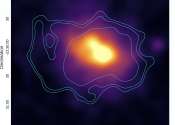
Australia has hailed a surprise decision giving it a role in a radio telescope project aimed at revolutionising astronomy, vowing to draw on its decades of experience in space science.
May 26, 2012 |
5 / 5 (4) |
3
SAfrica stops short of being disappointed over SKA verdict
South Africa stopped short of expressing disappointment after it failed to win the bid to single-handily host the world's most powerful radio telescope.
Space & Earth / Space Exploration
May 25, 2012 |
1 / 5 (2) |
0
SKA super telescope to be built in Australia, South Africa (Update 2)
A long-running joust to host a radio telescope that would give mankind its farthest peek into the Universe ended on Friday with a Solomon-like judgement to split the site between Australia and South Africa.
May 25, 2012 |
4.9 / 5 (7) |
4
Colliding galaxy cluster unravelled
An international team of astronomers has used the International LOFAR Telescope from ASTRON, the Netherlands Institute for Radio Astronomy, to study the formation of the galaxy cluster Abell 2256.
May 24, 2012 |
4.8 / 5 (4) |
2
Pandora sees higher loss, but revenue grows
Internet radio firm Pandora on Wednesday reported that its loss widened in the past quarter but investors welcomed news of a jump in revenue.
May 23, 2012 |
not rated yet |
2
Famed US alien seeker shifts gaze back to Earth
After decades spent scanning the heavens for signs of life elsewhere in the cosmos, astronomer Jill Tarter is stepping back, and letting a colleague take charge of the quest.
Space & Earth / Space Exploration
May 22, 2012 |
5 / 5 (4) |
13
Scientists design indoor navigation system for blind
University of Nevada, Reno computer science engineering team Kostas Bekris and Eelke Folmer presented their indoor navigation system for people with visual impairments at two national conferences in the past ...
May 18, 2012 |
4.7 / 5 (3) |
0
|
Three-telescope interferometry allows astrophysicists to observe how black holes are fueled
(Phys.org) -- By combining the light of three powerful infrared telescopes, an international research team has observed the active accretion phase of a supermassive black hole in the center of a galaxy tens ...
May 16, 2012 |
4.9 / 5 (13) |
1
|
Astrophysicists discover new heating source in cosmological structure formation
(Phys.org) -- So far, astrophysicists thought that super-massive black holes can only influence their immediate surroundings. A collaboration of scientists at the Heidelberg Institute for Theoretical Studies ...
May 15, 2012 |
4.1 / 5 (11) |
8
|
EU physicists use 20 new satellites to forecast space weather
The northern lights interfere with radio communications, GPS navigation and satellite communications. Researchers are now going to launch 20 satellites containing world class instruments from the University ...
Space & Earth / Space Exploration
May 14, 2012 |
3 / 5 (2) |
0
New research could mean faster computers and better mobile phones
Graphene and carbon nanotubes could improve the electronics used in computers and mobile phones, reveals new research from the University of Gothenburg, Sweden.
Nanotechnology / Nanomaterials
May 14, 2012 |
3 / 5 (2) |
1
Radio
Radio is the transmission of signals by modulation of electromagnetic waves with frequencies below those of visible light. Electromagnetic radiation travels by means of oscillating electromagnetic fields that pass through the air and the vacuum of space. Information is carried by systematically changing (modulating) some property of the radiated waves, such as amplitude, frequency, or phase. When radio waves pass an electrical conductor, the oscillating fields induce an alternating current in the conductor. This can be detected and transformed into sound or other signals that carry information.
For more information about Radio, read the full article at
Wikipedia.
This text uses material from Wikipedia and is available under the GNU Free Documentation License.